Luxury Accessories Authentication Specialist
Luxury accessories authenticator. Covers small leather goods, belts, and eyewear.
Published October 2026 · Contact
What Makes DITA Sunglasses Distinctive
DITA is a Los Angeles brand whose titanium and acetate frames are described by retailers as handmade in Japan, which is why the lettering on the temples matters so much to buyers. The Mach One, Mach Six, Grandmaster, Decade, Meta-Evo, Creator and Sequoia lines all share a house style: a model name engraved along the temple, a code line, a size stamp, a "Made in Japan" line near the tip, a small D-shield logo on the nose pads and the temple end, and a model name etched in the corner of each lens. A fake has to copy every one of them.
That is the problem with a guide like this. We have reviewed a large number of genuine DITA sunglasses from LuxeDetect orders, and we have also reviewed pairs that failed authentication. Several of the fake-graded pairs carry correct engravings, a believable code, a neat D-shield and an etched lens, so none of those marks proves a pair is genuine. Treat everything below as a description of what genuine pairs in our records show, not as a test a fake cannot pass.
Worth knowing
This guide is built from verified genuine DITA sunglasses. The counterfeit pairs we reviewed copy the engravings, codes and logos so closely that no repeatable tell held up across them. We do describe a few odd details below, but each was seen on a single pair and on none of the genuine pairs we reviewed, so treat them as reasons to look harder, not as verdicts. If you are comparing against other brands, the same caution applies to [Tom Ford eyewear](/blog/authenticate-tom-ford-eyewear-guide) and [Gentle Monster](/blog/authenticate-gentle-monster-real-vs-fake-guide).
The Temple Engraving: Model Name and Material
On the genuine metal-temple models we reviewed, the inside of one temple carries the model name followed by the material, for example "MACH SIX // titanium". The slashes and spacing vary slightly from pair to pair, and acetate models such as the Creator and Sequoia carry just the model name in spaced capitals ("CREATOR") followed by the code.
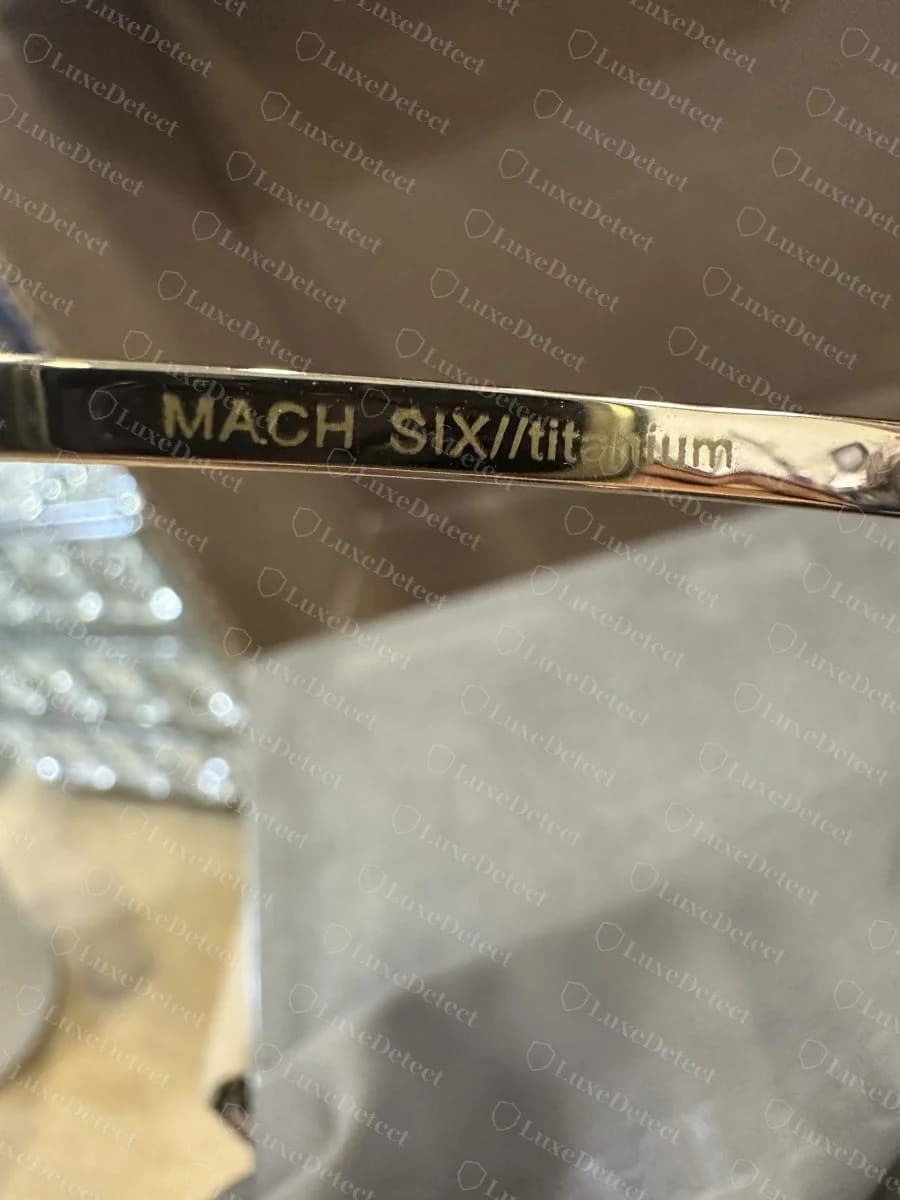
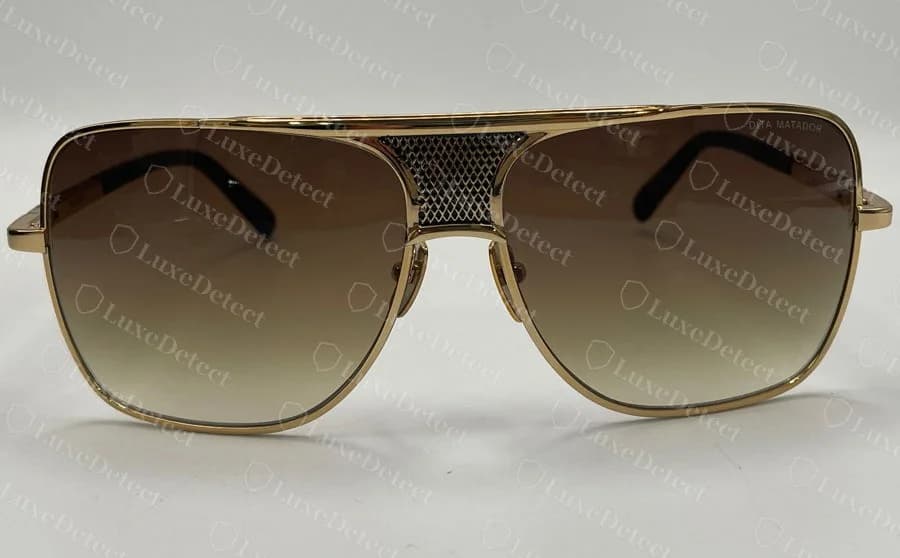
Read the name against the frame in your hands. A Mach Six has the double brow bar and forked hinge, and a Grandmaster Five has a thick acetate front with gold trim. Names on the genuine pairs we reviewed use specific spellings, for example "GRANDMASTER-FIVE" as one hyphenated word and "META-EVO ONE". Limited editions add a spaced "LIMITED EDITION" line with the edition number, such as a number out of a few hundred.
The Code Line: DRX and DTS
Next to the name is a code line. On the genuine pairs we reviewed, it reads like "DRX-2038-B-SLV-61" on a Matador or "DRX-2077-B-NVY-GLD-64" on a Grandmaster Five, with a model number, a letter, colour abbreviations and a size. Newer lines use a "DTS" format such as "DTS121-62-05" on a Mach Six or "DTS147-A-03" on a Meta-Evo.
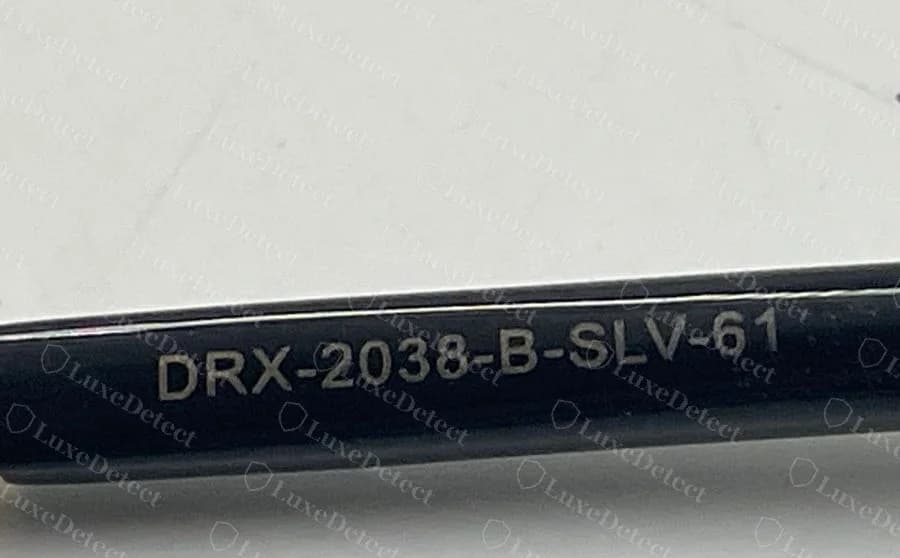
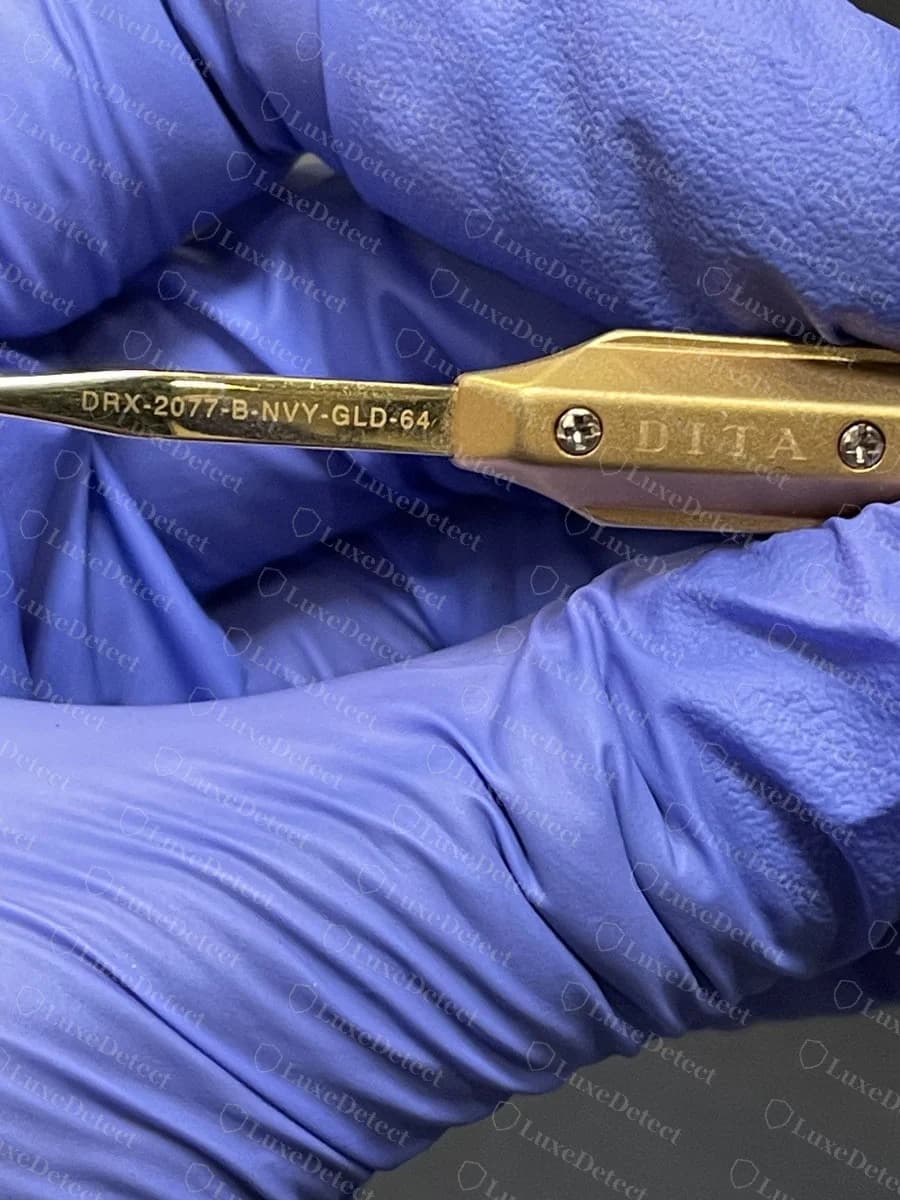
Treat the code as a label for the model and colour, not as a serial number. Every pair of that model and colour shares it, and it carries no production date we can decode. Retailer listings put the Mach One at DRX-2030, and the genuine Grandmaster Five we reviewed carries DRX-2077. Do not rely on our short list: look up the code on a retailer or DITA's own product page and check that the name and code belong together.
The Size Stamp and "Made in Japan CE"
Near the tip, genuine pairs show a size stamp with a small square between the lens and bridge widths, in the form "54□17-145" or "62□12-130" (lens, bridge, temple in millimetres), and a "Made in Japan" line with the CE mark. On acetate frames these sit on the end of the temple.
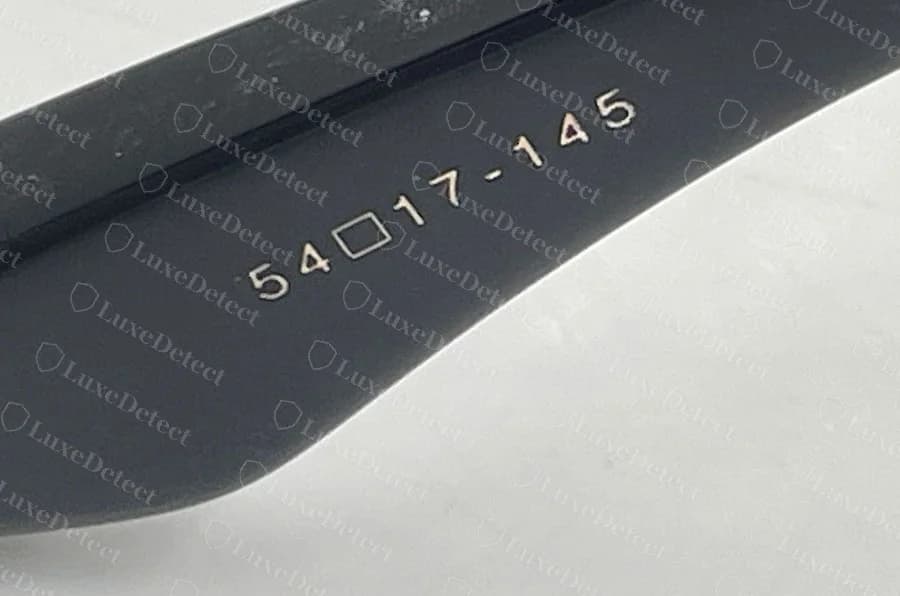
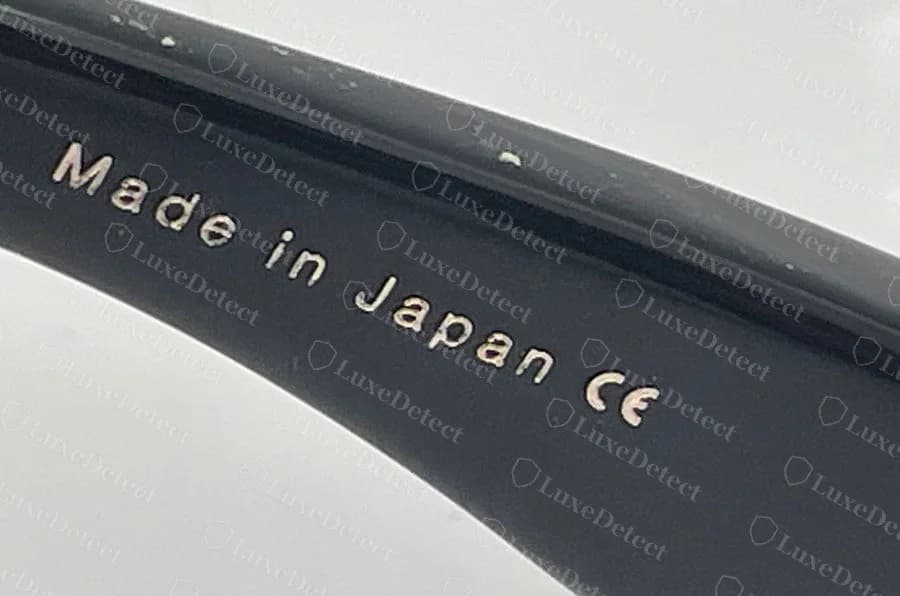
Every genuine pair we reviewed said Japan, and retailers describe the Mach One and Grandmaster Five as handmade in Japan. We found no source stating that every DITA line is made only in Japan, so a different origin is a reason to check further, not an automatic fake call. The size stamp should also match the frame: a Mach Six size such as 62-12-130 is consistent with retailer listings for that model.
The D-Shield on the Nose Pads and Temple Tips
A small shield with a "D" appears on the nose pads, on the hinge plate and set into the end of each temple. On the genuine pairs we reviewed, the nose pad is a titanium plate with a fine cross-hatch pattern above and below a raised shield, and the temple-tip logo is a clean round or shield-shaped inlay.
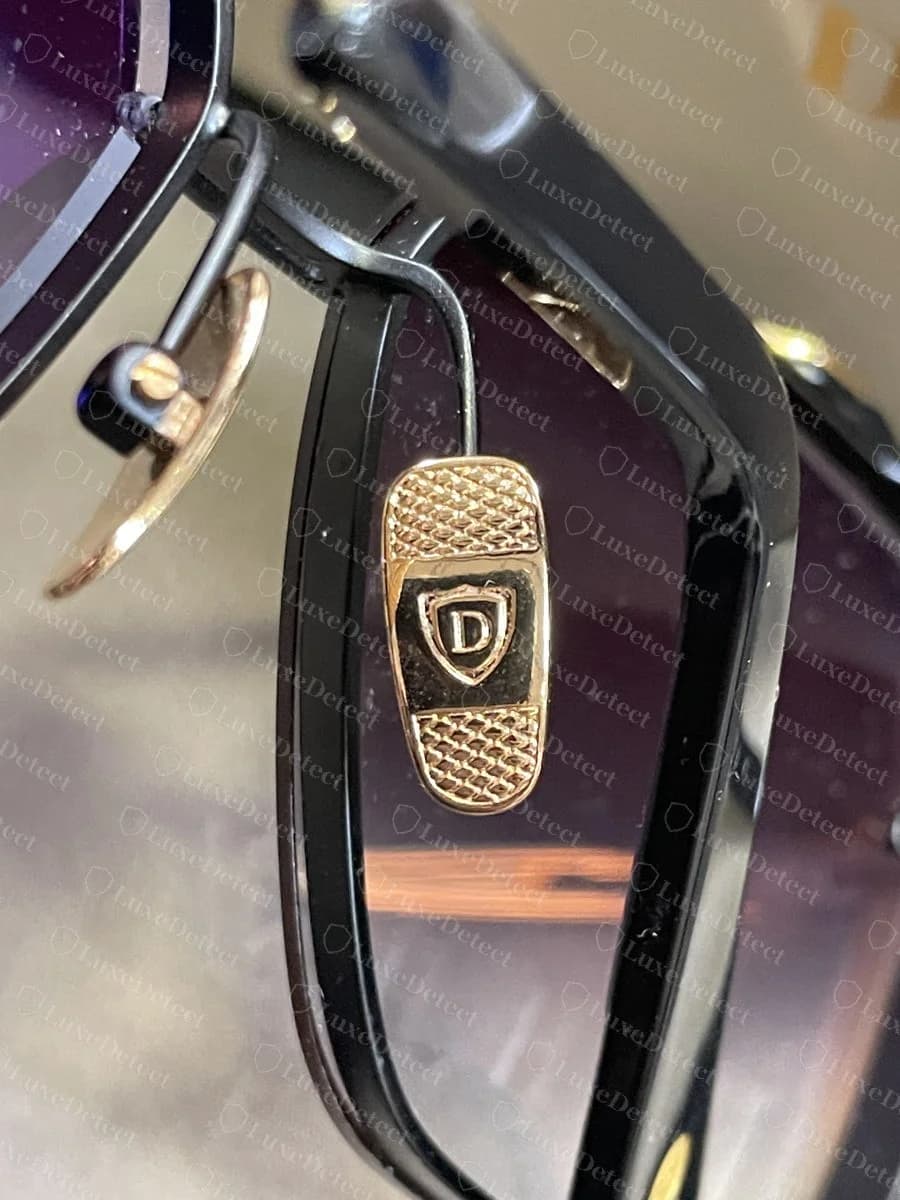
Judge depth and edge sharpness, not just the shape. Fake-graded pairs in our records also carry a neat D-shield, so a crisp logo is encouraging but not proof.
The Lens Etch
On the genuine sunglasses we reviewed, the lens carries "DITA" and the model name, lightly etched in a corner of one lens, such as "DITA MATADOR" or "DITA META-EVO ONE". It is visible at an angle and not easy to see head-on. Etching is what you want; ink that wipes off is not.
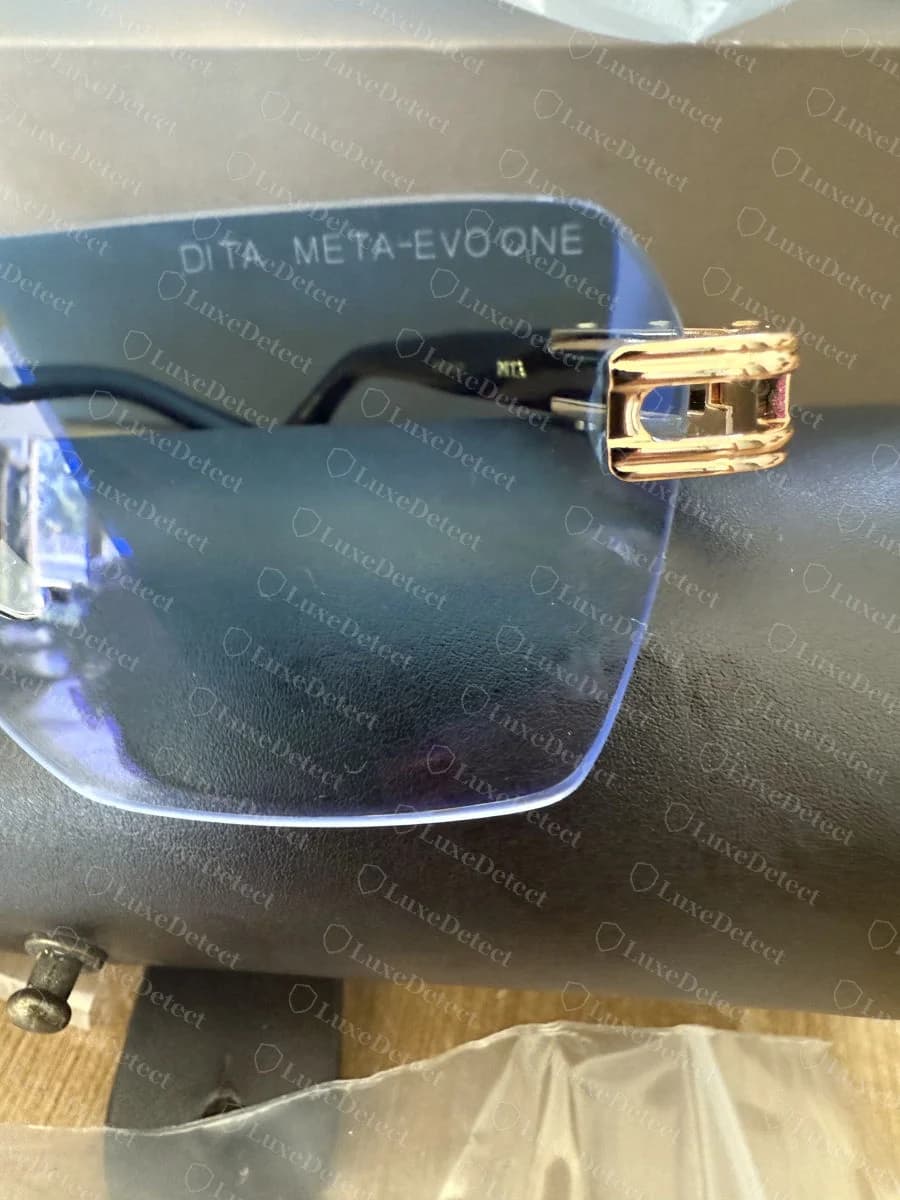
Lens etching is easy to copy, and fake-graded pairs we reviewed carry convincing etches. Use it as one more consistency check: the model name in the lens should match the temple.
The Case and Box
Genuine DITA cases in our records are rigid and black, with a plain metal DITA plaque on a fold-over lid, or a leather-look case with an embossed name. The box is grey with gold lettering.
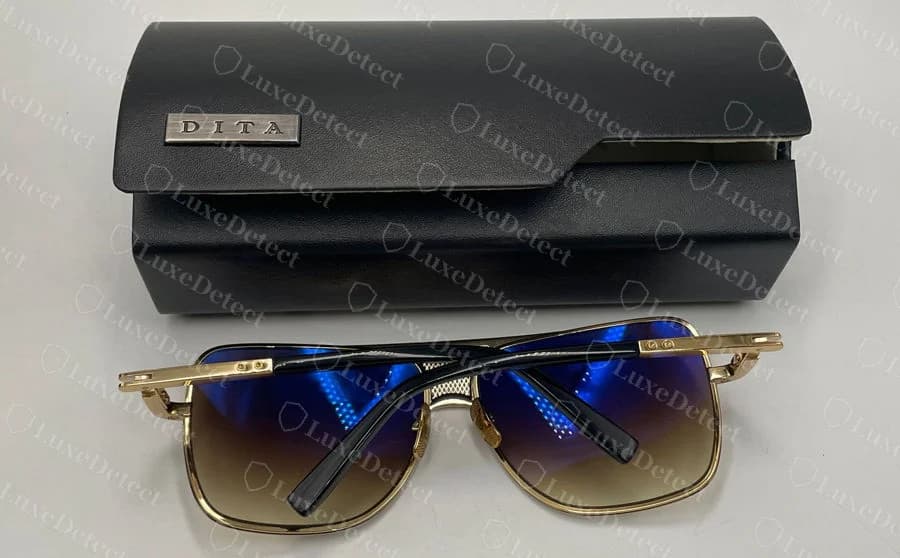
The case and box are easy to swap between pairs. Cases and boxes frequently circulate separately from the frames, so packaging helps a seller look credible but says nothing about the frame.
Single-Pair Red Flags
The best fakes copy everything above, so there is no dependable tell across all of them. The details below each turned up on a single pair in our records and on none of the genuine pairs we reviewed. That makes them worth stopping for. It does not make them a rule.
Red flag
"Made in Italy" on the temple. One fake-graded pair read "DITA MADE IN ITALY CE" on the temple with a size stamp of 60-19-131. Every genuine pair we reviewed said Made in Japan. Some resale listings mention other origins for certain lines, so we cannot call every non-Japan origin fake, but a country line that disagrees with the rest of the pair deserves a close look.
Red flag
A model name that contradicts its code. One fake-graded pair showed "GRAND MASTER - FIVE" with spaces on one temple and the code "DRX-2030D-59" on the other. Retailer listings put DRX-2030 on the Mach One, and the genuine Grandmaster Five we reviewed carries a DRX-2077 code and spells the name "GRANDMASTER-FIVE" as one word. A name and code from two different models is a strong reason to walk away.
Red flag
A typo in a limited-edition engraving. One fake-graded Mach Six read "MACH SIX LIMITEDITION" on the temple, with a size stamp of 63-13-140. Genuine limited editions we reviewed spell it "LIMITED EDITION" with a space, though the number format is not the same on every line. Read every letter of an engraving slowly: a run-together word is the kind of slip a genuine factory does not make.
Red flag
A lens that says only "DITA". More than one fake-graded pair showed only the brand name in the lens corner with no model name. On the genuine pairs where the lens corner was photographed, the model name follows DITA. Compare the lens against the temple, but note a plain "DITA" lens is not conclusive on its own.
What Does Not Prove Anything
- A perfect engraving. Several fake-graded pairs, including a Mach Five, a Decade Two, a Mach One and a Talon, carry correct names, believable codes and a neat D-shield. A clean temple does not clear a pair.
- Reseller codes in a listing. Order names such as "J-0555315-A", "W-0543182-E" or a long barcode label are reseller or liquidation stickers on the bag, not DITA serials. They appear on genuine and fake pairs alike, so they say nothing about authenticity. DITA frames carry no public serial number we could use.
- Case, box, cloth and authenticity card. Any of them can come from another pair.
- A single odd-looking detail. Wear, polishing and later repair change the look of a hinge or logo on a genuine pair.
When to Get a Professional Opinion
DITA frames resell for hundreds of dollars, and the best fakes are very hard to separate from genuine pairs in a listing's photos. If a pair is a meaningful purchase, compare the temple engraving, the code line, the size stamp, the lens etch and the hardware against genuine references at full resolution. LuxeDetect authenticates eyewear from photos, starting at $15 for a 24-hour turnaround, and the result is a written verdict you can show a seller or use to request a refund. For a comparison with a similar tier of frames, see the Cartier sunglasses guide. To start, submit photos for a professional authentication.
FAQ
How can I tell if my DITA sunglasses are real?
Check that the model name on the temple, the code line, the size stamp and the lens etch all describe the same model, and that the temple tip says Made in Japan with a CE mark. Then look at the D-shield on the nose pads and temple ends. A pair that matches everything is not proven genuine, because several fake-graded pairs copy these marks, so use professional authentication when money is involved.
Do DITA sunglasses have a serial number?
Not one we could find. The code on the temple, such as DRX-2038-B-SLV-61 or DTS121-62-05, identifies the model, colour and size and is shared by every pair of that kind. Numbers like J-0555315-A in listing titles are reseller labels, not DITA serials.
Are DITA sunglasses made in Japan?
Retailers describe the Mach One and Grandmaster Five as handmade in Japan, and every genuine pair we reviewed was marked Made in Japan. We could not find a source that says every DITA line is made only in Japan, so a different origin should prompt closer checks rather than an instant verdict.
What should the lens of real DITA sunglasses say?
On the genuine pairs we reviewed, the lens carries DITA plus the model name, lightly etched in a corner, for example DITA MATADOR or DITA META-EVO ONE. It is faint head-on. Fake-graded pairs also carry etches, so the lens is only a consistency check.
What does DRX or DTS mean on DITA sunglasses?
They are the prefixes of the model code engraved on the temple. We treat the code as a label for the model and colour, not as something that decodes to a date. Retailer listings put DRX-2030 on the Mach One and the Mach Six uses DTS121. Check that the code you see belongs to the model name beside it.
Can a fake DITA have a perfect temple engraving?
Yes. Several fake-graded pairs we reviewed carried correct model names, codes, Made in Japan lines and D-shield logos. Engravings are a first screen that catches careless fakes, not a clearance.
Is "Made in Italy" on DITA sunglasses a sign of a fake?
We saw it on one fake-graded pair and on none of the genuine pairs we reviewed. We could not confirm whether any genuine DITA line is made outside Japan, so treat it as a reason to look much harder rather than as a verdict on its own.
Where can I get my DITA sunglasses authenticated?
LuxeDetect authenticates DITA sunglasses from photos. Start an order and include clear photos of the front, both temples with every engraving, the temple tips, the nose pads, the lens corners and the case.