Ready-to-Wear Authentication Specialist
Published September 2026 · Contact
Why Oscar de la Renta Clothing Is a Label-First Authentication Problem
Oscar de la Renta's ready-to-wear is built to a genuinely high standard, and that cuts against counterfeiters in a specific way: reproducing tailored construction, natural fabrics and clean stitching at scale is expensive, so most fakes don't try very hard on the garment itself. A convincing plaid blazer or a good silk shift dress is not hard to source generically. What is much harder to fake cheaply, and what a factory producing counterfeits usually treats as an afterthought, is the interior paperwork: the woven brand label, and the printed care and content tag sewn in beside it.
That makes Oscar de la Renta a label-first authentication problem. Unlike a hardware-heavy handbag or a stamped leather good, most of what you can verify from a photograph on this brand lives in two small pieces of fabric sewn into the interior seam: what the label says and how it's woven, and what the care tag says and how it's printed.
This guide is built entirely from real Oscar de la Renta order photography, both genuine and counterfeit. It's worth being direct about the limits of that photo set before going further, because they shape how confidently this guide can talk.
What to check, ranked by reliability
| Checkpoint | Reliability | What it tells you |
|---|---|---|
| 2. The Care and Content Tag — Wording, Fabric Blend and Origin | ★★★★★ | A synthetic-heavy blend or printed tag inconsistent with the garment quality is worth investigating, but based on a single confirmed fake so not decisive alone. |
| 1. The Woven Main Label — Script and Wording | ★★★★★ | A cursive script is the consistent genuine format, but the archive also shows a confirmed fake with a convincing cursive label, so script quality alone does not settle it. |
| What Packaging and Retail Tags Do and Do Not Prove | ★★★★★ | A retail or boutique co-brand tag is context only — a confirmed fake in the archive carried one alongside a plausible main label. |
| Model Reference Before You Start | ★★★★★ | Identifies which labelling convention applies to the garment; does not on its own distinguish genuine from counterfeit. |
| 3. Overall Construction and Fit | ★★★★★ | General tailoring-quality context only — this guide has no confirmed counterfeit example documenting a specific construction failure. |
Where This Guide Is Limited
The archive behind this guide is heavily skewed toward authenticated clothing: well over a thousand confirmed-genuine garments, against a genuinely small number of confirmed counterfeits in the clothing category. After excluding one record that turned out to be a mislabeled non-Oscar-de-la-Renta garment (a Moschino piece filed under the wrong brand — a reminder to verify what's actually in a folder, not just its label) and one pair of leopard-print trousers with no visible Oscar de la Renta branding in any photo, this guide draws on a small handful of confirmed fakes, not a large one.
That thinness has two consequences for how this guide is written. First, the checkpoint table below rates nothing higher than a 3. A single counterfeit example, even a clear one, is not enough evidence to call a detail decisive — it shows you *a* way a fake failed, not *the* way fakes generally fail. Second, several observations that would elsewhere be flagged as red flags are marked [NOTE] instead, because they're drawn from one example each and haven't been corroborated against a second failure or an outside source.
What this guide can responsibly tell you: what a genuine Oscar de la Renta tailored-clothing label and care tag consistently look like, confirmed across multiple independent authenticated garments, and what differed on the counterfeit examples available. What it cannot tell you: a comprehensive list of every way Oscar de la Renta clothing gets faked. If your garment passes every check here, that is meaningfully reassuring; it is not a guarantee, and for a significant purchase a second opinion from someone who has handled volume is worth the modest cost.
Model Reference Before You Start
Oscar de la Renta (the house, founded by the Dominican-born designer after he acquired Jane Derby in 1969) produces ready-to-wear across several internal labelling conventions, and listings often don't distinguish between them. Before running the checks below, establish what you're actually looking at.
- Main-line ready-to-wear — women's dresses, jackets and separates. The interior label is a cursive "Oscar de la Renta" script, usually burgundy or navy thread on a cream or white satin ground.
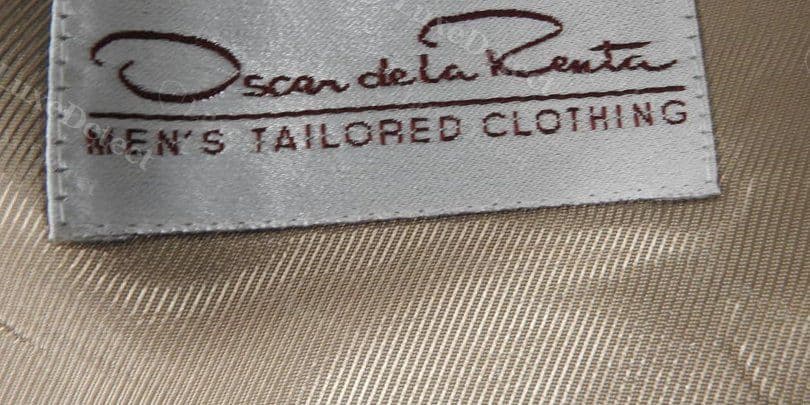
- Men's Tailored Clothing — suiting and blazers. The label carries the same cursive script with "MEN'S TAILORED CLOTHING" beneath it in a smaller block serif, on the same cream satin.
- Retail-exclusive co-branding — some pieces, particularly from department store collaborations, carry a second tag alongside the main label (for example, a Saks Fifth Avenue tag) rather than replacing it.
- Secondary or licensed labelling — some interior tags depart from the cursive script entirely, using a plain sans-serif wordmark instead. Whether a given secondary label is a legitimate diffusion or licensed line, or a sign of a problem, is not something this guide can settle with confidence from the photo evidence available, and it's treated as a [NOTE] below rather than a ruling.
If a listing doesn't show the interior label and care tag clearly, ask for those photos before anything else. On this brand, they carry more authentication weight than an exterior shot of the whole garment.
The Woven Main Label — Script and Wording
The clearest, most consistently reproducible authentic marker across the photo archive is the interior woven label. Three independent authenticated men's and women's garments in the archive all show the same cursive "Oscar de la Renta" signature, rendered in a flowing script with consistent letterforms, machine-embroidered onto a satin ground with clean, even stitching at the label's border. On the men's tailored pieces, "MEN'S TAILORED CLOTHING" appears beneath the signature in a small serif block, aligned and evenly spaced.
One confirmed counterfeit blazer in the archive carries a visibly different label: a plain sans-serif wordmark reading "OSCAR DE LA RENTA" over "COMPONENTS", printed rather than embroidered in flowing script, on a dark grey ground rather than cream satin.
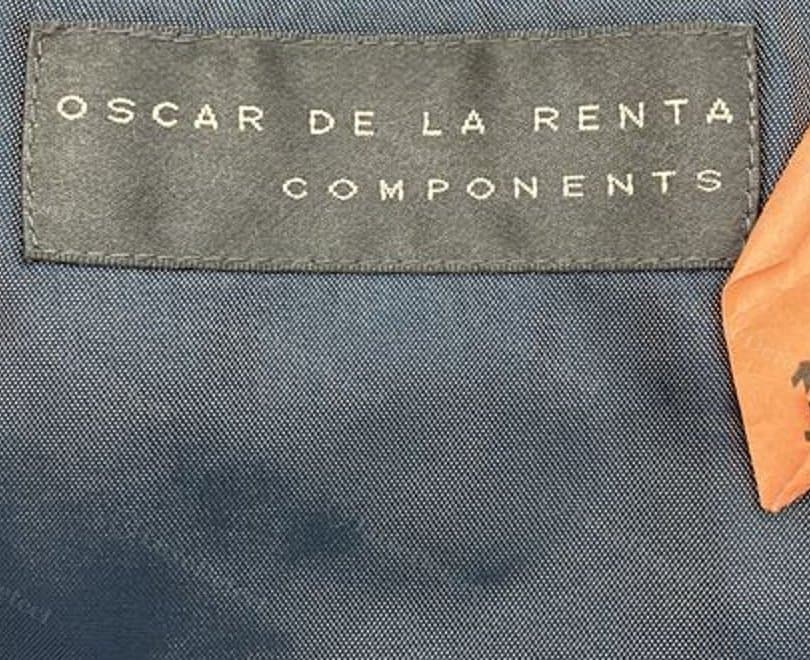
| Element | Authentic | Counterfeit (this example) |
|---|---|---|
| Script | Flowing cursive signature, consistent letterforms | Plain block sans-serif |
| Label ground | Cream or white satin | Dark grey/navy woven ground |
| Secondary line | "MEN'S TAILORED CLOTHING" in small serif, menswear only | "COMPONENTS" in matching block caps |
| Construction | Embroidered, clean satin-stitch border | Printed/woven-in text, visible edge fraying on the sample seen |
Worth knowing
This comparison is drawn from one confirmed counterfeit example against three confirmed genuine ones, so it should be read as "this is what genuine consistently looks like" rather than "any label departing from cursive script is fake." The archive also contains a separate counterfeit garment carrying a well-executed cursive "Oscar de la Renta" script paired with a co-branded department store tag — proof that a convincing script label alone does not settle the question. Script quality is a useful first read, not a standalone verdict.
The Care and Content Tag — Wording, Fabric Blend and Origin
The second interior tag, usually sewn just below or beside the main label, states the fabric composition, size and care instructions, and it carries a second, independent authentication signal: does the stated fabric and origin make sense for the garment and price point.
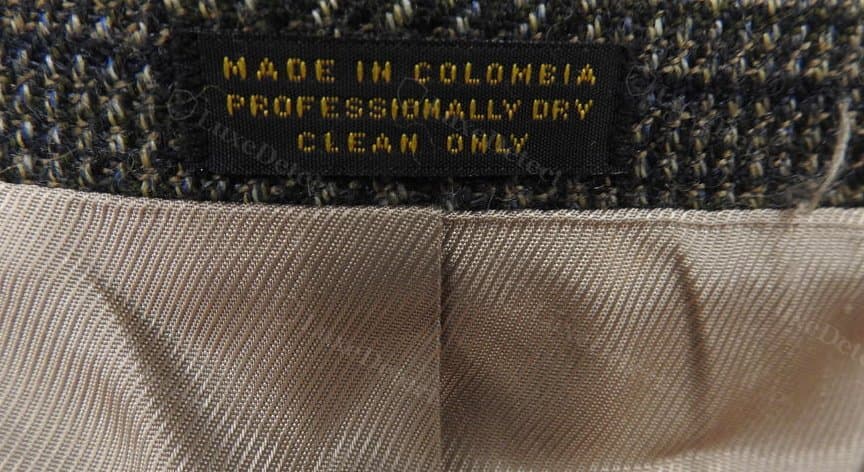
On the authenticated men's tailored blazers in the archive, this tag consistently reads 100% wool, Made in Colombia, with care instructions on a separate small woven strip reading "MADE IN COLOMBIA / PROFESSIONALLY DRY CLEAN ONLY" in gold thread on black. Colombia is a documented, legitimate production origin for Oscar de la Renta menswear tailoring — it shows up consistently across multiple authenticated pieces in this archive and is corroborated by production records on the secondary market, so a Colombia origin tag on a tailored piece is not itself a concern.
The confirmed counterfeit blazer's printed care tag, by contrast, lists 44% wool, 54% polyester, 2% lycra spandex, Made in Mexico. A wool-blend synthetic fabrication at nearly half polyester is a materially different (and cheaper) construction than the 100% wool used on the genuine tailored pieces this guide could compare it against.
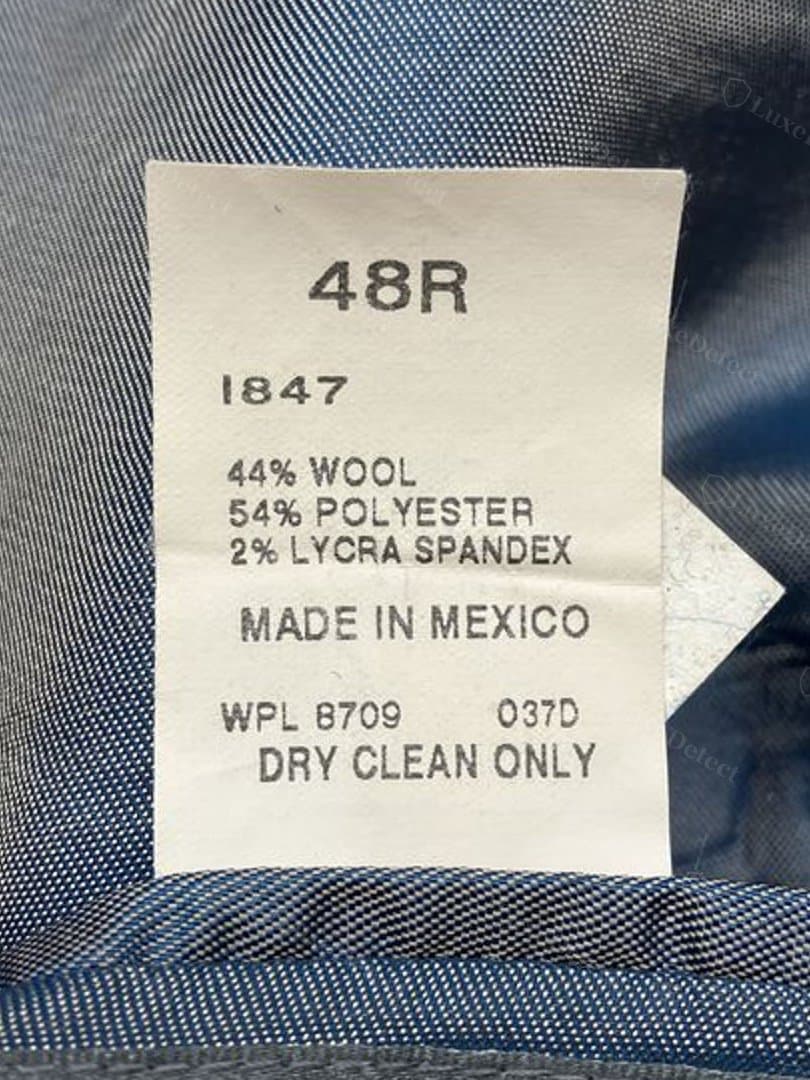
| Element | Authentic (tailored clothing) | Counterfeit (this example) |
|---|---|---|
| Fabric | 100% wool | 44% wool / 54% polyester / 2% lycra spandex |
| Origin | Made in Colombia | Made in Mexico |
| Format | Separate woven care strip (gold on black) plus a printed content tag | Single printed tag combining size, content and care |
| Tag construction | Woven text, sharp and even | Printed text, legible but on a lighter-weight tag stock |
Worth knowing
A wool-polyester blend and a Mexico origin are not automatically disqualifying on their own; Oscar de la Renta produces across multiple countries and fabric weights depending on the line and era, and this guide only has authenticated Colombia-origin, wool tailored-clothing examples to compare against. What's genuinely useful here is the combination: a tailored blazer priced and marketed as main-line construction, but carrying a synthetic-heavy blend and a printed rather than woven care strip, is worth treating as a real discrepancy to investigate further rather than dismiss.
Overall Construction and Fit
With only interior label photography to work from for most of the confirmed counterfeits, this guide can say less about construction quality with the same confidence as the label checks above. What's visible in the archive's fake examples is consistent with generically cut ready-to-wear: acceptable-looking silhouettes on the hanger, but this photo set does not include close, well-lit seam or lining shots of a confirmed fake garment that would let this guide state a specific construction tell with confidence.
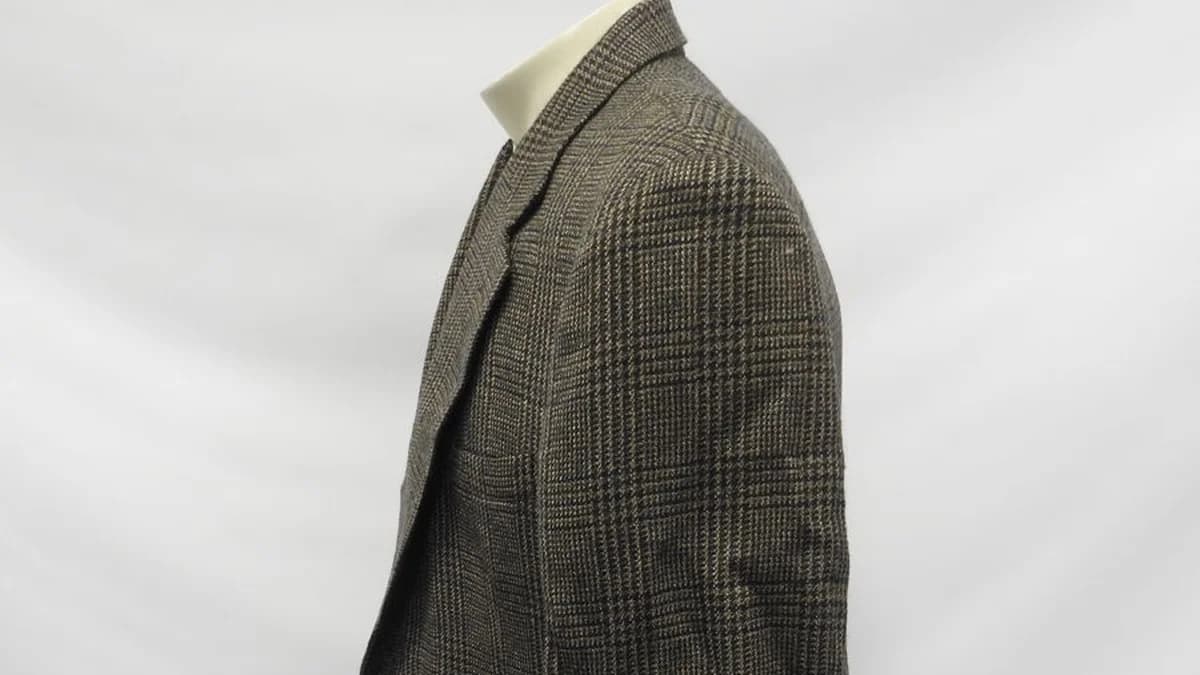
What's worth checking regardless, based on how the authenticated pieces in the archive are consistently built: even, tight stitching at the lapel and pocket edges with no visible thread pulls; a full, smooth lining (typically a warm beige or matching tonal silk-blend) attached without puckering at the seams; and buttons that sit flush and match in finish across the garment. None of these were specifically contradicted on a confirmed fake in this archive, so they're offered as general tailoring-quality context rather than a documented counterfeit failure point.
Worth knowing
Construction quality is real signal on any tailored garment, but this guide cannot currently back it with a photographed counterfeit failure the way it can for the label and care tag. Treat this section as "what good construction looks like," not as a documented fake tell.
What Packaging and Retail Tags Do and Do Not Prove
Some Oscar de la Renta pieces carry a second tag from the retailer that sold them — a department store co-brand tag sewn in alongside the main label, for instance. A retail tag can help confirm where and roughly when a piece was sold, which is useful context. It is not, on its own, evidence of authenticity: the archive's own counterfeit examples include at least one garment with a plausible-looking cursive main label paired with a co-branded retail tag, which did not prevent it from being confirmed fake. Treat any retail or boutique tag as context to cross-reference, not proof.
Quick Authentication Checklist
- Interior label is a flowing cursive "Oscar de la Renta" signature (plus "MEN'S TAILORED CLOTHING" in small serif, on menswear tailoring specifically)
- Label ground is cream or white satin, embroidered with an even satin-stitch border
- Care/content tag fabric composition and stated country of origin are internally consistent with the garment's apparent quality level (tailored wool pieces from this archive are 100% wool, Made in Colombia)
- Care tag text is woven or cleanly printed, not smudged, misaligned, or on noticeably lighter tag stock than the main label
- Stitching at lapels, pockets and lining seams is even, with no puckering or loose threads
- Any retail or boutique co-brand tag is treated as context, never as standalone proof
Given how thin the confirmed-fake evidence is for this brand, no single check above should be treated as fully decisive on its own. A garment that fails two or more of these is a genuine reason for caution; a garment that fails only the label wording or fabric blend, with everything else consistent, is worth a second opinion rather than an automatic pass or fail.
When to Get a Professional Opinion
This is a brand where a written guide is more useful for telling you what to photograph than for letting you make the final call yourself, particularly given how few confirmed counterfeit examples currently exist to generalize from. A convincing label reproduction paired with a plausible-sounding fabric blend and a period-appropriate retail tag is well within reach of a motivated counterfeiter, and the photo evidence available here can't tell you how common that combination is in the wild.
Our specialists authenticate Oscar de la Renta clothing from photographs — starting at $15 for 24-hour turnaround, with faster tiers available — and return a Certificate of Authenticity you can use in a dispute or resale. Given the label-first nature of this brand's authentication, clear, well-lit photos of the interior label and care tag are the single most useful thing you can provide.
FAQ
Where is the label on Oscar de la Renta clothing?
Sewn into the interior seam, usually at the back neck or a side seam. On main-line ready-to-wear it's a cursive "Oscar de la Renta" signature on cream or white satin; on men's tailored clothing, the same script appears above "MEN'S TAILORED CLOTHING" in a smaller serif line. A separate care and content tag, listing fabric composition and country of origin, is typically sewn in beside or just below it.
Does "Made in Colombia" mean an Oscar de la Renta garment is fake?
No. Colombia is a legitimate, documented production origin for Oscar de la Renta menswear tailoring, confirmed across multiple authenticated pieces in this guide's photo archive and corroborated by production records on the secondary market. Origin alone doesn't determine authenticity either way; what matters is whether the stated origin and fabric are internally consistent with the rest of the garment.
Is a printed care tag always a sign of a fake?
Not necessarily, and this guide is deliberately cautious here: the one confirmed counterfeit examined for this guide had a printed care tag with a synthetic-heavy fabric blend, while the authenticated comparison pieces had a woven gold-on-black care strip and a 100% wool content. That's one data point, not a rule. Treat a printed tag with an unusual fabric blend as something to look at more closely, not as automatic proof of a fake.
Can a genuine Oscar de la Renta label look different from what's shown in this guide?
Yes. This guide focuses on the ready-to-wear and men's tailored clothing labels because those are what the available authenticated photo archive supports with confidence. Oscar de la Renta has produced across different lines, eras and licensing arrangements, and label formats have changed over time. A label that doesn't match the cursive script shown here isn't automatically wrong; it means you're outside what this specific guide can confirm, and a second opinion is the more reliable next step.
Why does this guide rate every checkpoint 3 stars or lower?
Because the confirmed-counterfeit photo evidence behind it is genuinely thin. This guide is built from real authenticated and confirmed-fake Oscar de la Renta clothing photography, but after excluding a mislabeled record and an unbranded pair of trousers, only a small handful of confirmed fakes remain to compare against a much larger set of genuine examples. A single counterfeit example is useful for showing one way a fake failed; it isn't enough to call any one detail decisive on its own, so the ratings reflect that honestly rather than overstating confidence.
How much does it cost to authenticate Oscar de la Renta clothing?
Clothing authentication starts at $15 for 24-hour turnaround, with 12-hour, 2-hour and 30-minute tiers available at a higher price. The service is photo-based with no shipping required, and you receive a Certificate of Authenticity stating the verdict either way.