Luxury Leather Goods Specialist
Luxury leather goods specialist. Works on Italian house construction, hardware, and interior stamping.
Published September 2026 · Contact
Furla Sits in an Odd Spot for Counterfeiters
Furla occupies the accessible end of Italian leather goods, retailing well below Prada or Bottega Veneta while still carrying real saffiano leather and solid brass hardware. That price gap is exactly what makes it worth faking: a convincing counterfeit doesn't need to fool a Chanel-level buyer, it just needs to look right in a low-resolution marketplace photo. The Metropolis, Furla's best-selling bag since its 2017 launch, is the single most-copied silhouette in the range, and it's the one you're most likely to encounter as a listing photo with no verification behind it.
What makes Furla different from a house like Hermès is that there's no blind stamp or date code system to decode. Authentication comes down to hardware quality, interior tag construction, and saffiano leather grain — things a factory producing thousands of units can get right on the cheap version too. The tells that separate real from fake are smaller and more mechanical: screw types, engraving depth, and whether every branded piece of metal on the bag actually says "Furla."
What to check, ranked by reliability
| Checkpoint | Reliability | What it tells you |
|---|---|---|
| 2. Small Hardware: Rivets, D-Rings, and Zip Pulls | ★★★★★ | Any branded metal piece stamped with a different brand name entirely is decisive on its own — genuine hardware is never mixed-sourced. |
| 1. Turn-Lock and Flip-Lock Hardware Construction | ★★★★★ | A blank, unengraved closure plate or the wrong screw type on the reverse rejects the bag outright. |
| 4. Saffiano Leather Grain and Stitching | ★★★★★ | Useful for judging overall quality, but a well-made non-Furla saffiano bag can look similar in photos — weight it behind the hardware checks. |
| 3. The Interior Leather Tag | ★★★★★ | A correct-looking tag is common on good fakes too — necessary but not sufficient on its own. |
| What the Box and Dust Bag Do and Do Not Prove | ★★★★★ | Packaging is reused freely across items — useful only for cross-referencing a style code, never as evidence. |
Model Reference Before You Start
Furla's handbag range is built almost entirely around saffiano and cross-grain leather in a handful of recurring silhouettes. Knowing which one you're looking at helps you know what hardware to expect:
- Metropolis — structured top-handle bag with a signature front turn-lock closure and detachable chain strap. The most counterfeited model in the current lineup.
- 1927 — flap bag with a smaller flip-lock closure, often in smooth or saffiano leather.
- Candy — rubberized tote/bucket bag, a different material system entirely (no leather grain to check, but a rubberized "jelly" texture that's hard to fake convincingly).
- Classic totes and shoulder totes — open-top or zip-top bags without a lock closure, more reliant on the interior tag and exterior logo hardware for verification.
Furla bags are made primarily in Italy, and genuine pieces are marked "Furla — Made in Italy" or similar on the interior tag. Listings that don't specify a model, or that use a generic "Handbags — Furla" title with no silhouette named, are common in resale marketplaces and aren't themselves suspicious, but they mean you're working from photos alone rather than a named reference model.
Worth knowing
This guide is built from a set of saffiano leather Furla totes and structured bags with visible hardware, rather than a single named model. The checkpoints below apply across the saffiano handbag range, including the Metropolis, but this guide doesn't document every Furla silhouette individually — treat it as a construction-and-hardware framework, not a model-by-model catalog.
Turn-Lock and Flip-Lock Hardware Construction
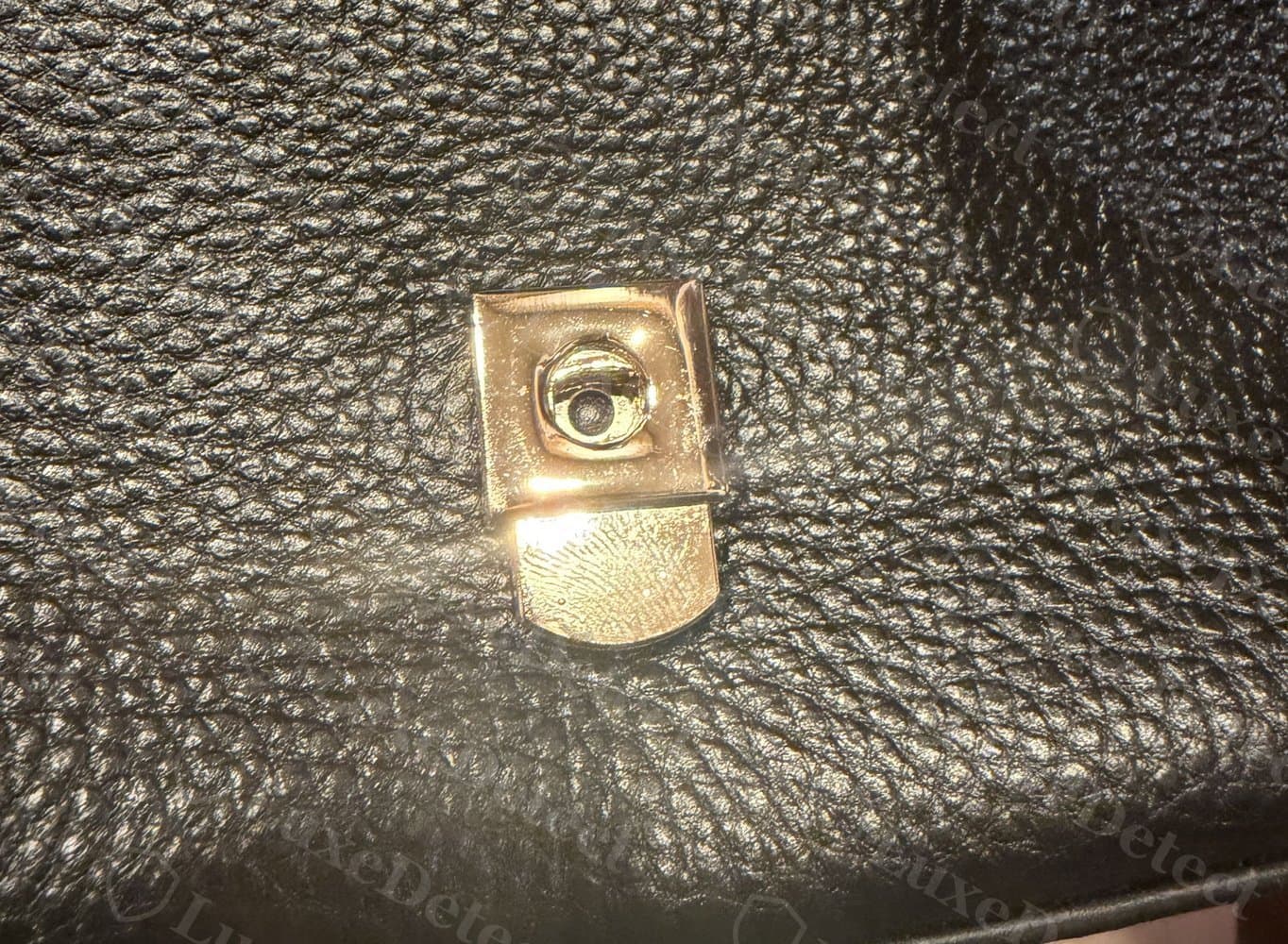
If the bag has a front closure — a turn-lock on the Metropolis or a flip-lock on the 1927 — this is the single most reliable check available on Furla bags, and it's grounded in how the hardware is actually manufactured, not just how it looks.
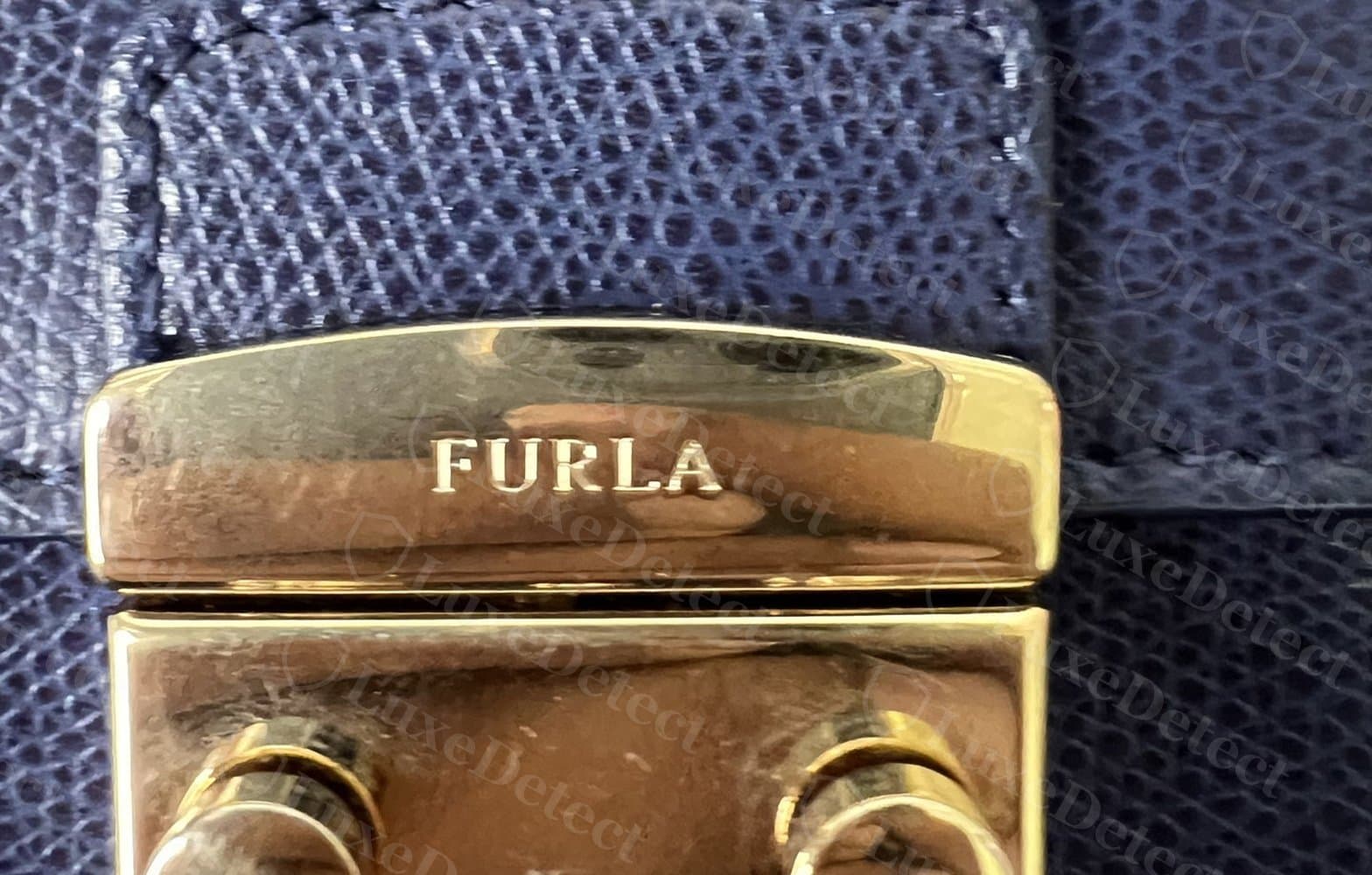
Genuine Furla lock hardware is finished to a mirror-polish gloss with no unevenness in the plating, and the back of the mechanism is secured with hexagon (Allen-key) socket screws, not ordinary slotted or Phillips screws. The word "FURLA" is engraved directly into the metal, cleanly and evenly spaced, on the lower bar of the lock. On the reverse of the mechanism you should be able to make out the fastening detail clearly; it should look deliberate, not stamped out cheaply.
| Element | Authentic | Counterfeit |
|---|---|---|
| Lock finish | Even, high-gloss mirror polish across the whole face | Dull, patchy, or uneven plating |
| Screw type (reverse) | Hexagon socket (Allen-key) screws | Ordinary slotted or Phillips screws |
| "FURLA" engraving | Crisp, evenly spaced, deeply cut | Faint, shallow, or absent entirely |
| Mechanism feel | Firm click, no rattle | Loose, rattles, or catches |
Red flag
A closure hardware plate with no visible engraving or branding at all — a blank, generic gold or silver plate where "FURLA" should be — is one of the clearest tells available on this brand, since genuine closure hardware is never left unbranded.
Small Hardware: Rivets, D-Rings, and Zip Pulls
Beyond the main closure, Furla bags carry branded hardware on nearly every metal piece: strap rivets, D-ring swivel hooks, and zipper pulls. This is a check that's easy to overlook because it's not the "headline" hardware, but it's one of the most decisive tells when it fails.
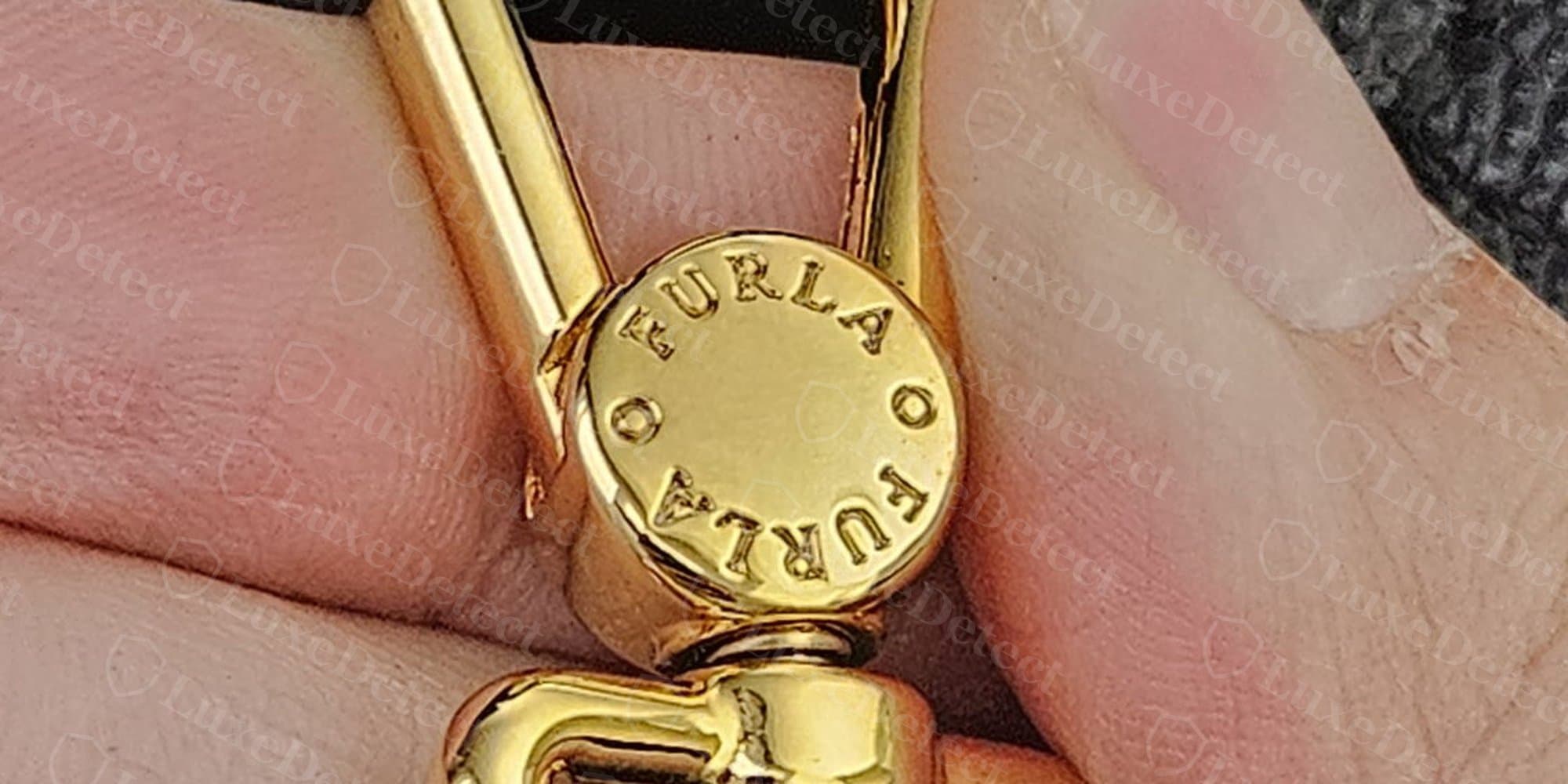
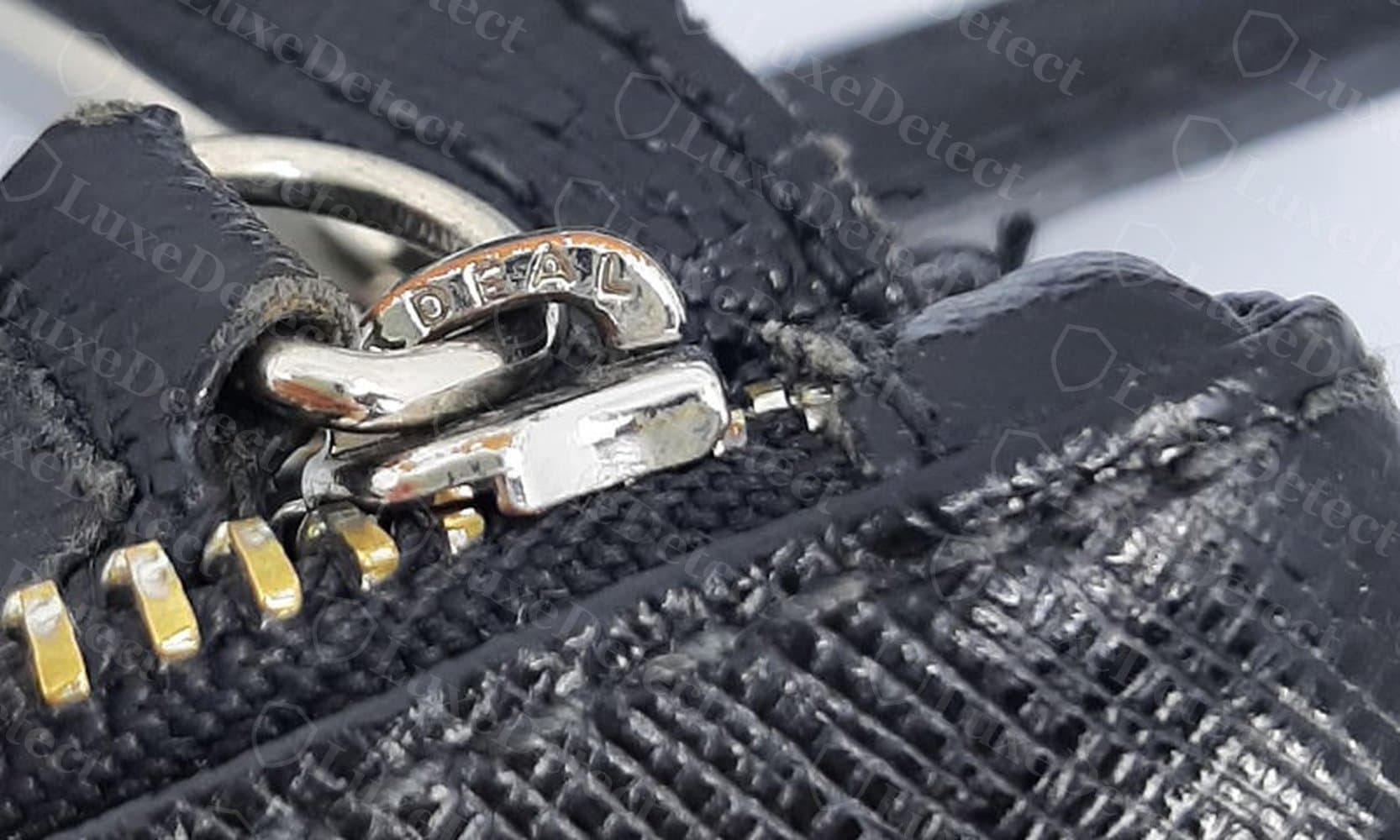
On genuine pieces, small swivel-hook hardware is commonly engraved with a repeating "FURLA" pattern around a circular rivet head, and zipper pulls carry the "FURLA" wordmark stamped into the metal tab. The engraving is consistent in font and depth with the rest of the bag's hardware.
| Element | Authentic | Counterfeit |
|---|---|---|
| Swivel hook / rivet | Engraved "FURLA" (often repeating around a circular head) | Unbranded, or branded with a different, unrelated name |
| Zipper pull | "FURLA" wordmark stamped into the tab | Blank tab, or a mismatched brand name |
| Consistency | Every metal piece on the bag matches the same brand and finish | Mixed hardware from unrelated sourcing |
Red flag
Zipper pull hardware stamped with a different brand name entirely is about as decisive as a tell gets. It sounds almost too obvious to need saying, but it happens: hardware gets sourced generically by counterfeit workshops, and a batch of pulls stamped for an unrelated brand ends up on a bag being sold as Furla. If any branded metal piece on the bag doesn't say "Furla," stop the inspection there.
The Interior Leather Tag
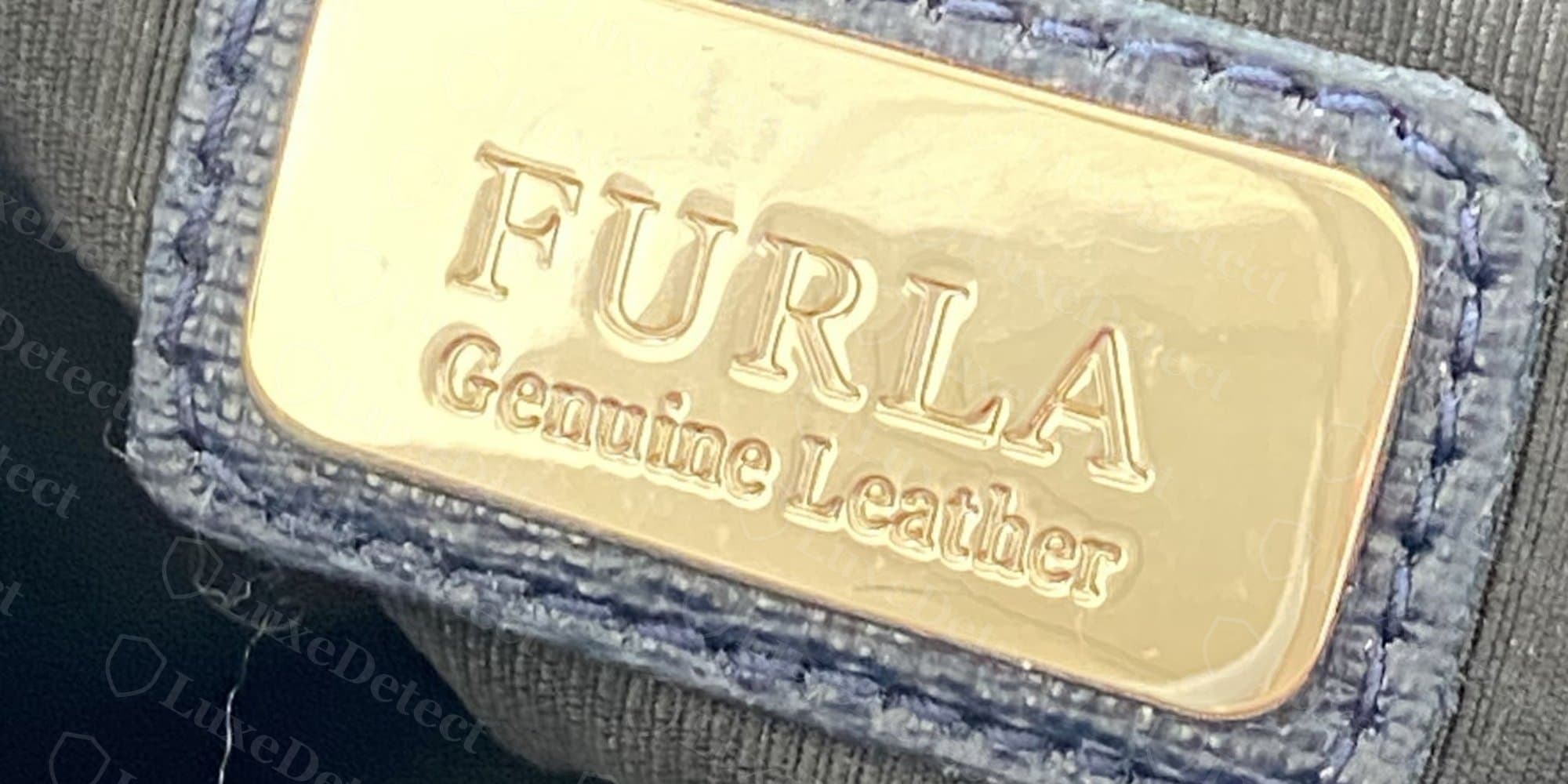
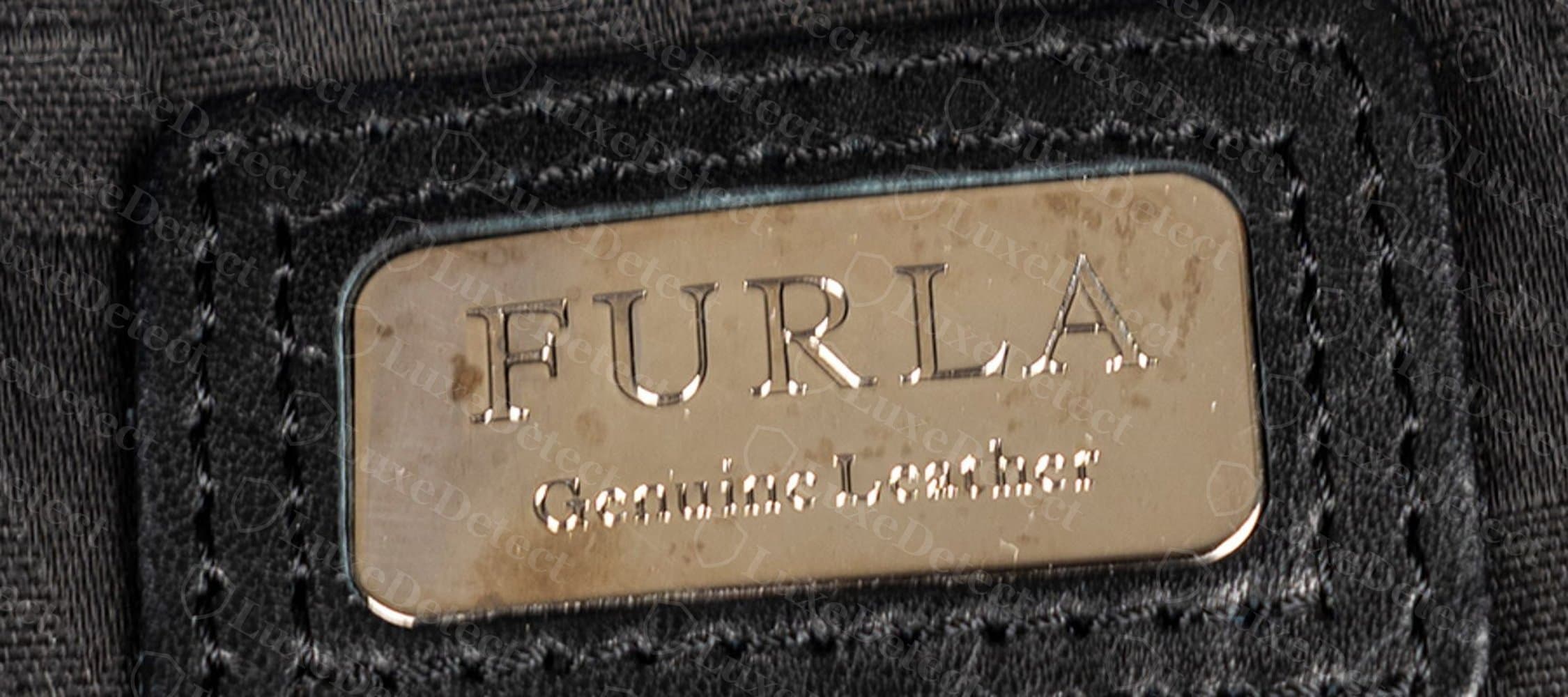
Nearly every Furla bag has an interior tag — either a metal plate riveted or stitched onto a leather patch, or the wording embossed directly into the leather at the top of the interior. It typically reads "FURLA" above "Genuine Leather" in a serif-adjacent font, foil-stamped in gold or silver depending on the hardware finish of the bag.
This check is worth doing, but be honest about its limits: font and plate construction on this tag are one of the easier details for a well-made counterfeit to replicate closely, and in practice the difference between a genuine tag and a good fake's tag can be subtle enough that photos alone won't always resolve it.
| Element | Authentic | Counterfeit |
|---|---|---|
| Wording | "FURLA" / "Genuine Leather" | Correct wording is common even on fakes — not alone diagnostic |
| Plate material | Solid metal plate, stitched or riveted into a leather surround | Can be closely replicated |
| Placement | Consistent position near the top interior, by the zip opening | Usually correct on well-made fakes |
Worth knowing
Don't treat a correct-looking interior tag as proof of authenticity on its own. It's a necessary but not sufficient check — a tag that's obviously wrong (misspelled, wrong font family, printed rather than foil-stamped) is useful evidence, but a tag that looks right doesn't clear the bag by itself. Weight this check behind the hardware checks above.
Saffiano Leather Grain and Stitching
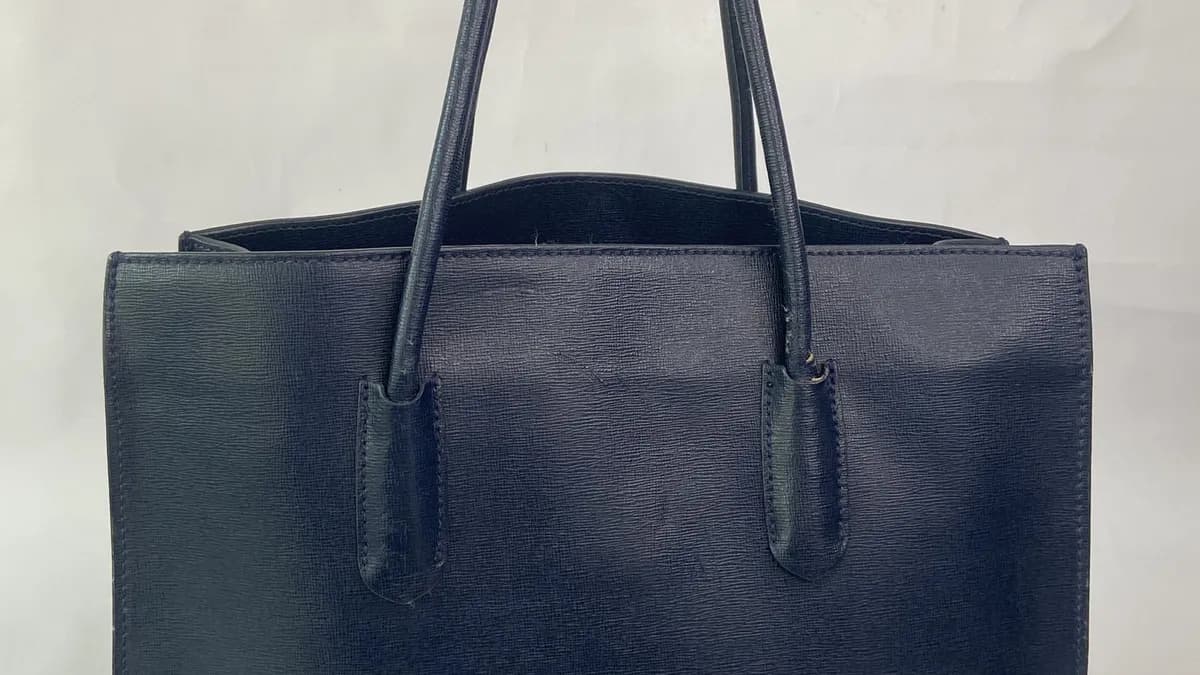
Furla's signature material on totes and structured bags is saffiano leather — a cross-hatch textured finish achieved by pressing a pattern into the leather (or a leather-like coated fabric on lower-tier pieces) before finishing. Genuine saffiano has a fine, consistent cross-hatch grain across the entire panel, with no flat or smooth patches breaking up the texture.
Edge stitching on structured Furla totes is typically tight, even, and follows a straight line parallel to the seam, in a thread color that matches or intentionally contrasts with the leather. Loose stitches, visible backing material at the seam, or a saffiano texture that looks printed rather than pressed (flat under raking light, or inconsistent in scale across panels) are quality issues worth noting.
Worth knowing
Leather grain quality is a genuine indicator but a weak one used alone — it tells you about manufacturing quality, not brand origin, and a well-made non-Furla saffiano leather bag can look very similar in photos. Use this check to build confidence alongside the hardware checks, not to override them.
What the Box and Dust Bag Do and Do Not Prove
Furla ships bags in a branded dust bag, sometimes with a printed cardboard box for higher-tier pieces, and a fold-out authenticity/care booklet with the "FURLA" wordmark on a repeating geometric pattern cover. A swing tag with a style code and barcode is usually still attached on unworn pieces.
None of this is evidence of the bag itself. Packaging is sold separately on secondary markets and reused freely; a correct dust bag proves nothing about the item inside it. Its only real value is cross-referencing: if a style code on a swing tag doesn't match what you'd expect for the claimed model, that's a legitimate inconsistency worth asking about. A correct box and tag on their own settle nothing.
Quick Authentication Checklist
- Check the front closure hardware (if present) for engraving depth, finish, and screw type on the reverse.
- Inspect every other branded metal piece — rivets, D-rings, zipper pulls — for consistent "Furla" branding.
- Look for the interior tag and confirm wording and plate construction, while treating it as supporting evidence only.
- Examine the saffiano leather grain for consistency and check edge stitching quality.
- Cross-reference any style code on a swing tag against the claimed model, without treating packaging as proof either way.
Two or more failures means walk away. A single failure on the closure hardware or on branded small hardware (check 1 or check 2) is on its own sufficient to reject the bag — these are the checks a counterfeit workshop is least likely to get exactly right, because they require sourcing correctly branded components rather than just approximating a look.
When to Get a Professional Opinion
Photos can hide a lot. Engraving depth, plating evenness, and the specific feel of a lock mechanism clicking shut are all things that are hard to judge from a marketplace listing, and a sophisticated counterfeit workshop that sources correctly branded generic hardware components can clear several of the checks above without being genuine. If you've gone through this guide and you're still unsure, particularly on a Metropolis or another lock-closure model where the stakes are higher, a professional authentication service that can examine detailed photos of the hardware, tag, and stitching is worth the cost relative to the risk of a bad purchase.
LuxeDetect's handbag authentication starts at $25 for a 24-hour turnaround and goes up to $65 for a 30-minute rush review, with $35 and $45 tiers in between for 12-hour and 2-hour turnarounds. Every submission includes a Certificate of Authenticity you can keep with the item or share with a seller or marketplace as part of a dispute.
FAQ
How can I tell if a Furla bag is real?
Start with the hardware: check the front closure (if the bag has one) for clean, deep "FURLA" engraving and hexagon socket screws on the reverse, then check every other metal piece — rivets, D-rings, zipper pulls — for consistent branding. A mismatched or unbranded piece of hardware is one of the clearest tells available.
What is Furla's most counterfeited bag?
The Metropolis, Furla's best-selling model since its 2017 launch. Its turn-lock closure and chain strap are recognizable at a glance, which makes it a frequent target for low-effort counterfeits sold through resale marketplaces.
Does Furla have a serial number or date code system?
Not in the way Hermès or Louis Vuitton do. Furla relies on an interior leather tag reading "FURLA" and "Genuine Leather," along with a swing tag carrying a style code and barcode on unworn pieces, rather than a stamped date code inside the bag.
Is the interior tag enough to prove a Furla bag is authentic?
No. A correct-looking interior tag is a necessary check but not a sufficient one — well-made counterfeits can replicate the wording and plate style closely. Weight it behind the hardware checks, which are harder for a counterfeit workshop to get exactly right.
What does it mean if the hardware on a Furla bag has a different brand name engraved on it?
It means the bag is not genuine, full stop. This happens when counterfeit workshops source hardware components generically and a batch intended for an unrelated brand ends up on a bag being sold as Furla. Any branded metal piece that doesn't say "Furla" ends the inspection.
Is saffiano leather always genuine leather on Furla bags?
Not necessarily — some lower-tier Furla pieces and most counterfeits use a coated fabric or bonded material with a pressed cross-hatch texture rather than full leather. Genuine saffiano leather has a fine, consistent grain with some natural texture variation; a texture that looks uniformly printed or flat under angled light is worth a second look.
Where is Furla manufactured?
Primarily Italy. Genuine interior tags typically reference "Made in Italy" alongside the Furla name, consistent with the brand's Italian leather goods heritage.
Should I trust a Furla bag that comes with the box and dust bag?
Not on its own. Packaging is sold and reused separately from the item, so a correct dust bag or booklet proves nothing about the bag itself. Its only useful role is cross-referencing details like a style code against the claimed model, not as standalone evidence of authenticity.