Luxury Handbag Authentication Specialist
Watch authentication specialist covering Swiss manufacture references and bracelet construction.
Last updated November 2026 · Published June 2026 · Contact
The Bayswater's Place in the Market
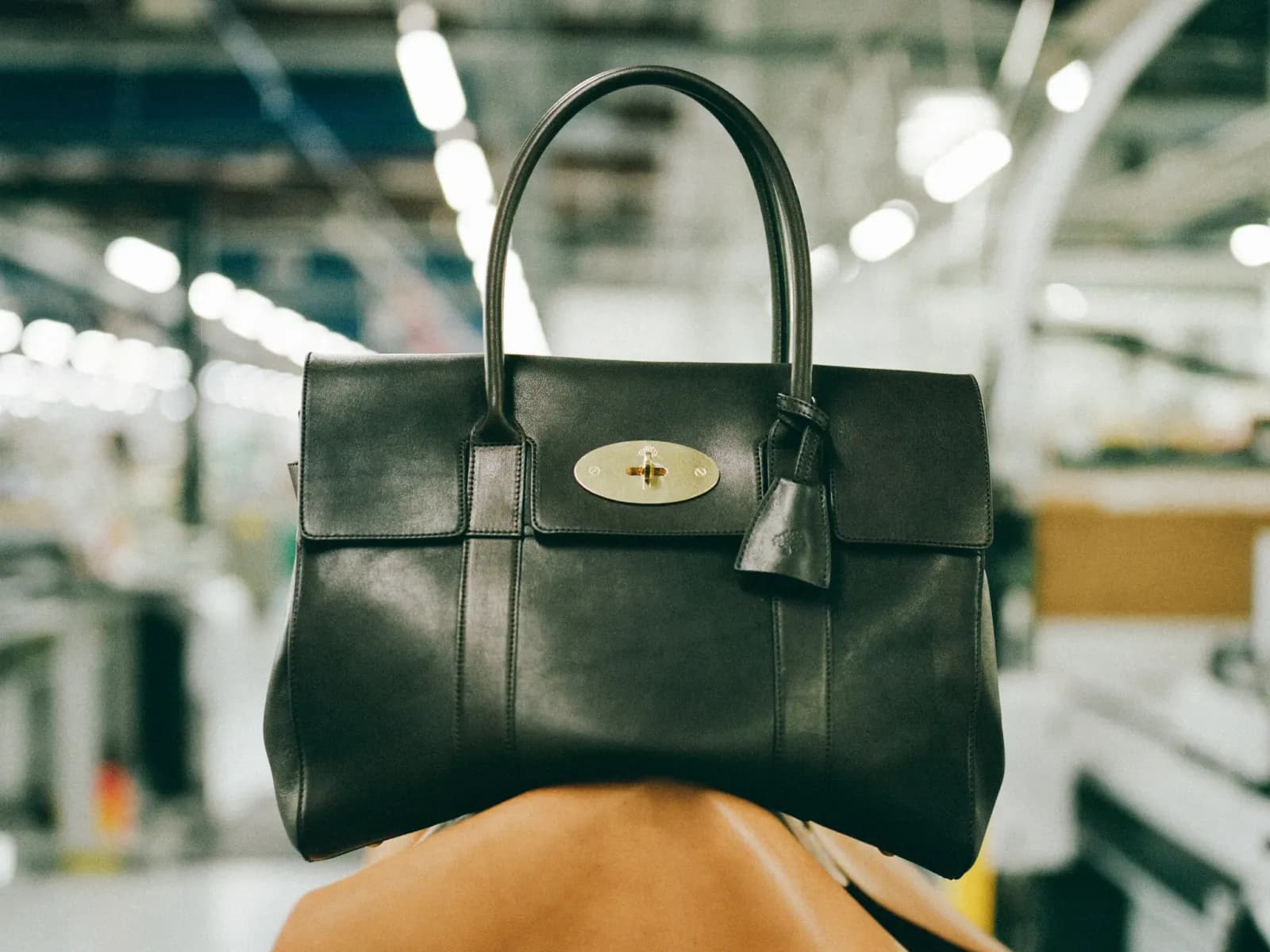
Mulberry introduced the Bayswater in 2003, and it quickly became the defining British It-bag of the decade, a structured shoulder bag with the distinctive postman's lock closure that references English postal history. The Bayswater is positioned below Chanel and Louis Vuitton in price (typically £800–£1,200 retail) but occupies a similar market position to accessible-luxury totes like the Coach and Marc Jacobs, which drives a comparable volume of fake trade. Because the postman's lock is on every Bayswater regardless of leather or colourway, and the tree-logo padlock is on many production years, they carry more of the authentication weight here than on brands where hardware varies model to model.
The Bayswater has been revised several times since 2003, so what a genuine bag looks like depends on its era. The earliest bags, from the mid-2000s, carry antique, brushed brass hardware with a deliberate matte finish and a keyed lock, often on Darwin leather. Later bags moved to polished gold and silver hardware. Place the bag in its era first, then apply the checks below against a verified bag of the same era, because a matte, brushed finish on an early bag is correct and a bright polished finish is not a requirement.
The Postman's Lock
The postman's lock is the Bayswater's most distinctive element and the most scrutinized authentication point.
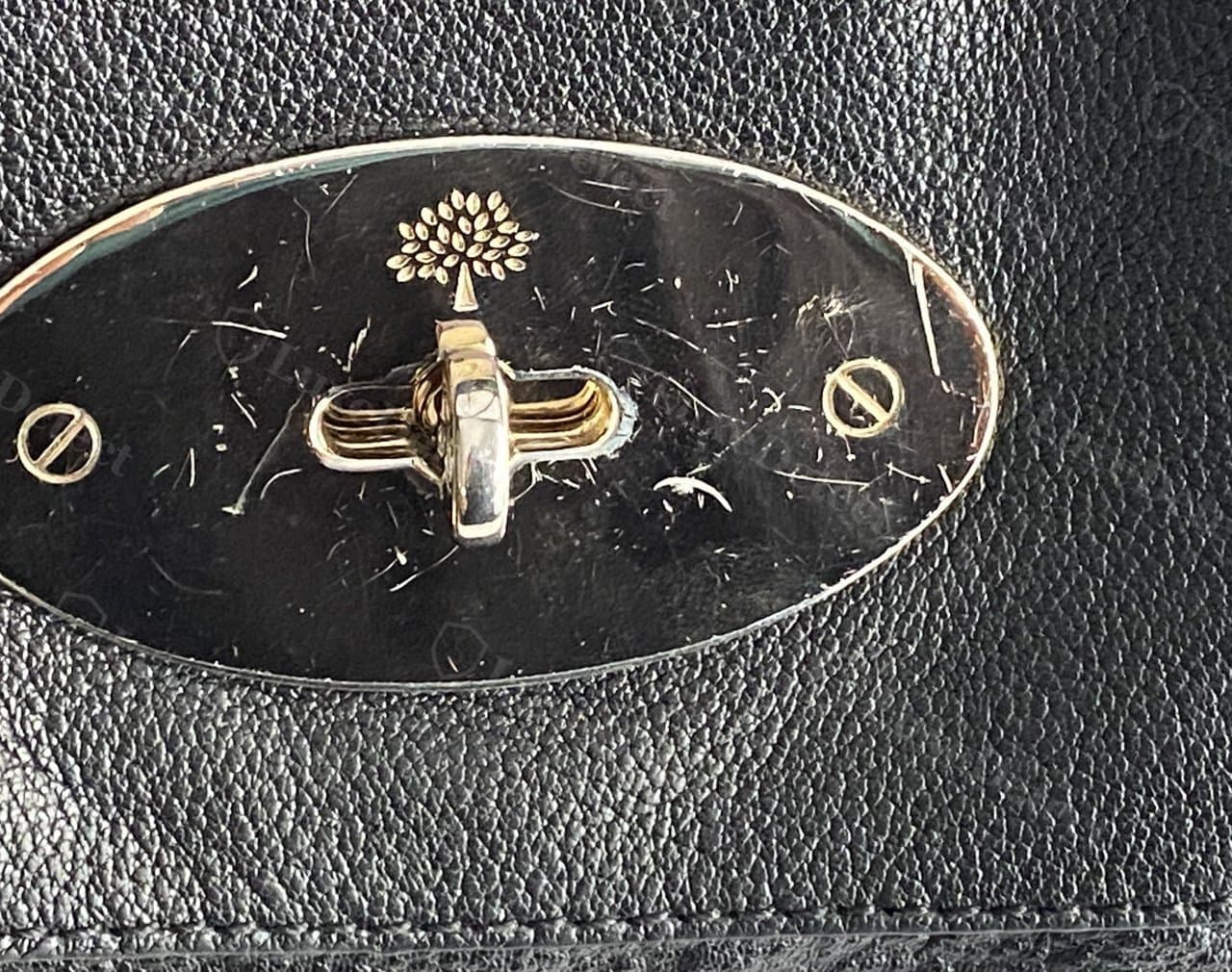
Mechanism: The lock clicks open with a specific pressure applied to the lower face — a satisfying, confident click with a definitive release. It closes with the same firm click. Fakes often have loose, imprecise mechanisms that require force, rattle, or don't click cleanly.
Early locks: on bags from the mid-2000s the lock is brushed antique brass rather than polished, and it is keyed, sold with a set of two keys. A dull, matte brass lock is expected on these bags and is not a warning sign by itself.
Weight: The lock is solid brass — it should feel heavy. Lift the lock by pinching it — it should have a substantial, cool weight. Lightweight or warm-to-touch locks are not brass.
Finish: Authentic locks come in polished gold or silver on later bags and in brushed antique brass on early ones. Whichever it is, the finish is consistent across the lock face and matches the other hardware on the bag — no patchiness, no areas of rubbed-through plating on a new bag.
Engraving: A small tree logo is struck into the lock face, and the plate is held in place by flat-head screws (see below). The engraving is deep and clean — legible without a loupe, with crisp, non-mushy edges to the tree's leaves.
Screws: Genuine Bayswater locks are secured with flat-head screws, neatly aligned and sitting flush with the plate. Cross-head screws, or screws that sit proud or crooked, are a documented fake indicator.
Front plate proportions: The postman's lock has a specific width-to-height ratio. The lower bar (the part you press to release) is a specific width relative to the upper plate. Fakes frequently get this proportion slightly wrong.
Worth knowing
Side by side, a well-made fake lock and a genuine one can look nearly identical, because fakes copy the engraving and the screws. Engraving depth and screw type are the two details worth checking closely, and the click and the brass weight are further points to compare against a verified bag. Compare the lock against a verified genuine Bayswater pair before you rely on it.
Real vs. Fake: Postman's Lock at a Glance
| Detail | Authentic | Counterfeit |
|---|---|---|
| Mechanism | Firm, confident click on open and close | Loose, imprecise, may rattle or require force |
| Weight | Solid brass, substantial and cool | Lightweight or warm to the touch |
| Finish | Consistent and matching the bag's era: polished gold or silver on later bags, brushed antique brass on early ones | Uneven plating, rubbed-through spots on a new bag, or a finish that does not match the rest of the hardware |
| Engraving | Deep, clean, legible tree logo without a loupe | Shallow, mushy, blurred leaf detail |
| Screws | Flat-head, flush and neatly aligned | Cross-head, or sitting proud/crooked |
Leather Quality
The Bayswater is produced in several Mulberry leather types — Natural Leather (the heritage option), Smooth Leather, Soft Grain, Darwin leather on early bags, and others.
Natural Leather: Mulberry's heritage vegetable-tanned leather. It starts as a firm, dense leather and develops a rich patina with use. On a new Natural Leather Bayswater, the leather is relatively stiff. Fakes sometimes use softer leather and market it as Natural Leather — the stiffness of new authentic Natural Leather is a tell.
Smooth Leather: Polished, supple calfskin. Authentic smooth leather is consistent in sheen and soft to touch. The surface shows fine natural grain under close inspection.
Soft Grain: A grained calfskin with a specific pebble. Authentic Soft Grain pebbles are fine and consistent — not coarse or wildly irregular.
Darwin leather: a grained leather used on early Bayswaters from the mid-2000s, paired with the antique brass hardware. Judge it against a verified early bag, since it does not look or feel like the polished-hardware era's leathers.
Touch test: All Mulberry leathers should feel cool to touch. Synthetic alternatives warm up quickly. It's the same tactile test worth running on other European heritage leather houses, including Delvaux, where leather stiffness and cool touch are equally diagnostic.
Worth knowing
Leather feel and stiffness are genuinely useful checks made with the bag in hand, so compare them against a verified genuine Bayswater.
Interior Stamp
Inside the Bayswater, a gold-foil or blind-embossed stamp reads:
"MULBERRY" (top line)
"Made in England" (second line)
Below these, the serial number appears on some models. On early bags the serial sits on a round brass tag inside the bag: the tree logo is on the front and the serial number is lightly engraved on the back.
"Made in England": Mulberry's heritage production is in Somerset, England, and "Made in England" is common on heritage Bayswaters. Some Mulberry products are made in other countries, and Mulberry has at various times moved some production outside England, so some later-production Bayswaters may carry a different origin stamp. Verify against a reference for your specific era. The country line is a plain fact about the bag and not an authenticity test, because fakes print one too. Judge the stamp's font, depth and placement against a verified Bayswater of the same era instead.
Font: The interior stamp uses Mulberry's specific font. The "M" in "MULBERRY" has specific proportions — its center V dips to a particular depth. Any deviation from the documented font is a tell.
Hardware Consistency
The Bayswater has additional hardware beyond the postman's lock — D-rings for strap attachment, the turn-screw closures at the base corners (on some versions), the shoulder strap hardware, and the small brass padlock-and-tree-tag charm that hangs from the front strap loop on many production years. Early bags have a round brass tree tag inside instead.
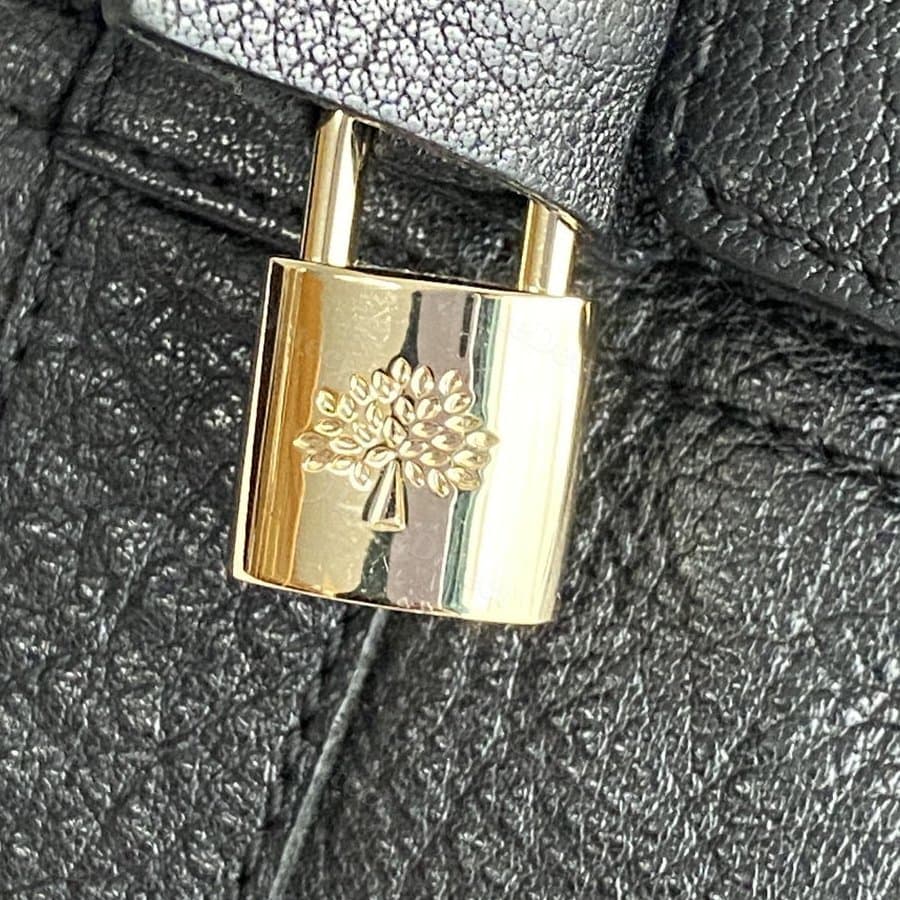
All same tone: All hardware on a single authentic Bayswater shares one tone and finish — polished gold or silver on later bags, brushed antique brass on early ones, not mixed.
D-rings: Heavy cast metal, consistent with the lock's weight.
Strap hardware: The shoulder strap (if included) has hardware that matches the bag.
Padlock and tab: Where fitted, the small brass padlock and its leather tab are worth close attention — on a polished-hardware bag the padlock is highly polished with a crisply struck tree logo, and the tab is tightly and evenly stitched into the loop it hangs from. On an early bag the round tag is brushed brass, so a matte surface is correct there.
Worth knowing
Hardware finish should agree across the bag and with its era. A polished padlock charm on a bag with a brushed antique-brass lock, or a tree stamp that is shallow or blurred beside loosely stitched tab leather, deserves a closer look against a verified bag of the same era. Dull or matte brass on its own proves nothing, because early bags are finished that way on purpose.
Stitching
Thread: Mulberry uses thread that matches the leather — not a high-contrast thread on a natural leather bag, for example.
Stitch count: Even and consistent across all panels and handle seams.
Handle attachment: Where the handles attach to the bag body, the leather panels overlap in a specific construction and are stitched through multiple layers. The attachment should be secure and the stitching clean.
Handles
The Bayswater's rolled top handles are a signature element.
Roll construction: The handles are rolled from a single piece of leather over a core — they should feel cylindrical and firm, not flat.
Handle leather quality: Same leather quality as the body — same color, same texture.
Handle drop: Authenticate the handle drop length against documented specifications for your specific Bayswater size.
Sizing
Standard Bayswater dimensions: approximately 38 × 29 × 16 cm. A Classic Bayswater Tote is slightly larger. Verify dimensions match what's stated.
Quick Authentication Checklist
- Postman's lock: firm click, heavy brass weight, crisp tree-logo engraving, correct proportions, finish that matches the bag's era (polished, or brushed antique brass on early bags)
- Leather: correct type (Natural/Smooth/Soft Grain), cool to touch, appropriate texture
- Interior stamp: "MULBERRY" in correct font, even depth
- Hardware: all one tone and finish for the era, substantial weight
- Stitching: even, matched thread
- Handles: rolled, firm, same leather as body
- Dimensions: match stated size
FAQ
Does "Made in England" on a Mulberry Bayswater tell me if it is real?
No. Mulberry's heritage production is in Somerset, England, and the Bayswater is primarily a "Made in England" bag, but some Mulberry products are made in other countries, and fakes print a country line too. Compare the interior stamp of your specific bag with a verified one of the same era, judging its font and depth, and check the postman's lock and the leather.
What leathers does the Mulberry Bayswater come in?
The Bayswater is produced in Natural Leather (the heritage option, develops patina), Smooth Leather (polished calfskin), Soft Grain (pebbled calfskin), Darwin leather on early bags from the mid-2000s, and seasonal special materials. Natural Leather Bayswaters are the most heritage option and typically command higher resale values.
Does the Mulberry Bayswater come with a serial number?
Some Bayswater versions include a serial number on the interior stamp area, and early bags carry it on a round brass tag inside, lightly engraved on the back. This serial can be verified with Mulberry for authentication (Mulberry offers verification services through their boutiques and online).
Is a matte, brushed brass Mulberry Bayswater fake?
Not by itself. Early Bayswaters from the mid-2000s were made with antique, brushed brass hardware and a deliberate matte finish, often on Darwin leather, with a keyed lock and a round brass serial tag inside. Later bags use polished gold or silver. Match the hardware finish to the bag's era and compare it with a verified bag of the same era before reading a dull finish as a fake sign.
What's the most reliable fake tell on a Mulberry Bayswater?
In hand, the postman's lock mechanism — specifically the click and the brass weight. Fakes use lighter, less precise locks, and a lock that rattles, requires force to operate, or feels light relative to its visual size is a strong warning sign that can be assessed immediately without specialist knowledge. A well-made fake lock can look nearly identical to a genuine one, so the lock alone should not carry a verdict (see the note in section 1). The padlock charm and its tab (section 4) were one of the more consistent tells across the fakes reviewed for this guide.
Why is the postman's lock significant to Mulberry?
The postman's lock is a direct reference to the traditional locks used on English postal bags — consistent with Mulberry's English heritage positioning. It was chosen by founder Roger Saul as a functional closure that also tied the bag to English craft tradition. The lock's quality is a statement of brand identity, which is why fakers consistently get it wrong.