Handbag Authentication Specialist
Handbag authentication specialist. Has reviewed submissions across Hermès, Chanel, Louis Vuitton, and Dior since 2019.
Published September 2026 · Contact
What Makes the Coach Willis Worth Knowing Well
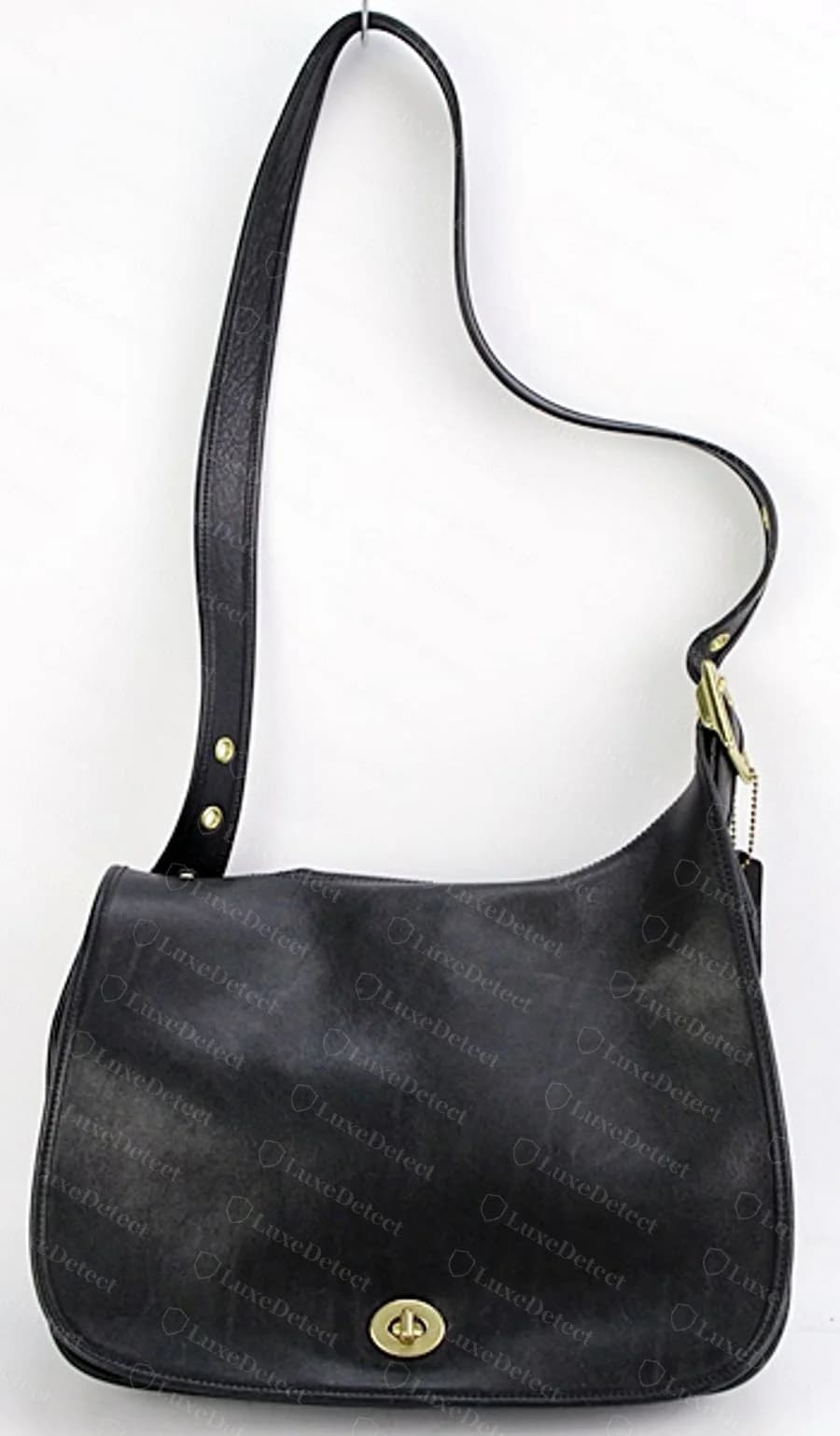
The Willis, sold under Coach's "Station Bag" name during the brand's classic American leather era, is a small flap-front crossbody with an oval turnlock, a top handle, and a separate long strap for wear across the body. It shipped for years under a handful of style numbers, most commonly #9927, #5130, and #9357, in black, brown, cognac, and a scattering of seasonal colors. It's compact, holds its shape, and the leather only improves with age, which is exactly why it never stopped circulating on the resale market.
That same durability is the problem for authentication. A 30-year-old bag that still looks showroom-fresh, and a very good counterfeit built to mimic one, can be difficult to tell apart from photos alone. Coach's classic-era construction is simple by design (molded brass turnlock, one embossed leather creed patch, riveted straps) and simple construction is easier to copy convincingly than a bag with dozens of distinct manufacturing steps.
Worth knowing
This guide is built from a wide set of verified authentic Willis/Station Bag examples, cross-checked against an equally wide set of confirmed counterfeit listings of the same silhouette. Across that counterfeit sample we found excellent silhouette accuracy but no single detail, not the creed patch, not the turnlock, not the zipper stamp, that reliably separated fake from real in photographs. We're documenting genuine construction in detail so you know exactly what to compare your own bag against, and being upfront that a photo-only checklist would overstate what we can actually prove.
Use our free Coach Creed Checker to read the production month, year and style number from your bag's creed patch.
Decode My Creed →Willis Reference: What Genuine Construction Looks Like
The Creed Patch, Both Wordings
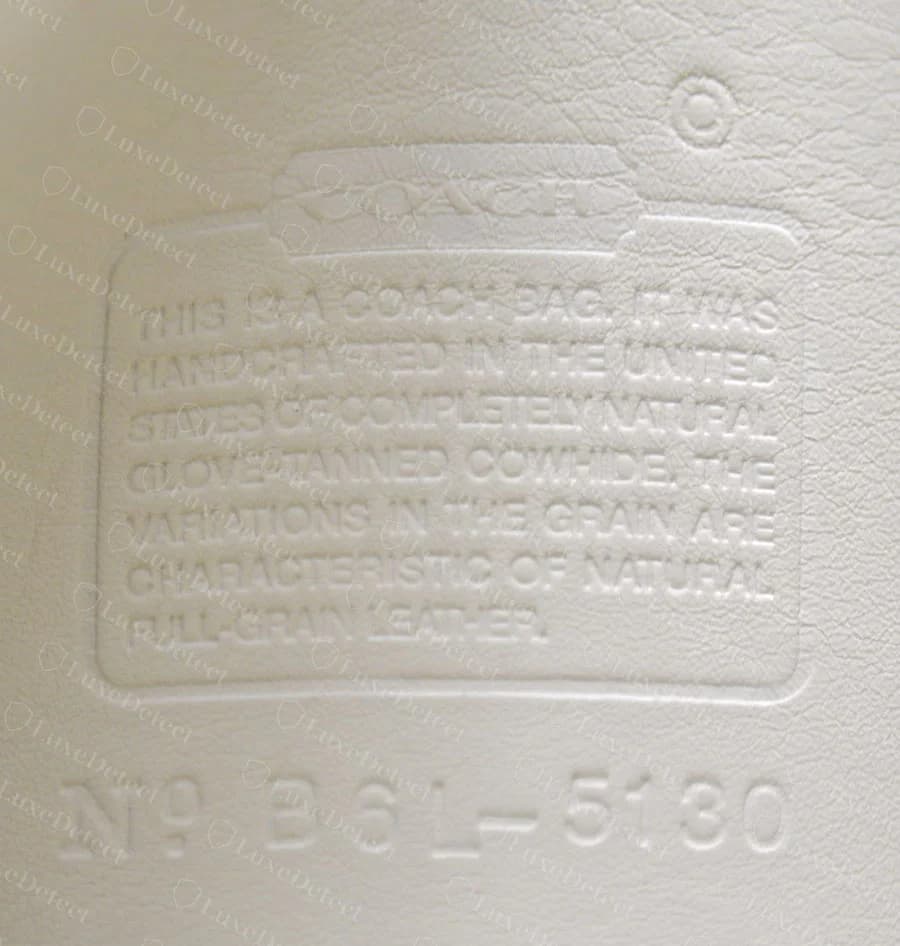
Every Willis has a rectangular leather creed patch stitched or glued inside, above the main compartment, reading "COACH" in a bordered box followed by a paragraph of text and a style number stamped "N° [factory code]-[style number]." The exact wording changed as production moved:
- Earlier, US-made bags read: "THIS IS A COACH BAG. IT WAS HANDCRAFTED IN THE UNITED STATES OF COMPLETELY NATURAL GLOVE-TANNED COWHIDE. THE VARIATIONS IN THE GRAIN ARE CHARACTERISTIC OF NATURAL FULL-GRAIN LEATHER," sometimes with a separate "MADE IN THE UNITED STATES" line beneath the paragraph.
- Later bags, once production moved overseas, read the same opening but swap the origin line, e.g. "HANDCRAFTED IN COSTA RICA," with the rest of the paragraph unchanged.
- A later Legacy-style reissue wording drops the origin claim differently: "...SUPERIOR CRAFTSMANSHIP AND ATTENTION TO DETAIL REFLECT OUR COMMITMENT TO ENDURING QUALITY."
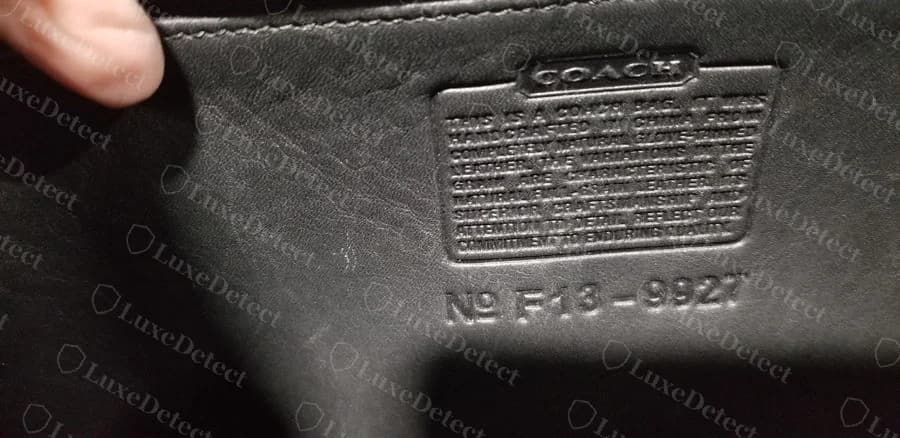
The style number format is consistently a short factory/batch code (two or three letters and digits, e.g. "K2P," "B61," "J8Y") followed by a dash and the model number: 9927, 5130, or 9357. We saw this exact format, in both wordings, across every confirmed-authentic bag we sampled.
Worth knowing
Don't treat the origin line alone as a test. Both "Handcrafted in the United States" and "Handcrafted in Costa Rica" are genuine Coach production lines for this era, and we found convincing counterfeits stamped with both wordings too, in a format that matched authentic examples closely enough that we can't respectably call it a tell.
The Oval Turnlock
The Willis closes with a solid brass oval turnlock: an outer oval plate riveted through the flap, and a rotating bar-shaped turn piece that swivels a quarter turn to lock under a matching oval catch on the body of the bag. Genuine turnlocks show a slightly domed, softly finished brass surface with light scuffing that accumulates with age (a fresh, unworn one has a smoother, less textured face). The rotating bar has a faint oval cutout at its center where it meets the catch.
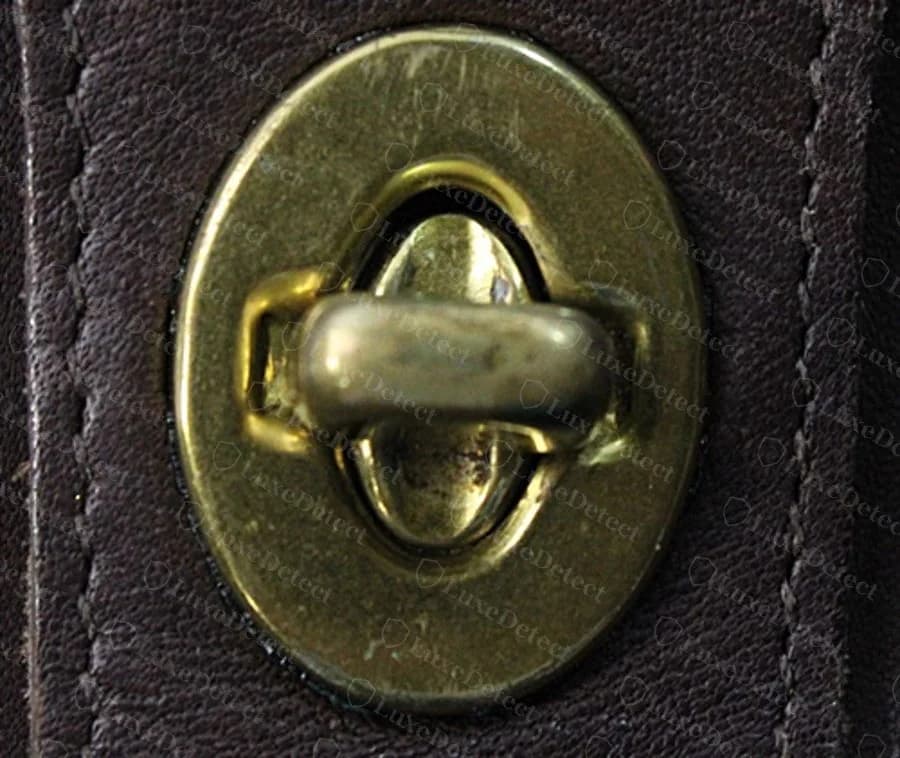
We looked closely at this hardware across every sample because a turnlock is exactly the kind of part a counterfeiter has to tool separately, and it's often where corners get cut. On the Willis specifically, we didn't find that gap. Confirmed counterfeit turnlocks in our sample matched the authentic casting shape, the finish, and even the wear patina closely enough that side-by-side photos of a real and fake example were, in several cases, difficult to tell apart without the bag in hand.
Hardware Stamps and Strap Hooks
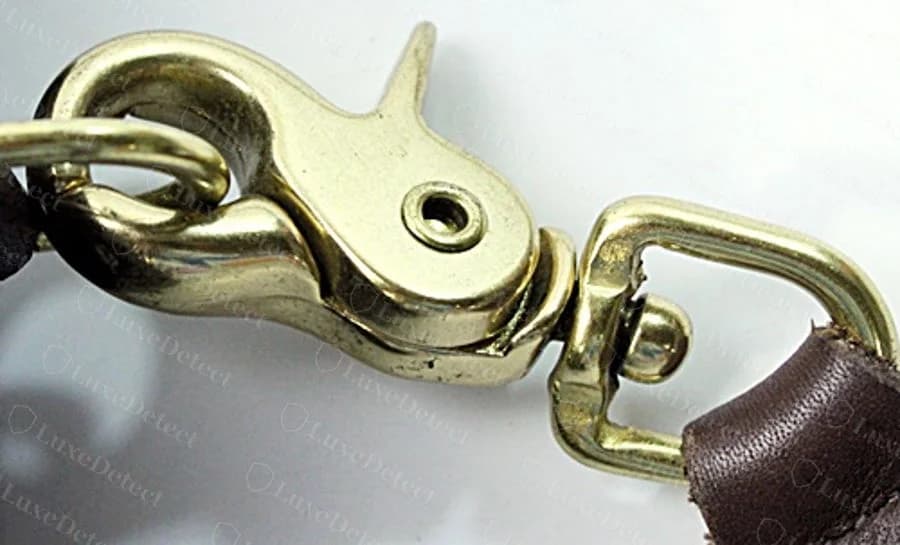
Look at the brass swivel hooks that connect the crossbody strap to the D-rings, and at any belt-style buckle on the strap itself. Genuine Coach hardware from this era is often stamped discreetly: a "YKK" mark on the zipper pull if the bag has an interior zip pocket, or "SOLID BRASS" stamped along the inner curve of a buckle. These stamps are small, so they photograph best under close macro focus, but they should be crisp and evenly struck, not shallow or off-register.
Worth knowing
A legible hardware stamp is a good sign, but its absence in a photo usually just means the angle or lighting didn't catch it, not that the bag is fake. We found the same YKK and "solid brass" stamps, correctly formed, on multiple confirmed counterfeit listings in our sample.
Interior Lining and Stitching
The interior of a genuine Willis is lined in a soft suede-like material (not slick fabric), usually matching or complementing the exterior leather color, with the creed patch stitched into the main compartment above a zippered pocket. Stitching throughout the bag, at the gusset seams, the strap loops, and the flap edge, should be tight, even, and running in a straight line with consistent stitch length. On a well-used bag, expect wear at the corners and handle wrap, not at the stitching itself.
We didn't find a consistent stitching defect across our fake sample either. Stitch density and thread color matched authentic examples closely in nearly every case we reviewed.
The Leather Hangtag
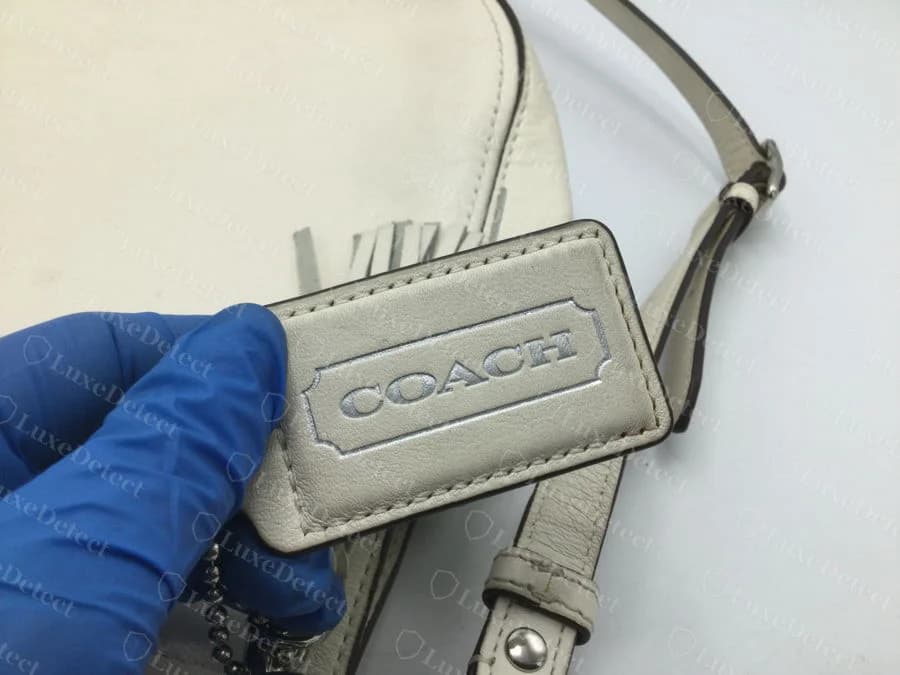
Most Willis bags carry a small rectangular leather hangtag on a brass ball-chain, debossed "COACH" in the same bordered box as the creed patch, usually blank on the reverse. The leather should match the bag's own hide in grain and color, and the debossing should be crisp with no bleeding, not because a soft edge is inherently damning, but because a crisp mark is what you'd expect from a heat-stamped die on quality leather.
What We Could Not Verify as a Tell
We want to be specific about the limits of this guide rather than imply more than the evidence supports. Working from a sample of roughly 20 confirmed counterfeit Willis/Station Bag listings, all matching the same crossbody silhouette (flap front, oval turnlock, top handle, separate long strap) and both style numbers 9927 and 5130, alongside a comparably wide set of confirmed authentic examples across both production eras, we checked:
- Creed patch wording, layout, and style-number format (both eras)
- Turnlock casting shape, finish, and rivet pattern
- Zipper pull and buckle hardware stamps (YKK, Solid Brass)
- Interior lining material and stitching quality
- Hangtag debossing
None of these held up as a repeatable, single-photo tell that separated the confirmed fakes from confirmed authentic bags. This matches what we found building our Hermès Bolide guide: some models are counterfeited by operations skilled enough that the individual construction details photograph as convincingly as the real thing. We'd rather say that plainly than force a checkpoint table onto data that doesn't support one.
One pattern worth flagging, not as a construction tell but as a buying-behavior one: several counterfeit listings in our sample reused identical photo sets across multiple listings with different claimed style numbers, and at least one listing's stated style number didn't match the number actually stamped on the bag's own creed patch in the photos. That's a seller-honesty red flag worth checking (does the number in the listing match the number in the photo of the bag itself?), even though it says nothing about the bag's construction quality.
General Market Context
Coach's classic leather bags, including the Willis, remain heavily counterfeited because the source materials (glove-tanned cowhide, brass hardware) and simple construction are within reach of a well-equipped counterfeit operation, unlike a house with dozens of proprietary finishing steps. Coach itself has never published a public serial-number lookup tool, so there's no official database to cross-reference a style number against. Buying from a seller who provides clear, high-resolution photos of the interior creed patch, the turnlock, and the strap hardware, and who can answer questions about where and when the bag was acquired, remains the most reliable practical safeguard alongside the physical checks above.
When to Get a Professional Opinion
If the checks above all look right and the price is reasonable for the bag's condition, that's a good sign but not a guarantee, precisely because our own sampling couldn't find a photo-only test that reliably fails a well-made fake. If you're buying a Willis for a meaningful amount of money, especially online, a physical inspection by someone who has handled a large volume of both genuine and counterfeit Coach leather goods is worth the cost. LuxeDetect's handbag authentication service starts at $25 for a 24-hour turnaround and includes a full written report plus a Certificate of Authenticity if the item passes, with faster turnarounds available.
FAQ
What style numbers does the Coach Willis come in?
The most common are #9927, #5130, and #9357, all sharing the same flap-front crossbody "Station Bag" silhouette with an oval turnlock, top handle, and a separate long strap. The number is stamped on the interior creed patch as "N° [factory code]-[style number]," for example "N° K2P-9927."
Is "Made in the United States" or "Handcrafted in Costa Rica" on the creed patch a sign of a fake?
No. Both are genuine Coach production lines from different points in the Willis's manufacturing history, and neither wording alone tells you anything about authenticity. We found both wordings, correctly formatted, on confirmed counterfeit bags in our sample as well.
Can you tell a fake Coach Willis from photos alone?
Not reliably, based on our research. We reviewed a wide sample of confirmed counterfeit Willis listings against confirmed authentic examples and found no single detail, creed patch, turnlock, hardware stamp, or stitching, that consistently separated them in photographs. These are unusually high-fidelity counterfeits.
What's the difference between the Willis and other Coach Station Bags?
"Station Bag" was Coach's family name for this crossbody silhouette across several style numbers; "Willis" became the popular nickname among collectors and resellers for the line generally, though Coach's own naming across catalogs and hangtags wasn't always consistent. If a listing calls a bag a "Station Bag" without naming Willis specifically, it may still be the same model.
Does the turnlock or hardware finish change with age?
Yes. Genuine brass hardware develops a soft, uneven patina and light surface scuffing with wear, which is normal and not a defect. A turnlock with an unnaturally uniform, bright, unworn finish on a bag claimed to be decades old is worth a second look, though this is a general wear-consistency check rather than a manufacturing tell specific to counterfeits.
Should I buy a Coach Willis if I can't verify it in person?
If the seller provides clear photos of the interior creed patch, the turnlock, and the strap hardware, and their story about the bag's history is consistent, it's a reasonable purchase at typical resale prices. For a higher-value transaction, a professional physical inspection is the safer route, since our own research found that photos alone can't reliably catch the best fakes of this model.