Dior Accessories Authentication Specialist
Luxury accessories authenticator. Covers small leather goods, belts, and eyewear.
Published September 2026 · Contact
Dior scarves are one of the most counterfeited accessories in the house's catalog, and one of the hardest to authenticate from a photo alone, because Dior itself has sold scarves under several different sub-labels, fiber blends, and countries of origin over the decades. A silk twill paisley scarf with a "Christian Dior Monsieur" label made in Japan, a wool "CASHLUXE" acrylic-blend scarf made in Korea, and a modern Oblique jacquard fringed scarf made in Italy can all be genuine at once. That range is exactly what counterfeiters exploit: a fake can claim almost any fiber or origin and sound plausible.
What doesn't vary is finishing quality and print accuracy. The way the raw edge of the fabric is finished, and whether the woven or printed "Christian Dior" signature is complete, correctly spelled, and consistently rendered across the piece, are the checks that hold up regardless of which era or sub-line a scarf claims to be from.
What to check, ranked by reliability
| Checkpoint | Reliability | What it tells you |
|---|---|---|
| 1. The Hem or Fringe Finish | ★★★★★ | A machine-serged edge instead of a hand-rolled hem is decisive on its own for printed silk scarves. |
| 3. The Woven or Printed Signature | ★★★★★ | Inconsistent letterforms between the two ends, or a rotated signature, is decisive but requires comparing multiple spots on the same piece. |
| 2. The Composition and Care Label | ★★★★★ | A misspelled or invented sub-brand name is decisive; the fiber content itself proves nothing either way. |
| 4. Print or Weave Pattern Quality | ★★★★★ | A useful supporting signal but subjective from a photo; we had no verified counterfeit example to illustrate a failure directly. |
| 5. Fringe Condition (Jacquard Scarves) | ★★★★★ | Sparse or uneven fringe is worth noting but unconfirmed as a standalone tell in our sample. |
| What Packaging Does and Does Not Prove | ★★★★★ | Boxes, ribbons, and authenticity cards are sourced separately from the scarf and prove nothing alone. |
Model Reference Before You Start
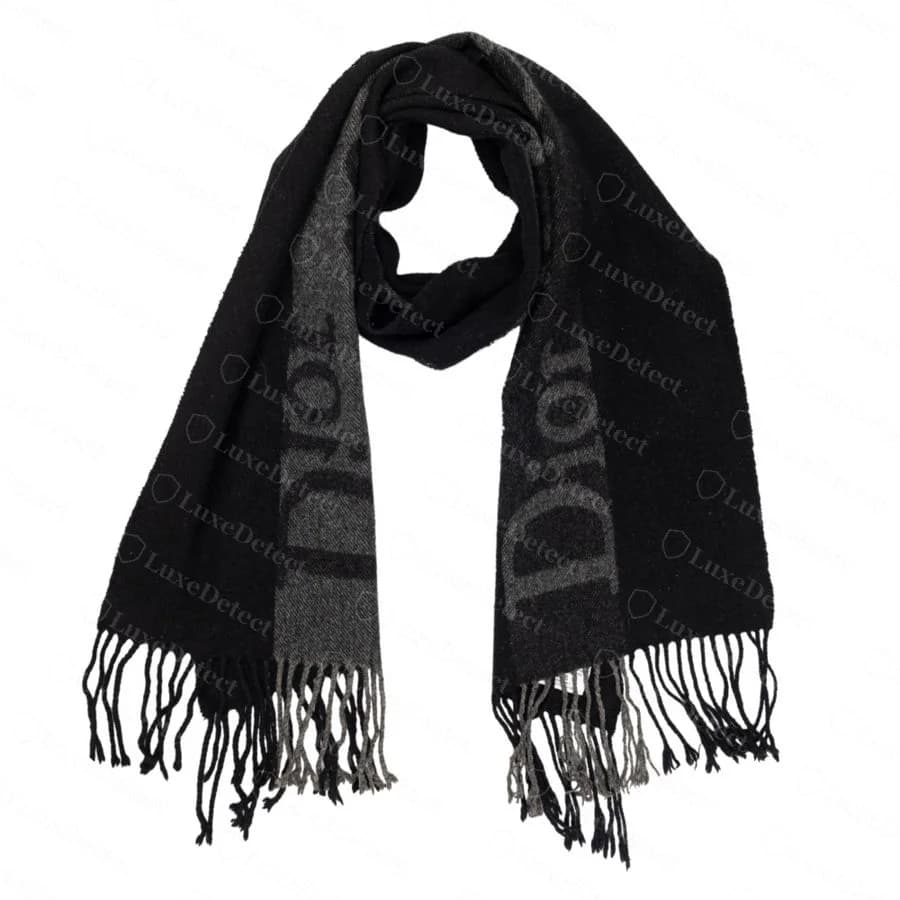
- Oblique/CD-monogram jacquard scarves (like the "CD OBLIQUE" line seen widely in resale, often labeled "Bleu Marine," "Bleu Marine et blanc," or similar color codes) are fringed, woven (not printed) with the diagonal CD motif, and typically 35 x 180cm.
- Silk twill scarves (paisley, floral, equestrian, and novelty prints like the pocket-watch/jewelry motif) are printed silk, usually square (around 85-90cm), with a rolled hem and no fringe.
- "Christian Dior Monsieur" scarves are a separate menswear line (Paris/New York branding on the woven label), sold in silk-faced/wool-backed and 100% merino wool versions, some made in Japan rather than Italy. These are genuine, older stock and shouldn't be dismissed just because they weren't made in Italy or don't say "Dior" alone.
- "CASHLUXE" wool-acrylic blend scarves, some made in Korea, are a genuine licensed Dior product line, not a fake tell on their own. Composition and country of manufacture vary legitimately across Dior's scarf history; neither is a reliable check by itself.
- Genuine fringed jacquard scarves and genuine printed silk twill scarves use different hem constructions (see below), so match the check to the actual scarf type in front of you.
Use our free Dior Date Code Checker to decode the date code stamped inside your Dior bag.
Check My Date Code →The Hem or Fringe Finish
This is the most reliable check we found, because it's a construction detail that's expensive to replicate at scale and visible in almost any decent photo.
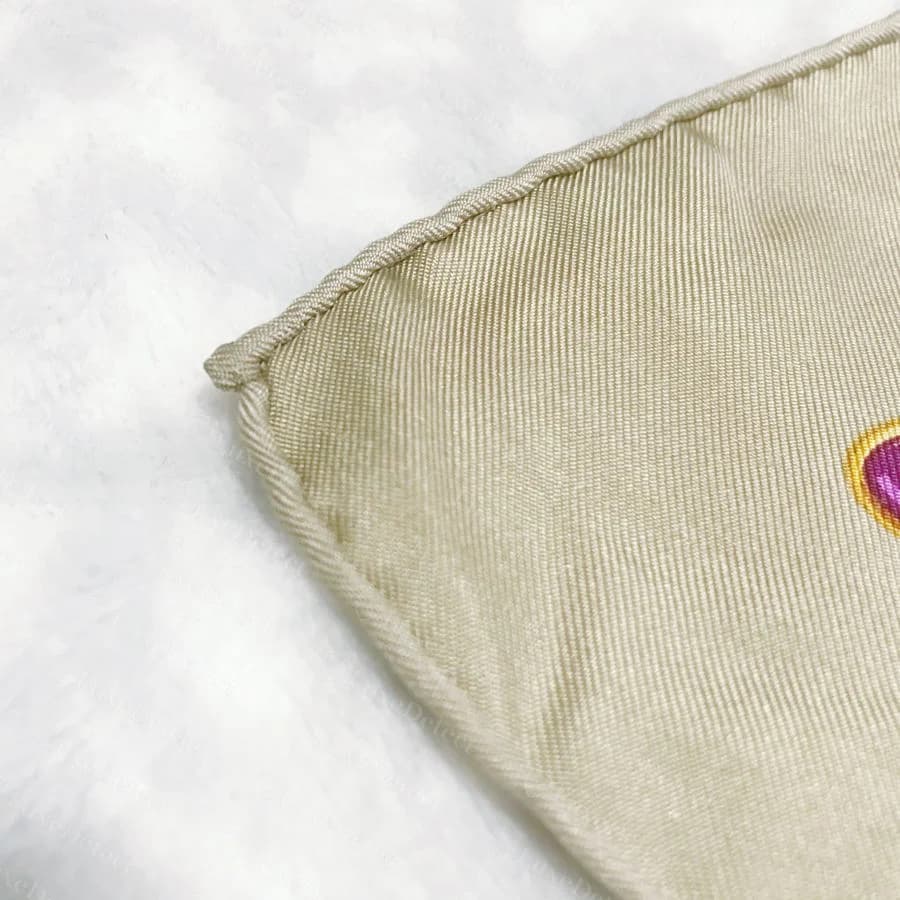
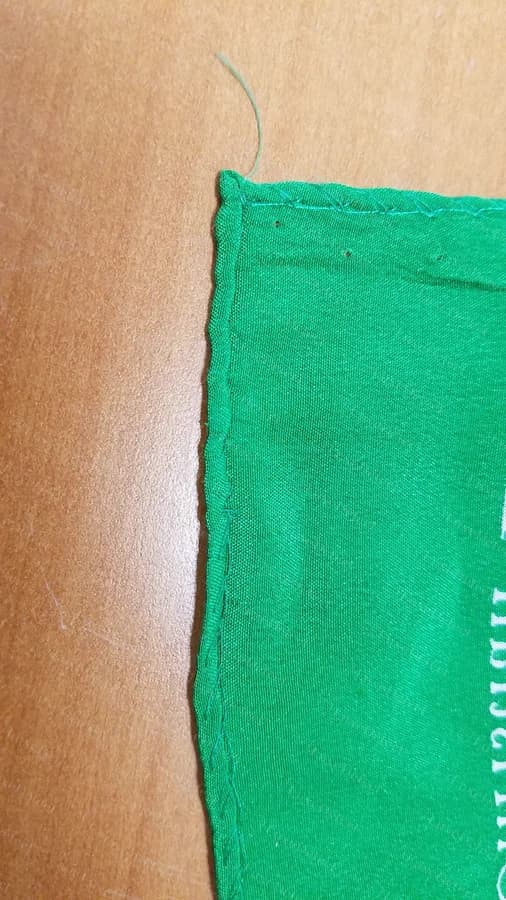
On printed silk twill scarves, a genuine Dior hem is hand-rolled: a soft, evenly rounded tube of self-fabric with no visible machine stitching and no fraying, consistent in thickness the entire way around the edge. On fringed jacquard scarves (the Oblique line and similar), the body of the scarf terminates in a woven selvage from which full-length, evenly twisted fringe strands hang; there's no raw cut edge behind the fringe.
| Element | Authentic | Counterfeit |
|---|---|---|
| Printed silk hem | Hand-rolled, smooth tube, no visible thread | Machine-serged (overlocked) zigzag edge, raw threads visible |
| Fringe (jacquard scarves) | Full, evenly twisted strands from a woven selvage | Present, but check for a machine-serged edge hiding behind or above the fringe line |
| Edge consistency | Even thickness and roll depth along the whole edge | Corners where the roll starts/stops unevenly, or thins out |
Red flag
A machine-serged (overlocked) zigzag stitch finishing a raw cut edge, rather than a rolled hem of self-fabric, is not how Dior finishes its printed silk scarves. A visible zigzag machine stitch instead of a rolled hem is enough on its own to reject a printed silk scarf.
The Composition and Care Label
Dior has used several genuine label formats across its scarf lines, so the goal here isn't to memorize one "correct" label; it's to check that whatever label is present is spelled correctly and uses real Dior sub-brand names.
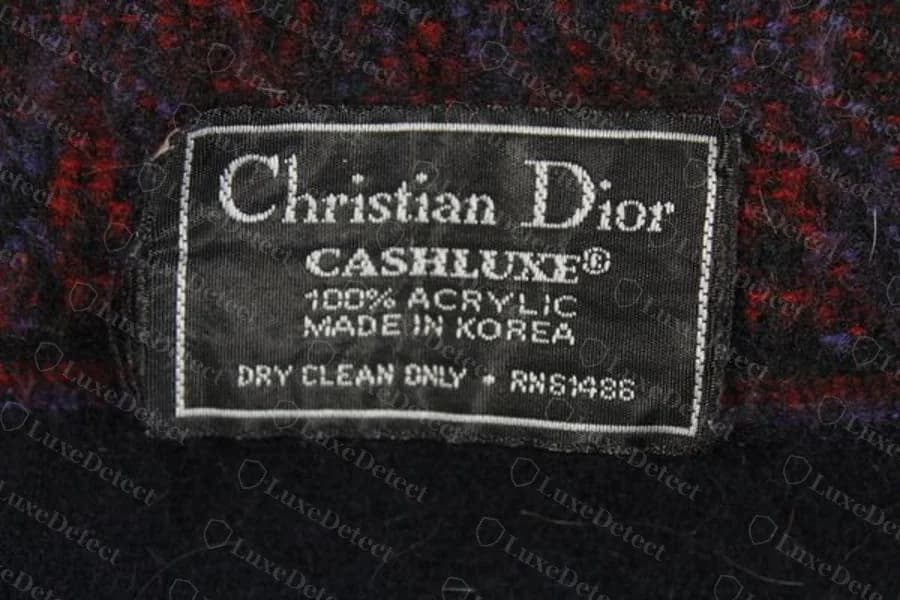
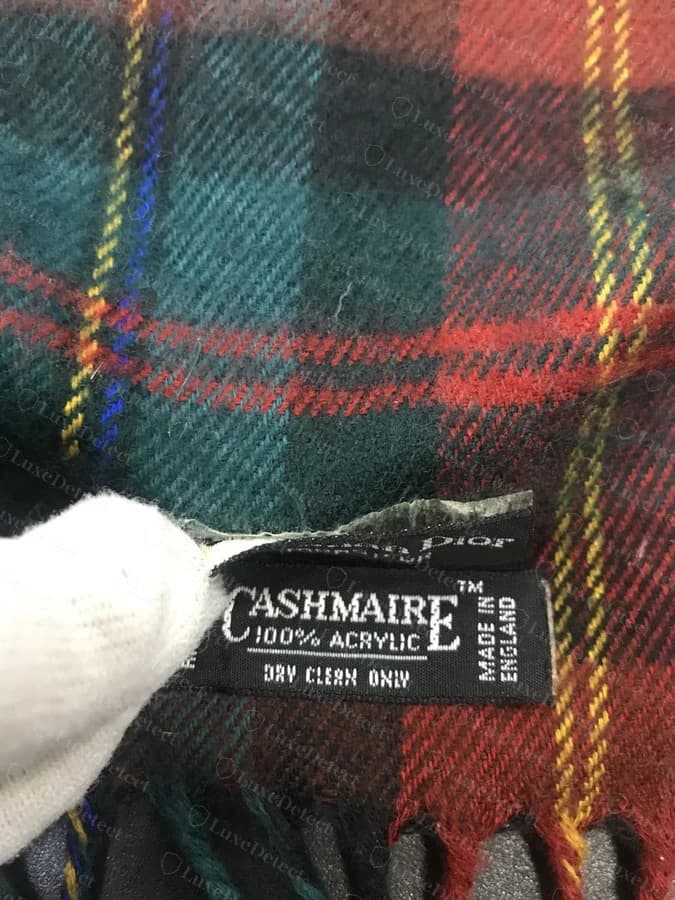
We found a fake in our sample with a woven label reading "CASHMAIRE™ 100% ACRYLIC, MADE IN ENGLAND." That's not a Dior product line; it's a misspelling of "cashmere" dressed up with a trademark symbol to look official. A genuine equivalent-era Dior wool-acrylic blend scarf we examined carries a woven label reading "Christian Dior / CASHLUXE® / 100% ACRYLIC / MADE IN KOREA" with a real RN number. The fiber content (100% acrylic) is identical on both. The tell is the misspelled sub-brand name, not the fiber content.
| Element | Authentic | Counterfeit |
|---|---|---|
| Sub-brand name | Real Dior labels ("CASHLUXE," "Christian Dior Monsieur," or no sub-brand at all) | Invented or misspelled names ("CASHMAIRE") |
| Composition claim | Varies legitimately (silk, wool, cashmere, acrylic, blends) across genuine lines | Composition itself isn't the tell; check the brand name text instead |
| Label attachment | Cleanly sewn in, even stitching | Can look plausible; not a reliable check alone |
Red flag
"CASHMAIRE" is not a real Dior product name; it's a misspelling of "cashmere" printed onto a label designed to look like a genuine sub-brand tag. A misspelled or invented sub-brand name on the composition label is decisive, regardless of what fiber it claims.
Worth knowing
Don't reject a scarf just because it lists an unfamiliar country of manufacture or an acrylic/synthetic blend. Dior has produced genuine scarves in Italy, Japan, Korea, and elsewhere, under several real sub-brand names, across different scarf lines and decades.
The Woven or Printed Signature
Both the fringed jacquard scarves and the printed silk scarves carry a "Christian Dior" signature, either woven into the fabric at each end or printed as part of the design. Two separate accuracy checks matter here.
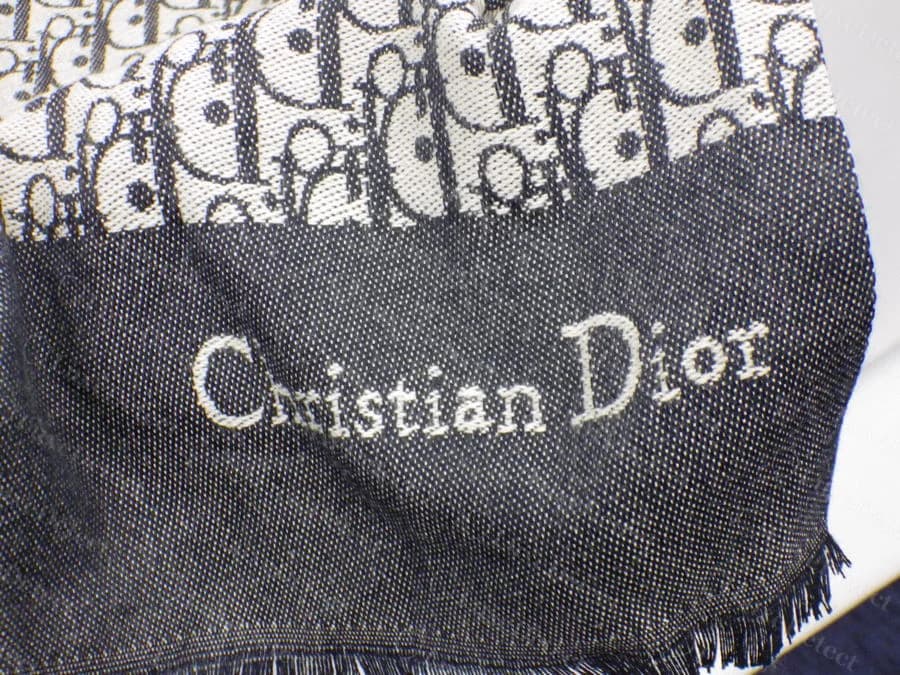
First, spelling and letterform consistency: on one fake in our sample, the woven signature at one end of the scarf read clearly as "Christian Dior," while the signature at the *other* end of the same piece had the "h" and "r" compressed together so tightly it read as "Cmistian." Since both ends of a genuine jacquard scarf are woven in the same pass on the same loom, both ends should render identically. A signature that's crisp and legible on one end and distorted on the other is a real quality-control gap, not a photo artifact.
Second, print registration: on a printed silk scarf in our sample, the "Christian Dior" signature block was printed upside down relative to the rest of the panel it sat in, while the *correct* orientation appeared on a different section of the same scarf. That kind of registration error, where a repeated design element sits at the wrong rotation, doesn't happen on a scarf that went through Dior's actual print production.
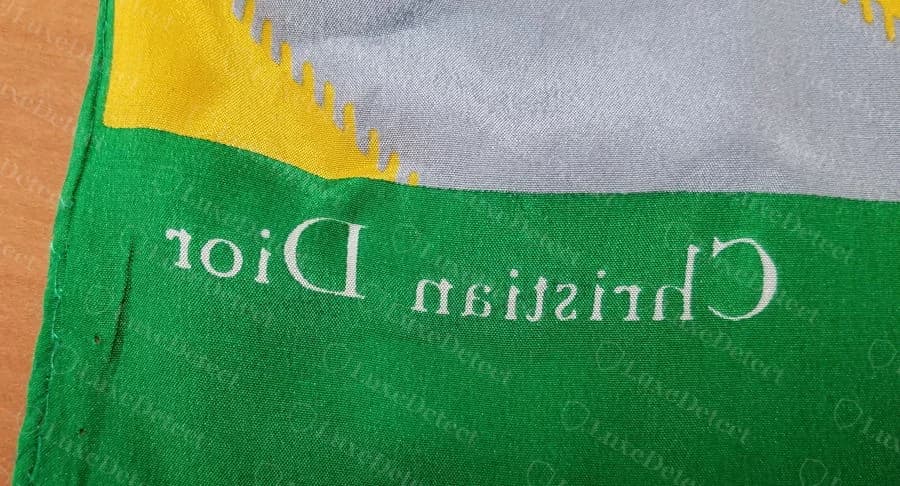
Red flag
Compare the signature at both ends (fringed scarves) or in every repeat (printed scarves). Inconsistent letterforms or a rotated/upside-down signature within the same piece is decisive — a genuine Dior scarf's print and weave are consistent across the whole piece.
Print or Weave Pattern Quality
Genuine Oblique jacquard is woven, meaning the CD motif is formed by the fabric's own structure, not printed on top of a plain weave. On a printed silk twill, the paisley, floral, or novelty motifs should have crisp edges and consistent color saturation repeat to repeat.
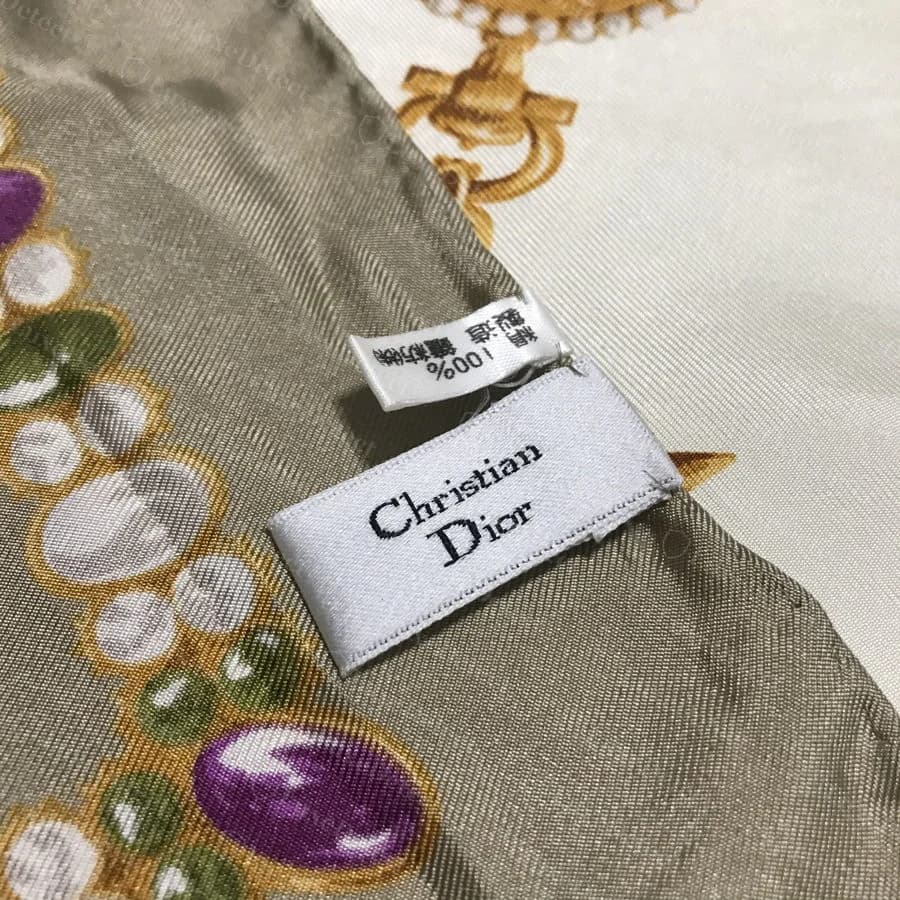
We didn't find a fake in our sample with a visibly blurred or muddy weave/print to use as a direct contrast image here, so we can't illustrate that specific failure mode with a verified example. Judge this check in combination with the signature and hem checks above rather than relying on it alone.
Worth knowing
Weave and print sharpness is a useful supporting check but a subjective one from a photo. Weight it below the hem/fringe finish and signature accuracy checks, which are concrete pass/fail construction details.
Fringe Condition (Jacquard Scarves)
On genuine fringed jacquard scarves, the fringe is full-length, evenly twisted into cords, and consistent in color and thickness across the width of the scarf.
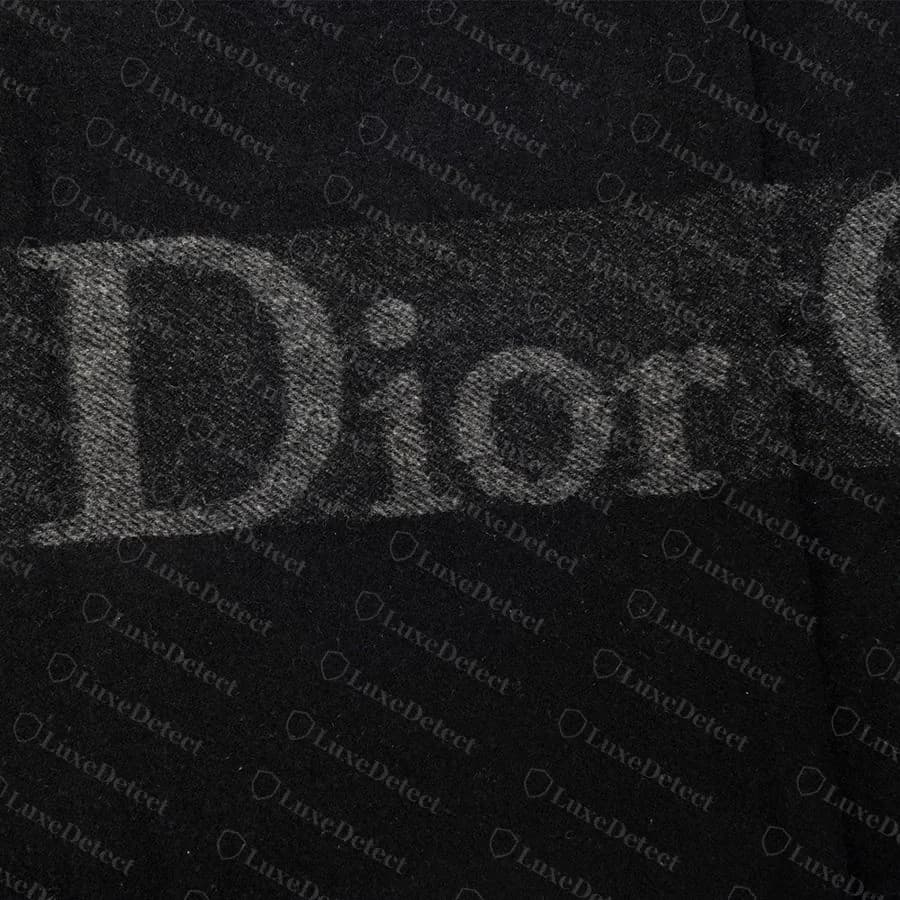
Worth knowing
We didn't have a verified counterfeit example in our sample with clearly degraded fringe to compare directly, so treat sparse, uneven, or unraveling fringe as a supporting concern to weigh alongside the hem, label, and signature checks, not as a standalone red flag.
What Packaging Does and Does Not Prove
A Dior box, ribbon, and authenticity card are easy to source or reproduce separately from the scarf itself, and in our sample we found a fake shipped with a box bearing a garbled French/English retail description ("Mode etlunettes de Solell," a URL for a domain Dior doesn't use for retail) alongside a "Carte d'Authenticité" with a printed serial number. None of that is unique to the scarf inside it. Packaging is useful for cross-referencing details like a reference number against the scarf's own woven tag, never as evidence on its own.
Quick Authentication Checklist
- Identify the scarf type first (printed silk twill vs. fringed jacquard vs. wool blend) so you're applying the right hem check.
- Inspect the hem or fringe finish: rolled and clean, or machine-serged and raw?
- Read the composition/care label closely for a misspelled or invented sub-brand name, not just the fiber content.
- Compare the woven or printed "Christian Dior" signature at both ends or in multiple repeats for consistent spelling, letterforms, and orientation.
- Weigh weave/print sharpness and fringe condition as supporting evidence, not standalone proof.
A visible machine-serged hem on a printed silk scarf, or a misspelled sub-brand name, or an inconsistent/rotated signature, is on its own sufficient to reject the piece. Two or more weaker signals (unfamiliar country of origin alone, soft print detail alone) without one of the checks above should prompt a closer look rather than an automatic pass.
When to Get a Professional Opinion
Scarves are small, low-cost items relative to bags and jewelry, but the counterfeit volume is high and the fakes in circulation now correctly replicate Dior's box, ribbon, and authenticity card format closely enough that packaging checks alone won't catch them. If the hem, label spelling, and signature all look clean in your own photos but you're still unsure, or if you can't get a clear enough photo of the hem and signature to judge confidently, a photo-based authentication starts at $15 for accessories with a 24-hour turnaround, faster tiers available, and includes a certificate of authenticity if the piece passes.
FAQ
Is a Dior scarf made of acrylic or made in Korea automatically fake?
No. Dior has sold genuine scarves under its "CASHLUXE" wool-acrylic blend line, some manufactured in Korea, alongside silk and cashmere lines made in Italy, Japan, and elsewhere. Composition and country of origin vary legitimately across Dior's real scarf history and aren't reliable authenticity checks on their own.
What's the most reliable way to tell a fake Dior scarf?
The hem or fringe finish is the most consistent tell we found. A genuine printed silk scarf has a hand-rolled hem with no visible machine stitching; a machine-serged, overlocked edge is a strong sign of a counterfeit. On fringed jacquard scarves, check that the fringe comes from a proper woven selvage rather than a raw cut edge.
Does the "Christian Dior" signature look different on fakes?
It can. In our sample, one fake had a woven signature that was crisp at one end of the scarf and had visibly compressed, distorted letterforms at the other end of the same piece. Another fake had its printed signature rotated upside down relative to the surrounding panel. Genuine Dior scarves render the signature consistently across the whole piece.
Does a Dior box or authenticity card prove a scarf is real?
No. Boxes, ribbons, and authenticity cards can be sourced or reproduced separately from the scarf. We found a fake shipped with packaging that had garbled retail copy and an unofficial-looking web address, but well-made counterfeit packaging exists too. Use packaging only to cross-reference details against the scarf itself, never as standalone proof.
How much does it cost to authenticate a Dior scarf?
Photo-based authentication for accessories starts at $15 with a 24-hour turnaround, with faster turnaround tiers available. It's worth the cost on any scarf where the hem finish, label spelling, or signature don't give you a clean answer from your own photos.
Are all Dior scarves fringed?
No. Dior's Oblique/CD-monogram jacquard scarves are typically fringed, but the brand's printed silk twill scarves (paisley, floral, and novelty prints) are usually square with a rolled hem and no fringe. Match your authentication approach to the scarf type in front of you.