Fine Jewelry Authentication Specialist
Fine jewelry authentication specialist. Focuses on hallmarks, stone setting, and metal finishing.
Published September 2026 · Contact
Why the Orb Is Faked More Than Almost Any Other Pendant
The Vivienne Westwood orb — a globe crossed by a cross, encircled by a Saturn-style ring, topped with a small cross — is one of the most recognisable logos in fashion jewellery, and it sits at an accessible price point. That combination makes it a magnet for counterfeiters: instantly recognisable, cheap enough that buyers do not scrutinise, and sold in enormous volume on marketplace and social-commerce platforms.
The fakes are not subtle once you know what to check. They copy the overall silhouette well and fail on the three-dimensional details and the finish, because those need real tooling and plating. This guide is written for the classic orb pendant (the Bas Relief and the plain orb), and most of it applies to orb earrings, rings and brooches too. It shares a lot in common with other studded-hardware brands that trade on a single recognizable motif, like Chrome Hearts.
What to check, ranked by reliability
| Checkpoint | Reliability | What it tells you |
|---|---|---|
| Orb Geometry — The Saturn Ring and Proportions | ★★★★★ | A Saturn ring whose ends do not share one axis is a crude mould and settles it. |
| The Reverse — Casting Quality and Engraving | ★★★★★ | Casting porosity on the back is a cheap cast and decisive even if the front looks right. |
| The Plating and Finish | ★★★★★ | Green corrosion and raw base metal in the recesses expose a cheap alloy and thin plating. |
| Crystal Setting (Bas Relief) and the Chain | ★★★★★ | Glued stones and a mismatched chain tone support a verdict on a Bas Relief piece. |
| Model Reference Before You Start | ★★★★★ | Separates a genuine "orb-style" lookalike from a piece falsely sold as Westwood. |
| What the Box and Card Do and Do Not Prove | ★★★★★ | Packaging is reproduced in bulk and sold separately — context, never evidence. |
Model Reference Before You Start
The orb appears across a wide range of pieces, and listings mix them up:
- Bas Relief pendant — the orb set with pavé crystal across the globe, on a chain or choker. The most faked.
- Plain orb pendant — polished metal orb, no stones.
- Mini Bas Relief — smaller pendant, often on a fine chain.
- Orb stud / drop earrings, rings, brooches — same motif, same checks.
Genuine current production carries a "Vivienne Westwood" engraving and is made to a consistent plating standard. Vintage pieces (pre-2000s) vary more and predate some of the marks — date the piece to the seller's claim before judging the hallmark.
Orb Geometry — The Saturn Ring and Proportions
The orb is a fixed piece of geometry, and fakes distort it in consistent ways.
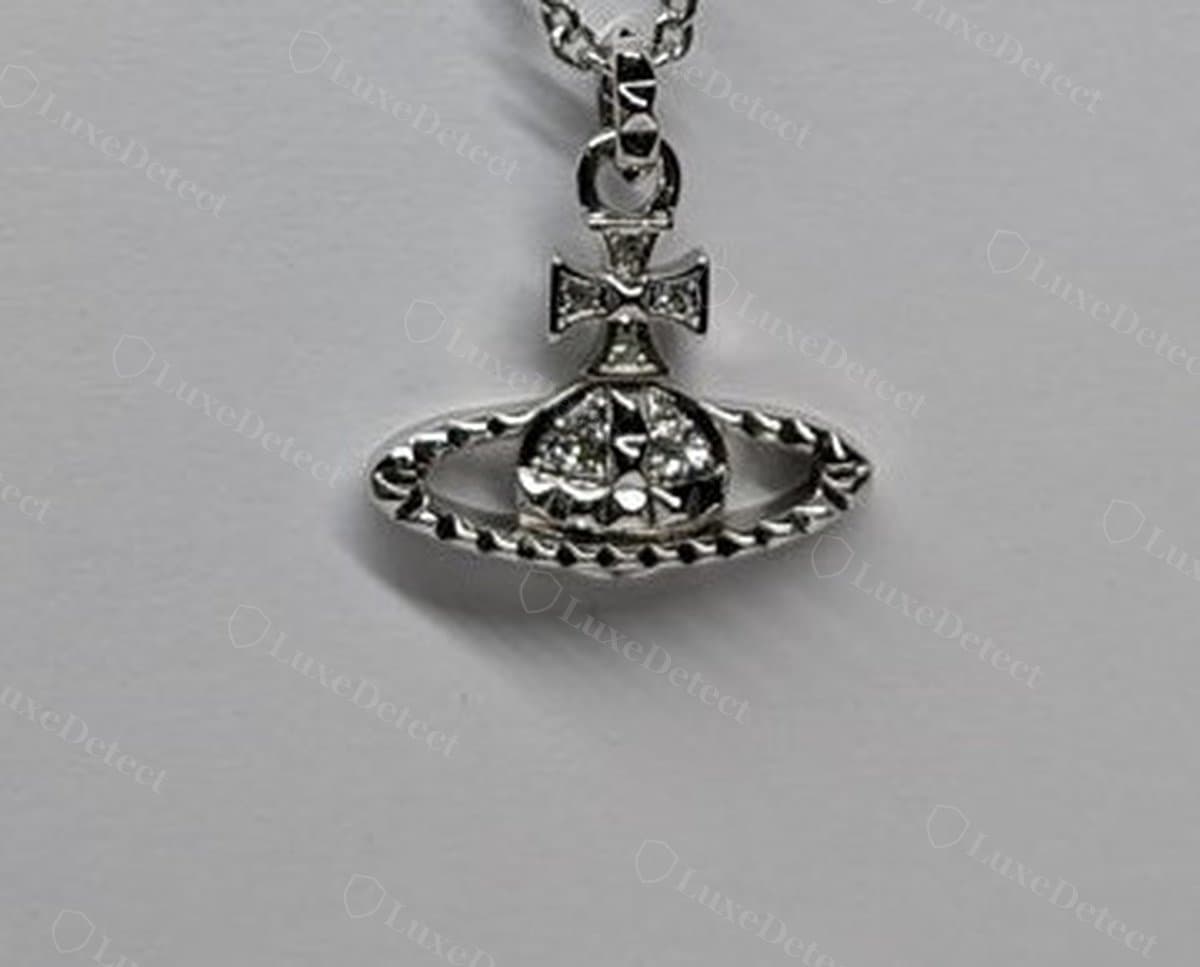
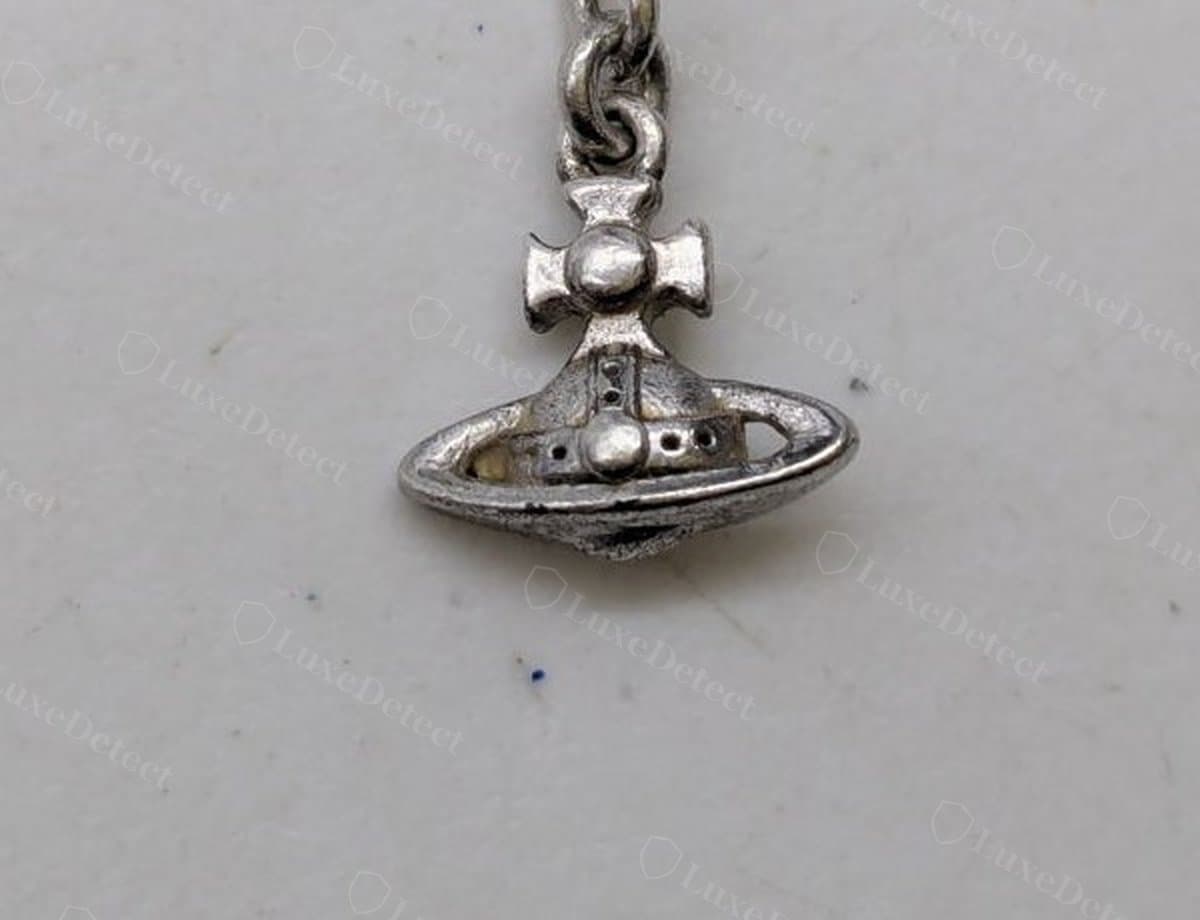
The Saturn ring: on a genuine orb the ring encircling the globe sits at a specific tilt — roughly 20–25° off horizontal — and passes cleanly behind the globe, reappearing on the far side at the matching angle. Fakes frequently render the ring too flat (near-horizontal), too steep, or with the two visible ends not aligned to the same axis.
The globe: a true sphere, with the cross-bands (the vertical and horizontal lines dividing it) meeting at clean right angles at the "poles" and "equator". Fakes produce a slightly egg-shaped globe or misaligned bands.
The top cross: small, upright, centred on the pole, with even arm lengths. Fakes lean it, oversize it, or set it off-centre.
The base cross (the one that projects forward from the globe): sits at the front centre, proportionate to the globe. Fakes make it too large or attach it at a visible seam.
| Element | Authentic | Counterfeit |
|---|---|---|
| Saturn ring tilt | ~20–25° off horizontal, both ends on one axis | Too flat, too steep, or ends misaligned |
| Globe shape | True sphere, bands meet at right angles | Egg-shaped, bands misaligned |
| Top cross | Small, upright, centred, even arms | Leaning, oversized, off-centre |
| Ring-to-globe join | Clean, ring passes behind the globe smoothly | Visible seam, ring "stuck on" the surface |
Red flag
A Saturn ring whose two visible ends do not line up on the same axis — one higher or more tilted than the other. The genuine orb is cast as a single geometry; a ring that reads as two mismatched arcs is a crude mould and settles it.
Worth knowing
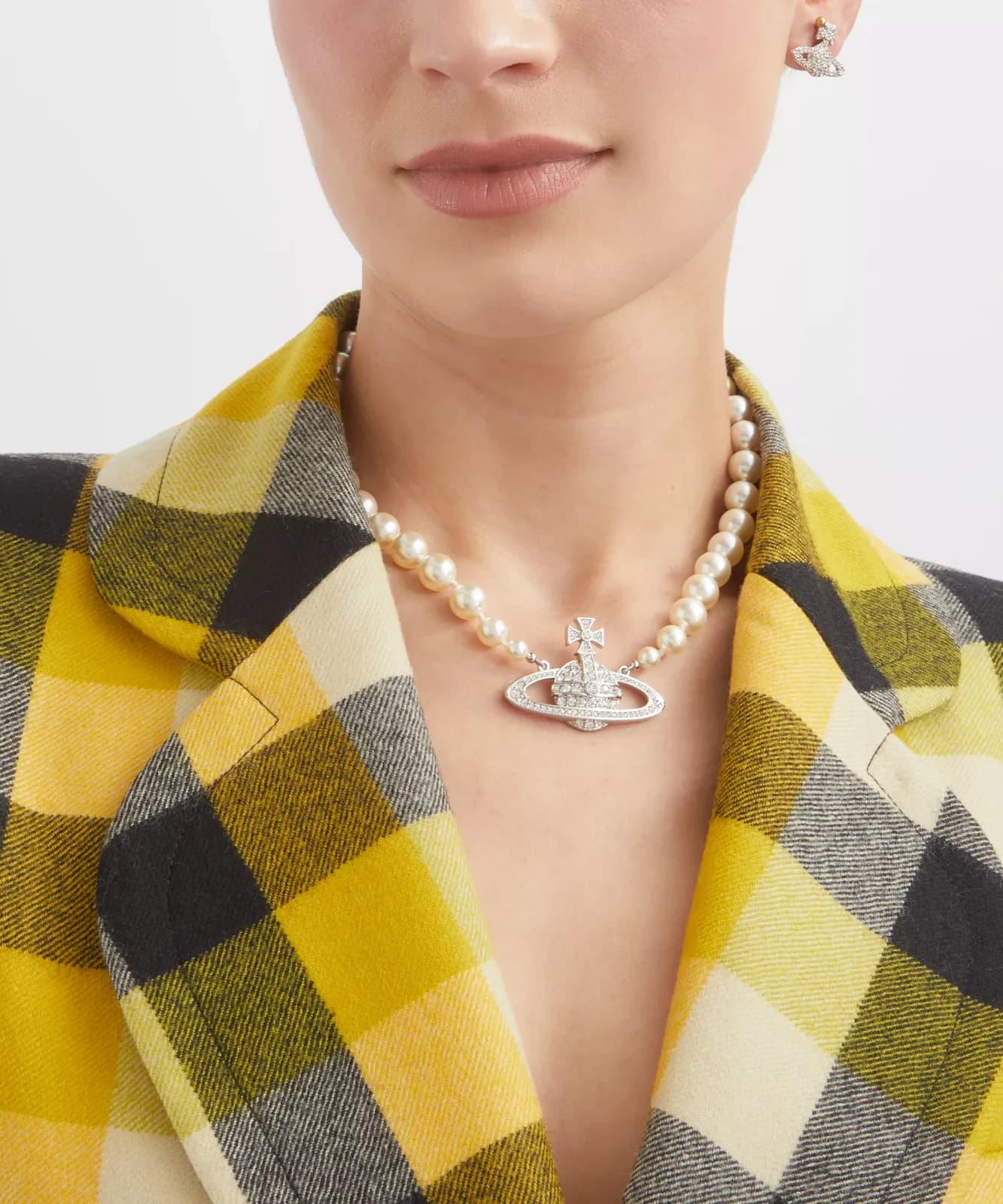
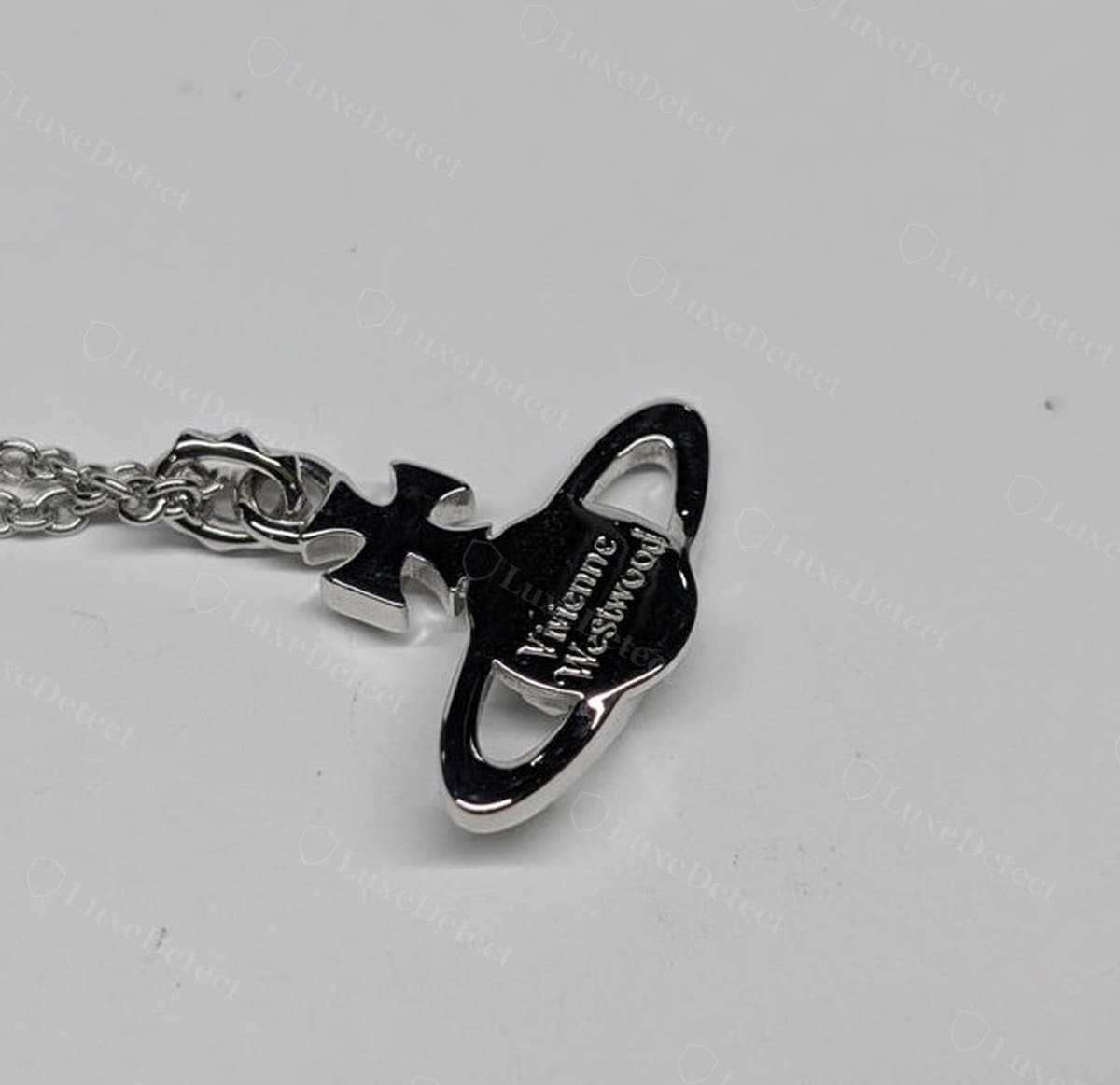
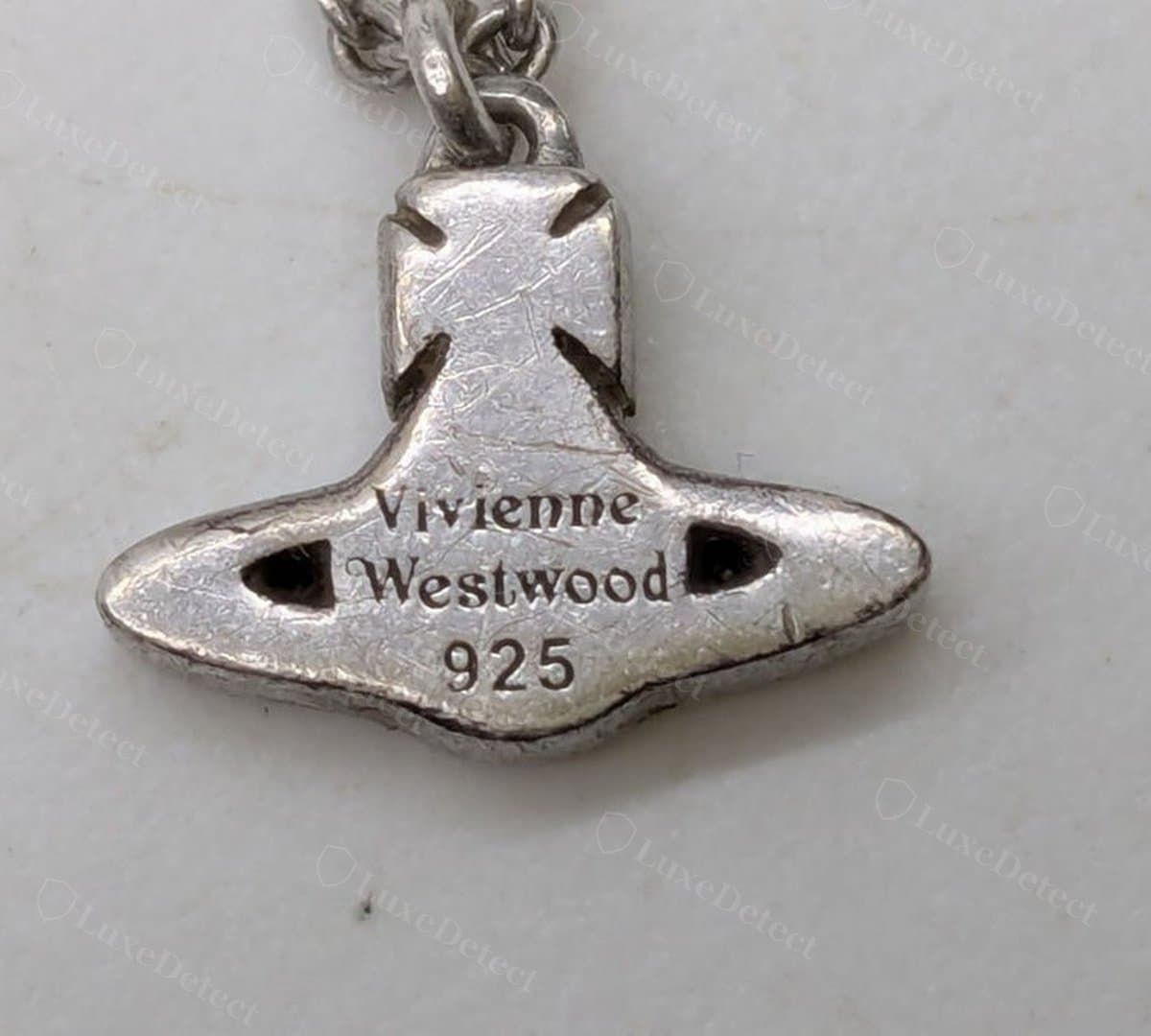
These photos compare a genuine Bas Relief pendant against a counterfeit mini orb pendant — different sizes of the same motif. The geometry and casting differences shown hold across sizes, but always compare a listing against reference photos of the same size and style before relying on scale alone.
The Reverse — Casting Quality and Engraving
Turn the orb over. The back is where fakes are laziest.
"Vivienne Westwood" engraving: on genuine current pieces the name is engraved — usually curved along the back of the globe or on the ring — in clean, even, sharp-walled lettering. Fakes render it shallow, uneven, with wrong letter spacing, or omit it entirely and rely on a hangtag.
Casting: the reverse of a genuine orb is cleanly finished — smooth surfaces, defined edges, no pitting or rough seams. Fakes show casting porosity (tiny pinholes), a visible mould seam running around the piece, or file marks where someone cleaned up a bad cast.
The bail (the loop the chain passes through): on genuine pieces it is neatly formed, fully closed, and finished to match the orb. Fakes use an open jump ring, a bail at the wrong angle, or one that is a different colour from the orb.
| Element | Authentic | Counterfeit |
|---|---|---|
| "Vivienne Westwood" engraving | Clean, even, sharp walls | Shallow, uneven spacing, or absent |
| Reverse finish | Smooth, defined edges, no porosity | Pinholes, visible mould seam, file marks |
| Bail | Neatly formed, closed, matches the orb | Open jump ring, wrong angle, mismatched colour |
Red flag
Casting porosity — a scatter of tiny pinholes — on the reverse. Genuine Westwood orbs are cast and finished to a clean standard; a pitted, porous back is a cheap sand or spin cast and is decisive even if the front looks right.
The Plating and Finish
Westwood orbs are plated base metal (this is normal and not a fault), but the plating quality is a strong tell.
Colour: the common finishes are a warm "antique" gold, a bright yellow gold, and rhodium (silver-tone). Genuine plating is even, with a consistent tone across the whole piece including the recesses. Fakes are often patchy, too brassy, or a flat grey where rhodium should be bright.
Coverage: genuine plating reaches into every recess — behind the ring, inside the cross arms. Fakes skip the hard-to-reach areas, leaving raw base metal visible in the tight spots.
Wear behaviour: genuine plating is reasonably durable; light wear dulls it evenly. A fake often shows base metal breaking through at high points (the top of the globe, the ring edges) very quickly, and some corrode or tarnish green.
| Element | Authentic | Counterfeit |
|---|---|---|
| Plating tone | Even, consistent into the recesses | Patchy, over-brassy, or dull grey |
| Coverage | Reaches every recess | Raw base metal in tight spots |
| Wear | Dulls evenly | Base metal breaks through fast at high points |
| Corrosion | None in normal wear | Green tarnish or verdigris |
Worth knowing
Plated base metal is correct for a Westwood orb — do not treat "it's not solid gold" as a fault. What matters is the quality: even tone, full coverage, no green corrosion. Verdigris specifically points to a cheap alloy the genuine supplier does not use.
Crystal Setting (Bas Relief) and the Chain
For the pavé Bas Relief and for the chain the pendant hangs on.
Crystal setting: on a genuine Bas Relief the stones are set in metal — pavé or channel — with tiny beads or walls holding each one, and they sit at a consistent height. Fakes frequently glue the stones into shallow cups; look for visible adhesive at the stone edges, stones sitting at different heights, or a missing stone leaving an empty glue-filled seat.
Stone quality: genuine pieces use good-quality cut crystal with clear sparkle. Fakes use dull, cloudy stones or plastic rhinestones that show no fire. If the piece is set with genuine Swarovski crystals rather than in-house stones, our Swarovski jewelry guide covers the setting and stone-quality checks specific to that brand.
The chain: genuine Westwood chains are consistent in link size, plated to match the orb exactly, and carry a small stamped tag or a branded clasp. Fakes use a chain in a slightly different tone from the pendant, an unstamped generic clasp, or links that vary in size.
| Element | Authentic | Counterfeit |
|---|---|---|
| Stone setting | Metal pavé/channel, beads or walls, even height | Glued into cups, visible adhesive, uneven height |
| Stone quality | Cut crystal, clear fire | Cloudy, dull, or plastic rhinestone |
| Chain tone | Exact match to the pendant | Slightly different tone, "off" against the orb |
| Clasp | Branded, or with a stamped tag | Generic, unstamped |
What the Box and Card Do and Do Not Prove
Westwood orb jewellery ships with branded packaging — a box or pouch and a card, often with orb graphics. All of it is reproduced in bulk and sold separately, and a correct-looking box is one of the cheapest things for a counterfeiter to include.
Packaging is context, not evidence. Authenticate the orb itself — the geometry, the reverse, the plating. The box tells you nothing the piece cannot tell you better.
Quick Authentication Checklist
- Saturn ring tilted ~20–25°, both ends on one axis
- Globe a true sphere; top and base crosses centred and proportionate
- "Vivienne Westwood" engraved on the reverse, clean and even
- Reverse casting smooth — no porosity, no mould seam
- Plating even into the recesses, no green corrosion
- Bas Relief stones set in metal, even height, no visible glue
- Chain tone matches the pendant exactly; clasp branded or tagged
Two or more failures means walk away. A single failure on the ring-axis alignment or on casting porosity at the back is on its own sufficient.
When to Get a Professional Opinion
The orb is inexpensive enough that most buyers never authenticate it — which is exactly why the counterfeit volume is so high, and why a convincing fake bought at "genuine" resale price is a common outcome. The geometry and casting checks above will settle most cases without help.
Where it is worth a professional review: vintage orb pieces (pre-2000s, where marks and construction vary and value can be significant), rare collaborations, and bulk resale purchases where verifying one piece validates a batch. Photo-based authentication typically runs $15 for accessories with a 24-hour turnaround, and returns a Certificate of Authenticity.
FAQ
Is a Vivienne Westwood orb necklace real if it's not solid gold?
Yes — genuine orb jewellery is plated base metal, and that is normal for the line, not a counterfeit indicator. What matters is the plating quality: even tone, full coverage into the recesses, and no green corrosion. A piece that tarnishes green is using a cheap alloy the genuine supplier does not, regardless of what it's plated with.
Where is the logo or engraving on a genuine orb pendant?
On current pieces, "Vivienne Westwood" is engraved on the reverse — along the back of the globe or on the Saturn ring — in clean, even lettering. Some pieces also carry a small stamped tag on the chain. Vintage pieces predate some of these marks, so date the piece to the seller's claim before treating a missing engraving as a fault.
What's the fastest way to spot a fake orb?
Look at the Saturn ring from straight on. On a genuine orb it sits at a consistent tilt and its two visible ends line up on the same axis. Fakes routinely render the ring too flat, too steep, or with the ends mismatched, because the geometry is cast as one piece on a real orb and approximated on a cheap mould. Then check the back for casting pinholes.
Are cheap orb necklaces on marketplaces always fake?
If it is described as Vivienne Westwood and priced far below the brand's own retail with no engraving and a generic clasp, almost certainly. There is a large market in unbranded "orb-style" pendants that are not sold as Westwood; those are not counterfeit, just similar. The counterfeit problem is pieces explicitly sold as Vivienne Westwood that are not. The same logic applies to logo-driven pieces like Chanel's CC earrings, where a recognizable motif at an accessible price point draws a similar volume of counterfeits.
Does the Bas Relief use real crystals?
Genuine Bas Relief pieces use good-quality cut crystal, set in metal pavé or channel settings, sitting at an even height with clear sparkle. Fakes glue duller or plastic stones into shallow cups — check for adhesive at the stone edges and for stones sitting at different heights.
How much does it cost to authenticate a Vivienne Westwood orb?
Photo-based authentication starts at $15 for accessories with a 24-hour turnaround. Most orb fakes are caught on the geometry and casting checks in this guide, but a professional review is worth it for vintage pieces and collaborations where construction varies and value is higher.