Luxury Accessories Authenticator
Luxury accessories authenticator. Covers small leather goods, belts, and eyewear.
Published September 2026 · Contact
Why Chrome Hearts Sunglasses Get Faked
Chrome Hearts eyewear is its own counterfeit category, distinct from the brand's silver jewelry and apparel. Frames run from around $700 for a simple acetate pair to $2,000+ for gold-plated or gem-set models, they're sold through a small handful of boutiques and optical stockists with no official Chrome Hearts e-commerce, and every pair carries the same instantly recognisable gothic wordmark and cross-and-dagger iconography as the rest of the brand. Scarce, expensive, and iconic is exactly the combination that draws counterfeiters, and the eyewear-specific checks are different enough from the brand's jewelry and hallmark guide that they need their own guide.
The good news is that genuine Chrome Hearts eyewear is heavily and consistently marked: a temple wordmark, a "FRAME MADE IN JAPAN" stamp, a specific model name (Chrome Hearts names every frame — Hotation, Slhoregasm, Mydixadryll, Blade Hummer, and dozens more, never a generic style number alone), a CE/size code, and cross or floral hardware at the hinges and temple tips. Fakes reproduce the overall silhouette and the hardware placement well, because that's what a reference photo shows, but the engraved lettering — the hardest thing to fake cheaply, since it has to be cut correctly at a tiny scale — is where a meaningful share of them fail. Not all of them: some of the eyewear-specific replicas we pulled for this guide get the wordmark and stamping right, so this is one check among several, not a single deciding test.
What to check, ranked by reliability
| Checkpoint | Reliability | What it tells you |
|---|---|---|
| 3. Hinge and Temple Hardware | ★★★★★ | A total absence of brand hardware (no cross, no medallion, no cutout anywhere) is disqualifying; soft or blurred casting is a strong secondary tell. |
| 1. The Temple Wordmark | ★★★★★ | A garbled or misspelled wordmark is decisive when it happens, but several well-made fakes get the lettering right, so a correct wordmark alone does not clear a pair. |
| 2. The Model Name and Size Code | ★★★★★ | A missing or generic model name is worth a second look, but a plausible-looking name and code do not independently confirm authenticity. |
| 4. Case, Cloth, and Packaging | ★★★★★ | A case is easily swapped between pairs, so treat it as supporting context only, never as primary evidence either way. |
The Temple Wordmark
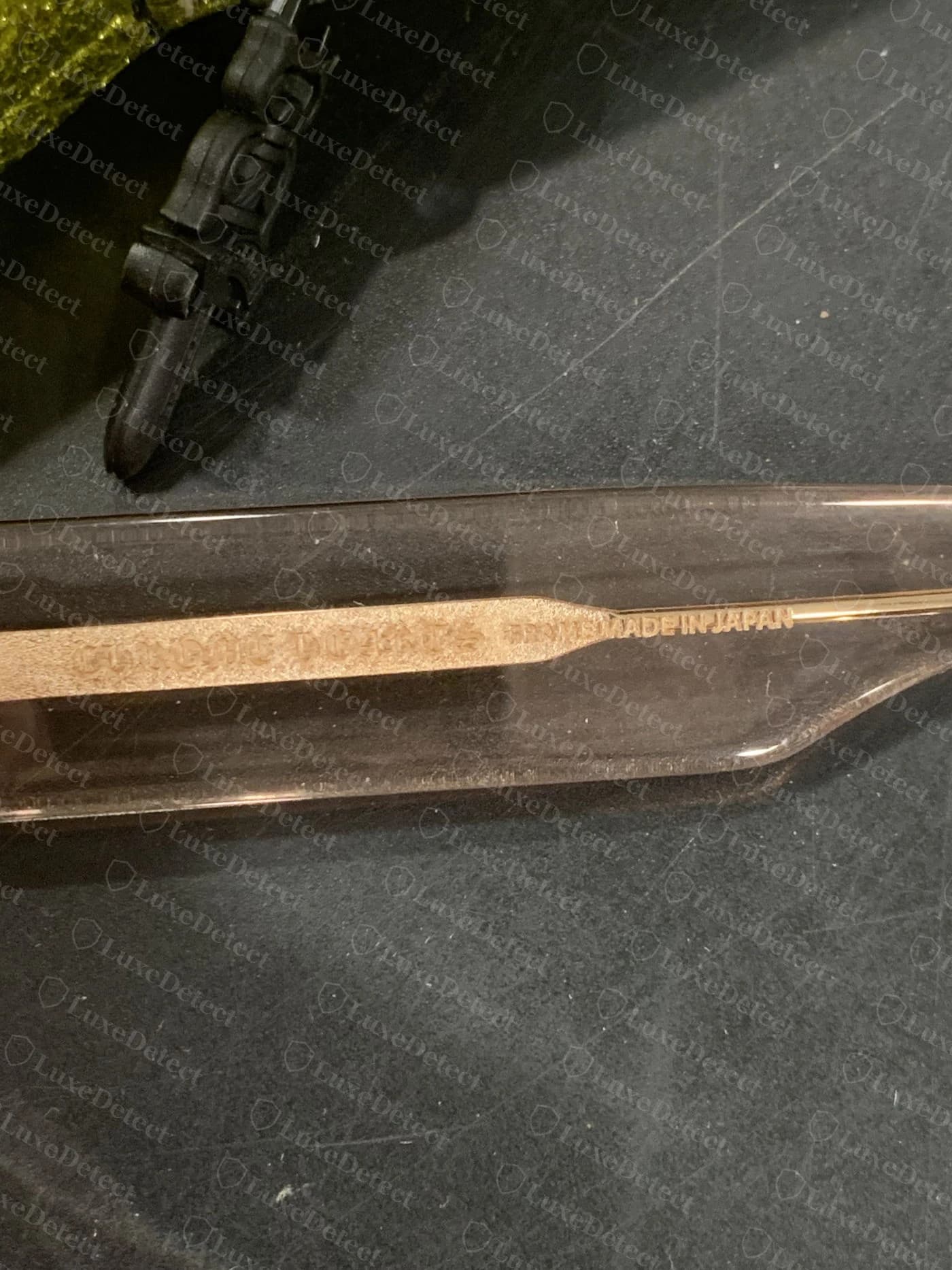
Every genuine pair has "CHROME HEARTS" engraved or printed on the inside of one temple arm, in the brand's exact gothic blackletter typeface, usually paired with "FRAME MADE IN JAPAN" in a plain sans-serif on the same line. The letterforms are crisp, evenly spaced, and consistent across every genuine example we checked — the same blackletter font the brand uses on its jewelry hallmarks and hoodie prints.
Independent fakes checked for this guide repeatedly got this wrong in ways a photo makes obvious once you know to look: one read "CHROME DUPHES" instead of "CHROME HEARTS," with a second engraving reading "ESTREL LA" where a genuine model name would sit; another read "CHROJME PC·ARTS," with a stray character and broken spacing splitting the wordmark in half. Both are on otherwise reasonably well-built frames — this is a lettering-execution failure, not a cheap-plastic giveaway.
| Element | Authentic | Counterfeit |
|---|---|---|
| Wordmark | "CHROME HEARTS" in the brand's exact gothic blackletter, evenly spaced, cleanly cut | Garbled or misspelled ("CHROME DUPHES," "CHROJME PC·ARTS"), broken spacing, or a stray character |
| Frame origin | "FRAME MADE IN JAPAN" alongside the wordmark, plain sans-serif | Missing, or present with the wordmark misspelled beside it |
| Consistency | Same font and cut quality across every genuine pair regardless of era or model | Varies pair to pair — some counterfeits get this right, most don't |
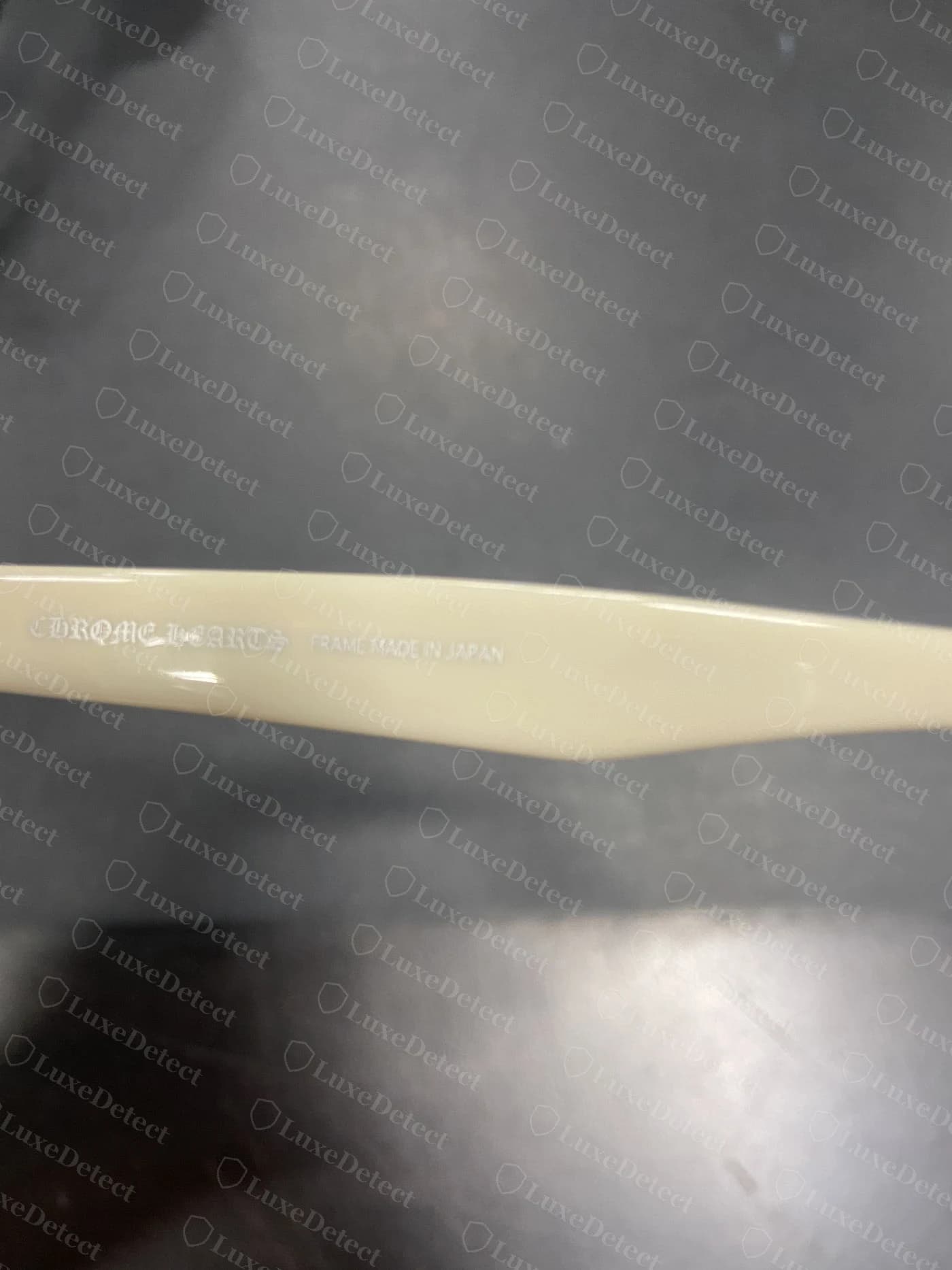
Red flag
A temple wordmark that doesn't read "CHROME HEARTS" cleanly — a wrong letter, a doubled stroke, a name that resolves to something else entirely — is decisive on its own. No genuine pair ships with a misspelled brand name.
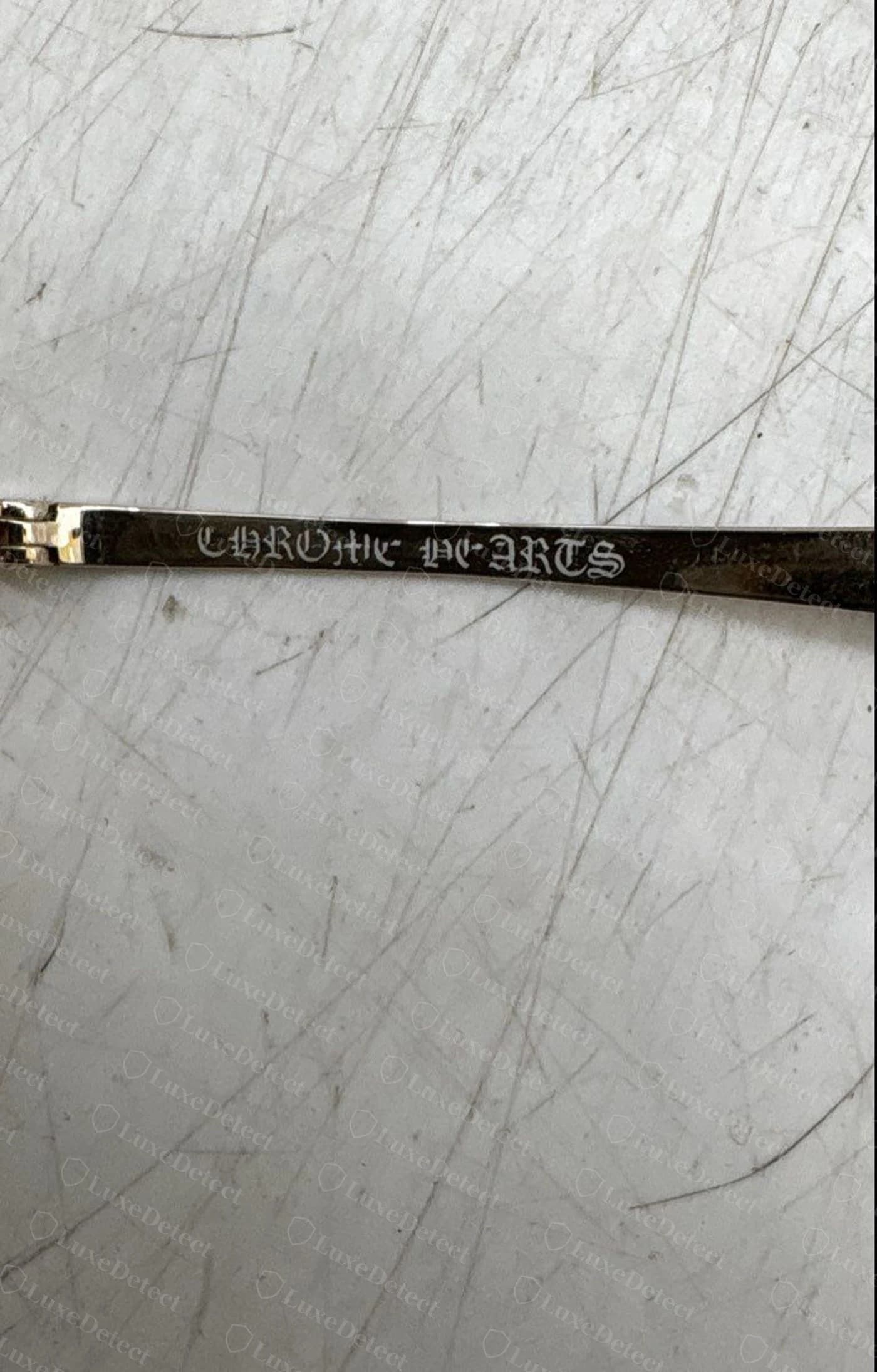
Worth knowing
A correct wordmark does not clear the pair by itself. Several of the better-made fakes checked for this guide had the wordmark right and failed elsewhere, so treat this as the fastest check, not the only one.
The Model Name and Size Code
Chrome Hearts names every eyewear model — never just a style number. Genuine temples show the model name (Hotation, Slhoregasm, Mydixadryll, Cox Ucker, Blade Hummer, and so on — the brand's naming is deliberately irreverent) alongside a CE mark and a size code in the format used across the optical industry, something like "55[]18-140" (lens width, bridge width, temple length in millimetres). This sits on the same or opposite temple from the wordmark, engraved or printed to match.
A frame sold as "Chrome Hearts Sunglasses" with no model name anywhere on it, or a size code that doesn't follow the standard three-number optical format, is worth a second look. This isn't as strong as the wordmark check — some fakes do carry a correct-looking model name and code — but a complete absence of one is unusual on a genuine pair.
| Element | Authentic | Counterfeit |
|---|---|---|
| Model name | A specific, named model on the temple, matching a name Chrome Hearts actually uses | Absent, generic ("Sunglasses" with no model), or a name that doesn't match any known release |
| Size code | Standard optical format (lens-bridge-temple in mm), e.g. "55[]18-140" | Missing, malformed, or inconsistent with the frame's actual dimensions |
Worth knowing
A correct model name doesn't independently confirm authenticity — it just removes one point of doubt. Cross-reference it with the wordmark and hardware checks rather than relying on it alone.
Hinge and Temple Hardware
Genuine Chrome Hearts eyewear uses distinctive hardware at the hinges and temple tips: a small floral cross or dagger motif cast into a metal medallion, cross-hatched or fluted metal panels on the temple arms (seen on models like Slhoregasm and the Blade Hummer line), and jewelled or diamond-set screws on higher-end models. The casting on genuine hardware is crisp and three-dimensional, with clean edges on the cross motif and no flash or blur in the floral detail, even at a few millimetres across.
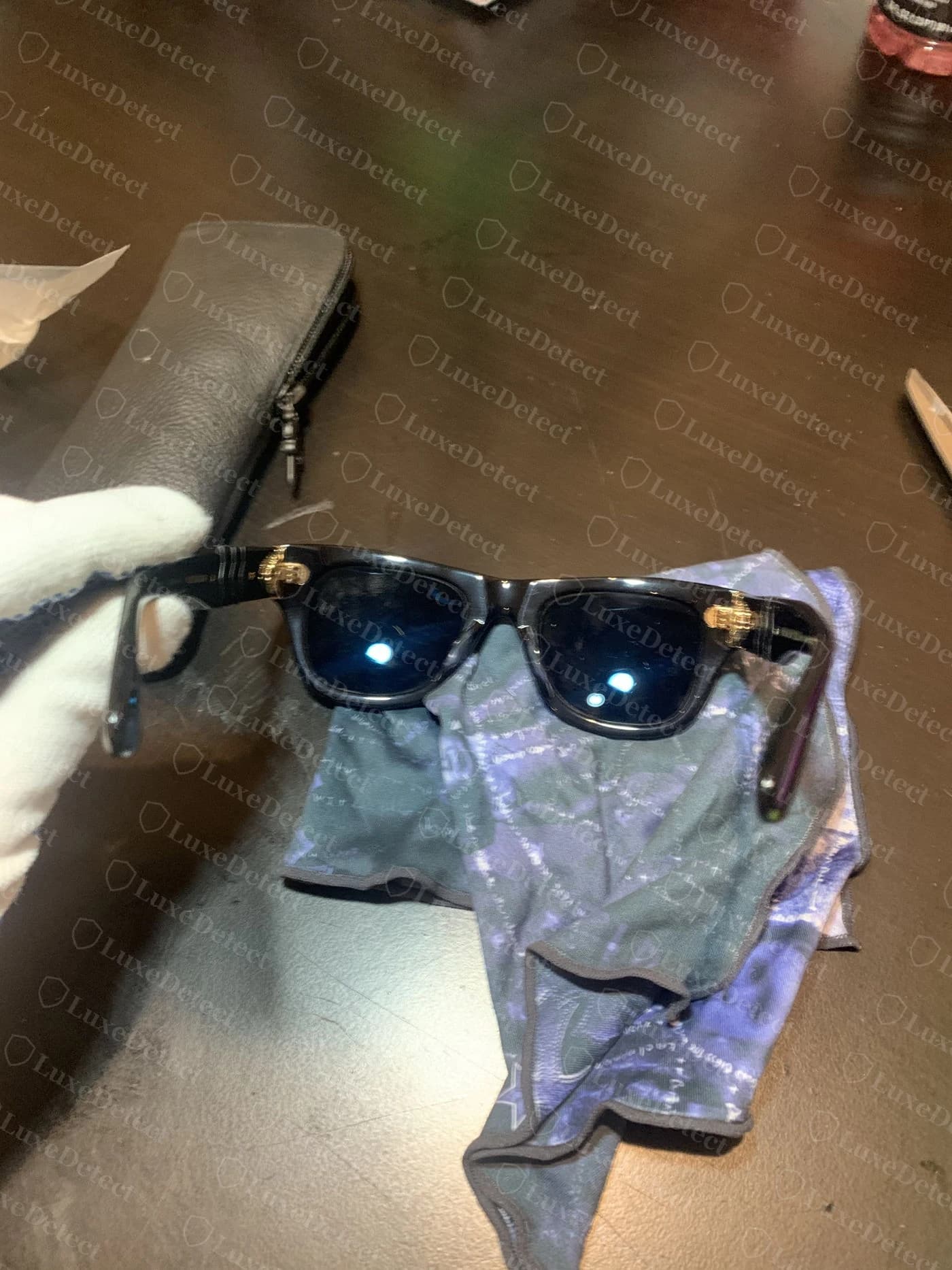
Cheaper fakes either skip this hardware entirely (a plain acetate frame with no cross medallion, no cutout, nothing at the hinge) or cast it soft and shallow, where the cross reads as a vague blob rather than a defined shape. One frame checked for this guide had zero branding anywhere — no wordmark, no cross, no cutout, nothing — just a generic black Wayfarer-style frame with Chrome Hearts written nowhere on it.
| Element | Authentic | Counterfeit |
|---|---|---|
| Hinge medallion | Crisp cast cross or floral motif, clean edges, sits flush | Absent, or soft/blurred casting that reads as a vague shape |
| Temple panel | Cross-hatched or fluted metal insert on applicable models, precisely cut | Missing, or a flat printed imitation of the texture |
| Screws | Jewelled or cross-stamped on higher-end models, seated cleanly | Plain generic screws with no branding, or visibly misaligned |
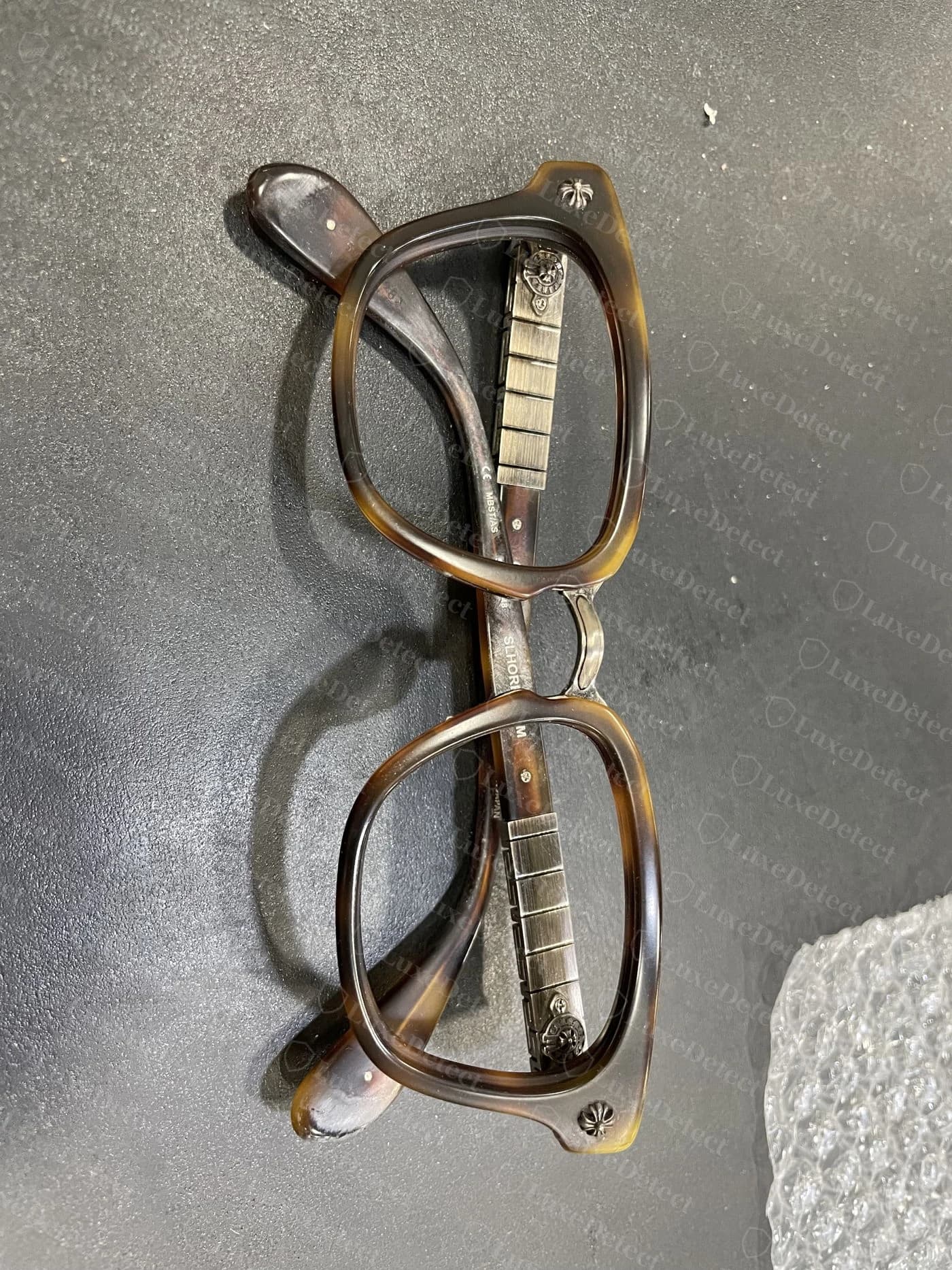
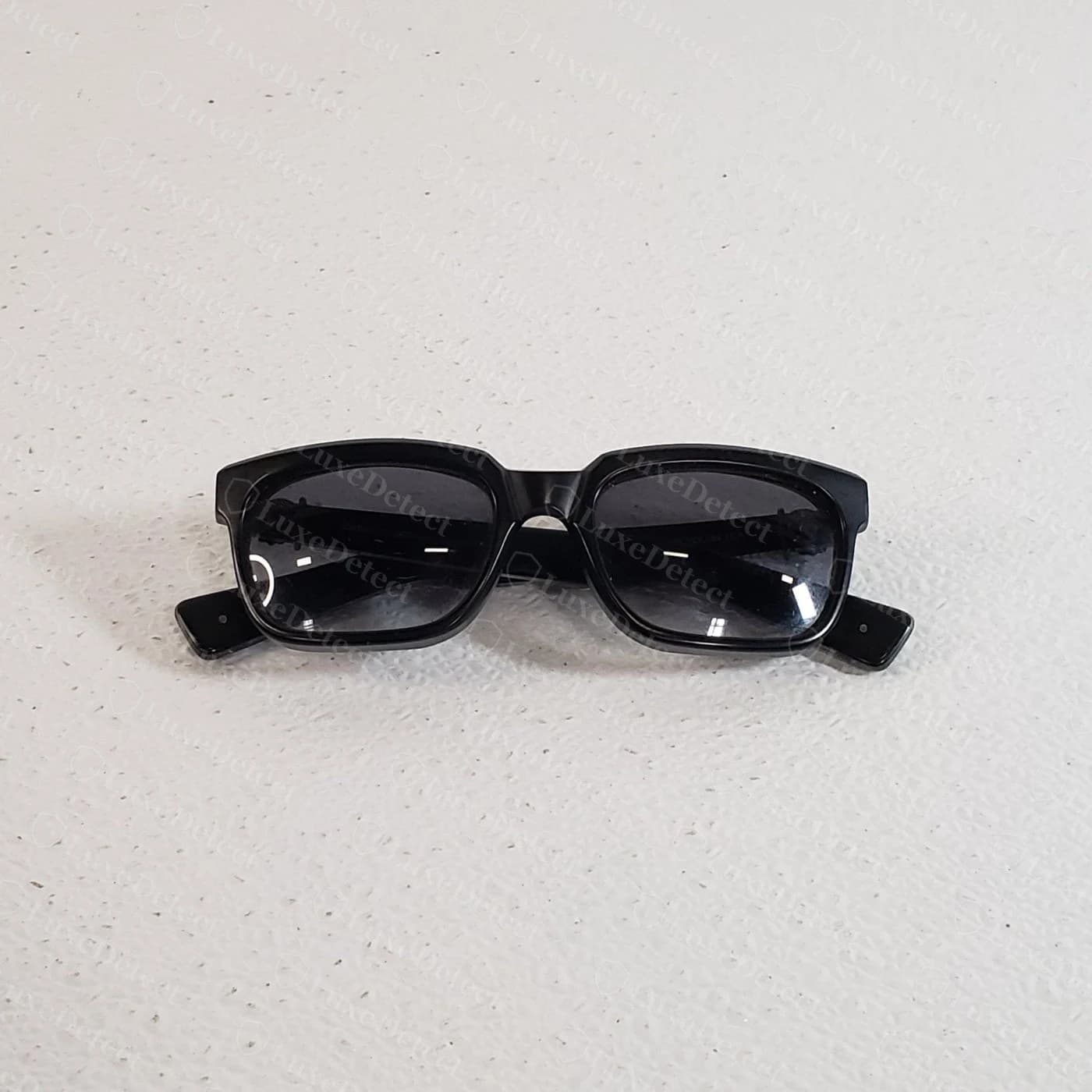
Red flag
A frame with no Chrome Hearts branding anywhere on the hardware — no cross, no cutout, no medallion at the hinge — is not a genuine pair regardless of how the silhouette looks. Every authentic model we checked carries brand hardware somewhere on the temple or hinge.
Case, Cloth, and Packaging
Genuine Chrome Hearts eyewear ships in a black leather zip case with the brand's cross-and-banner logo embossed into the leather, plus a matching branded cleaning cloth. The embossing on a genuine case is a legible, correctly spelled "CHROME HEARTS" banner flanked by small floral cross medallions, pressed cleanly into good-quality leather.
This is a weaker check than the frame markings themselves, because a case is easy to separate from its original pair and swap — a genuine case proves nothing about the glasses inside it, and a wrong or missing case doesn't prove the glasses are fake either. That said, a case with the same kind of garbled lettering seen on frame temples (one checked for this guide read as a compressed, barely legible mess where "CHROME HEARTS" should be) is a supporting red flag when it shows up alongside other issues.
Worth knowing
Treat the case and cloth as context only. A correct case does not make the glasses genuine, and a missing or mismatched case does not make them fake — verify the frame itself first.
Quick Authentication Checklist
- Read the temple wordmark under a loupe or macro photo — it must say "CHROME HEARTS" cleanly, in the brand's exact blackletter, with no garbled letters or odd spacing
- Confirm a specific model name is present, not just "sunglasses" or a bare style number
- Check the size code follows the standard lens-bridge-temple optical format
- Inspect the hinge and temple hardware for a crisply cast cross or floral motif — its total absence is disqualifying
- Look for "FRAME MADE IN JAPAN" alongside the wordmark
- Treat the case and cloth as supporting context, not primary evidence
- Remember there's no official Chrome Hearts website — any "official store" selling eyewear online is not Chrome Hearts
Two or more failures, or a garbled wordmark alone, means walk away.
When to Get a Professional Opinion
The clearest fakes fail on the wordmark alone — a misspelled or garbled "CHROME HEARTS" that's obvious once you're looking for it. The harder cases are well-built replicas that get the lettering right and copy the hardware placement convincingly; separating those from genuine pairs comes down to the precise casting quality on the hinge medallions, the exact size-code formatting, and cross-referencing the model name against what Chrome Hearts has actually released.
If it's a marketplace purchase or a private sale with no boutique receipt, get a second opinion before the money moves. LuxeDetect authenticates Chrome Hearts eyewear from $20 with a verdict and Certificate of Authenticity within 24 hours. Send macro photos of the temple wordmark, the model name and size code, every hinge and hardware detail, and the case if included.
FAQ
How can I tell if Chrome Hearts sunglasses are real?
Start with the temple wordmark: it must read "CHROME HEARTS" in the brand's exact gothic blackletter font, cleanly spaced, usually alongside "FRAME MADE IN JAPAN." Confirm a specific named model (not a generic style number) and a standard optical size code, then check that the hinges and temple tips carry crisply cast cross or floral hardware. A garbled wordmark or a complete absence of brand hardware is disqualifying on its own.
Does Chrome Hearts sell sunglasses online?
No. Chrome Hearts has no official e-commerce site and sells eyewear only through its own boutiques and a small set of authorized optical stockists. Any "Chrome Hearts official" website or online store with unlimited stock of a popular model is not a legitimate source.
What does the temple wordmark tell me?
Genuine frames carry "CHROME HEARTS" engraved or printed in the brand's exact blackletter typeface — the same font used across its jewelry hallmarks and apparel prints. Independent fakes checked for this guide misspelled it in ways only visible on close inspection ("CHROME DUPHES," "CHROJME PC·ARTS" with broken spacing), which is decisive when it happens. That said, some well-made replicas do get the wordmark right, so it's a fast first check rather than the only one.
Do all Chrome Hearts sunglasses have a model name?
Yes. Chrome Hearts names every eyewear release — Hotation, Slhoregasm, Mydixadryll, Blade Hummer, and many more — rather than selling by style number alone. A pair marketed only as "Chrome Hearts Sunglasses" with no model name anywhere on the frame is worth extra scrutiny, though a plausible-looking model name doesn't independently confirm authenticity either.
Is the case or cleaning cloth a reliable way to check authenticity?
No. A case is easy to separate from its original pair, so a correct case doesn't prove the glasses inside are genuine, and a missing or mismatched case doesn't prove they're fake. Use the case only as supporting context after checking the frame's own markings — the wordmark, model name, and hardware.