Luxury Jewelry Authentication Specialist
Authentication analyst covering the resale market, marketplace verification programs, and counterfeit trends.
Last updated September 2026 · Published July 2026 · Contact
Why Swarovski Still Gets Faked
Swarovski sits at a lower price point than fine jewelry brands, but its resale and gift-market volume makes it a frequent counterfeit target — particularly on marketplaces and street markets where buyers assume the lower price already reflects authenticity risk correctly. It often doesn't, a pattern that also shows up in APM Monaco's equally accessible price tier.
There is a second reason Swarovski authentication matters more than the price suggests. In 2021 Swarovski closed its crystal components business to outside manufacturers, ending decades in which independent jewellers legitimately used genuine Swarovski crystals in their own designs. A large volume of jewellery honestly described as "made with Swarovski crystals" still circulates on resale, and it is not counterfeit — but it is also not Swarovski-branded jewellery, and it does not carry Swarovski's hallmarks or command its resale value. Much of what buyers report as "fake Swarovski" is actually this category, mislabelled by sellers who do not know the difference.
Distinguishing the three cases — genuine Swarovski-branded jewellery, genuine crystals set by a third party, and outright counterfeit — is what this guide covers.
What to check, ranked by reliability
| Checkpoint | Reliability | What it tells you |
|---|---|---|
| Crystal Cut and Clarity | ★★★★★ | Dull refraction with no colour separation is decisive; faceting is the whole product. |
| Metal Plating and Settings | ★★★★★ | Plating that stops on the reverse exposes the base metal and the shortcut. |
| The Swan Logo and Hallmark | ★★★★★ | Catches era contradictions, but absence of a mark proves nothing on its own. |
| Packaging and Retail Tags | ★★★★★ | Boxes and tags are reproduced and sold in bulk; marginal support only. |
Crystal Cut and Clarity
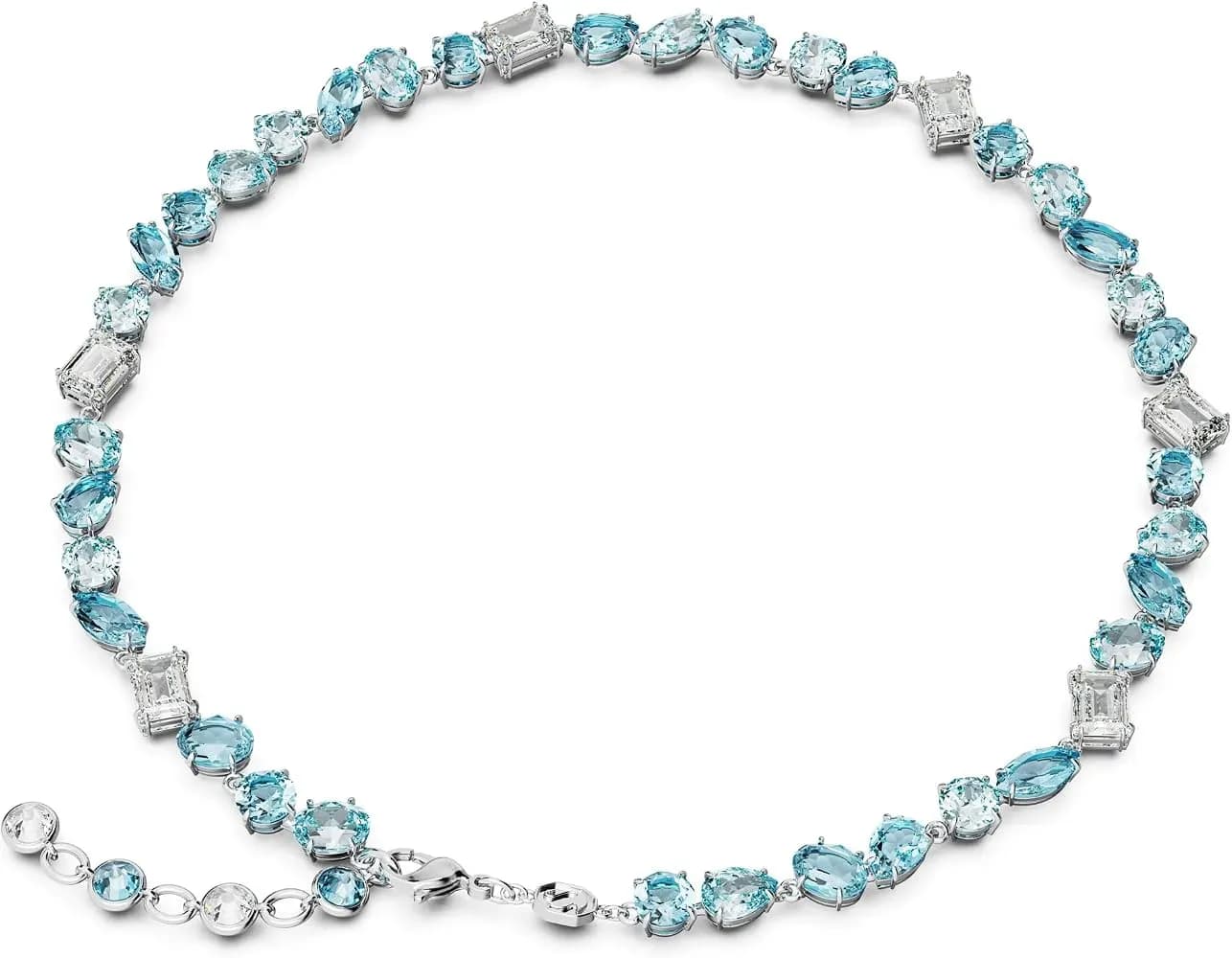
Swarovski's signature is precision faceting that produces exceptional light refraction — genuinely difficult to replicate cheaply.
Authentic crystals:
- Facets are sharp-edged and symmetrical under magnification, meeting at clean points with no rounding
- Light refracts into distinct, separated colour flashes — a true rainbow effect rather than a dull, muddy sparkle
- No visible bubbles, cloudiness, or inclusions within the crystal body
- Consistent colour and clarity across every crystal in a single piece
- The crystal feels cool to the touch and takes a moment to warm, unlike acrylic
Fake tells:
- Rounded or uneven facet edges, most visible where three facets meet at a point
- Dull, glassy sparkle without sharp refraction — the single most reliable indicator
- Visible bubbles or internal inconsistencies, which precision-cut crystal does not have
- Mismatched crystal colour or size within the same piece, indicating separately sourced stones
- Warming immediately to skin temperature, which suggests plastic rather than leaded glass
| Element | Authentic | Counterfeit |
|---|---|---|
| Facet edges | Sharp and symmetrical, meeting at clean points | Rounded or uneven, most visible where three facets meet |
| Light behaviour | Distinct separated colour flashes, true rainbow | Dull glassy shimmer with no separation |
| Body clarity | No bubbles, cloudiness or inclusions | Visible bubbles or internal inconsistency |
| Stone-to-stone match | Colour and size consistent across the piece | Mismatched stones, separately sourced |
| Thermal feel | Cool to the touch, warms slowly | Warms to skin temperature immediately (plastic) |
Red flag
A dull sparkle with no colour separation under a point light. Precision faceting is the entire product; crystal that refracts like window glass is not Swarovski, whatever the tag says.
The tilt test
Tilt the piece slowly under a single point light source. Genuine Swarovski crystal separates light into discrete colour flashes that change distinctly as the angle shifts. Cheap rhinestones and moulded glass produce a diffuse shimmer that stays broadly the same through the rotation. This test needs no magnification and works reliably in a shop or at a market stall.
The Swan Logo and Hallmark
Most genuine Swarovski jewellery carries a small stamped swan logo on the clasp, the setting, or an attached tag.
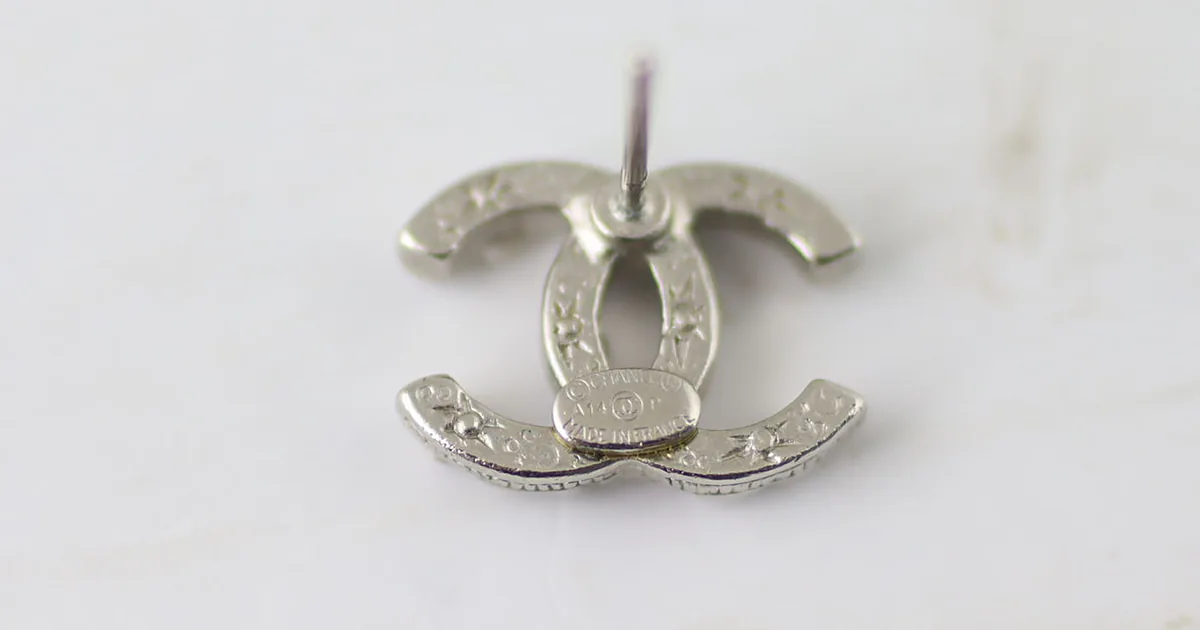
Authentic: The swan is cleanly stamped with a recognisable, symmetrical silhouette — a distinct head, a curved neck of consistent stroke width, and a defined body. Even at very small scale the outline stays crisp, the same die-wear standard our Chanel CC earrings guide applies to that house's own hallmark stamping.
Fake tells: A blurry, asymmetric, or oversimplified swan. Necks rendered too thick are the most common error, because the stamping die wears fastest at the thinnest point. A swan that reads as a generic bird shape rather than Swarovski's specific silhouette.
| Element | Authentic | Counterfeit |
|---|---|---|
| Silhouette | Distinct head, curved neck, defined body, symmetrical | Generic bird shape, asymmetric or oversimplified |
| Neck stroke | Consistent width along its length | Thickened, the commonest die-wear error |
| Edge quality | Crisp outline even at very small scale | Blurred or filled-in at the fine points |
| Era match | Edelweiss pre-1988, swan from 1989 onward | Mark contradicts the claimed production year |
Worth knowing
Absence of a swan is not proof of a fake. Small components inside a larger design often carry no mark at all. It only becomes a red flag when the model line documents a marked clasp and the mark is missing.
Era matters
Swarovski has revised its logo several times. Pieces from before 1988 carry an edelweiss flower mark rather than a swan; the swan was introduced in 1989 and has been refined since. If you are authenticating a vintage piece, compare the mark against the era the seller claims — a swan on a piece described as 1970s production is wrong, and an edelweiss on a piece described as recent is equally wrong.
Where the logo is absent
Some genuine Swarovski pieces, particularly small components within a larger design, carry no mark at all. Absence of a swan is not proof of a fake on its own — but on a piece where the model line documents a marked clasp, absence is a red flag.
Metal Plating and Settings
Swarovski jewellery commonly uses rhodium-plated or gold-plated base metal settings.
Authentic: Plating is even across every surface, including the reverse and the inner faces of settings, with no visible brassing except on genuinely well-worn pieces. Prongs holding each crystal are neat, symmetrical, and fully closed against the stone with no gaps. Settings feel substantial rather than paper-thin, and prongs resist light pressure without flexing.
Fake tells: Brassing — yellow base metal showing through — on a piece described as new. Plating that stops short on the reverse, where a counterfeiter assumed nobody would look. Prongs of uneven length or that stand away from the stone. Settings that flex under light finger pressure. Crystals that rattle or rotate in their settings.
| Element | Authentic | Counterfeit |
|---|---|---|
| Plating coverage | Even everywhere, reverse and inner faces included | Stops short on the reverse where nobody looks |
| Brassing | None on a piece sold as new | Yellow base metal showing at edges of a "new" piece |
| Prongs | Symmetrical, fully closed against the stone | Uneven length, standing away from the stone |
| Rigidity | Settings resist light finger pressure | Flex or bend under light pressure |
| Stone seating | No movement whatever | Crystals rattle or rotate in place |
Red flag
Plating that stops on the reverse. Genuine settings are plated as a whole component, so an unplated back is a shortcut only a counterfeiter takes, and it exposes the base metal underneath.
Adhesive
Authentic: Where crystals are glued rather than prong-set — common in pavé designs — adhesive is invisible, with no residue at the stone perimeter.
Fake tells: Visible glue at the crystal edges, cloudy adhesive under the stone, or crystals sitting at slightly different heights within a pavé field.
Packaging and Retail Tags
Genuine Swarovski jewellery ships in branded packaging with a hangtag carrying the swan logo and consistent typography.
Authentic: Print quality on tags is sharp and evenly inked, with correct typeface and spacing. Box construction is clean, with even edges and no visible adhesive. Certificate cards, where included, match the piece's model reference.
Fake tells: Slightly blurred or off-colour tag printing. Typography that is close but not exact — spacing errors are more common than letterform errors. Boxes with visible glue or uneven edges.
| Element | Authentic | Counterfeit |
|---|---|---|
| Tag print | Sharp, evenly inked, correct typeface | Slightly blurred or off-colour |
| Typography | Exact spacing and letterforms | Close but not exact; spacing errors most common |
| Box construction | Clean even edges, no visible adhesive | Visible glue, uneven edges |
| Certificate card | Model reference matches the piece | Missing, or references a different model |
| What it proves | Marginal support only | Nothing on its own |
Worth knowing
Packaging is the cheapest element to reproduce and is sold separately in bulk. Correct packaging raises confidence marginally and never settles the question. Authenticate the piece, not the box.
Quick Authentication Checklist
- Crystal: sharp symmetrical facets, distinct separated colour flashes under a tilt test, no bubbles or cloudiness
- Consistency: matched colour and size across every stone in the piece
- Swan logo: clean symmetrical silhouette, correct for the claimed production era
- Plating: even coverage including the reverse, no brassing on a claimed-new piece
- Settings: symmetrical closed prongs, substantial feel, no stone movement, no visible adhesive
- Packaging: sharp print, correct typography — supporting evidence only
Two or more failures means walk away. A single failure on crystal refraction, or plating that stops on the reverse, is on its own sufficient.
When to Get a Professional Opinion
Swarovski is the one brand in this series where the honest answer is usually don't bother. A standard piece often trades below the cost of authenticating it, and the tilt test plus a look at the plating will settle most of what you need to know in under a minute.
It becomes worth paying for in three cases: discontinued collections and designer collaborations trading well above original retail, vintage pieces where the era of the mark is the whole question, and bulk resale purchases where checking one sample validates a batch. In those cases our jewelry specialists authenticate from photos, from $30 for 24-hour turnaround, with a Certificate of Authenticity — the same service covers pieces like the Vivienne Westwood Orb.
The more common problem is not counterfeiting at all. If a seller describes a piece as "made with Swarovski crystals", they are telling you it is a third-party design containing genuine crystal, not Swarovski jewellery. That is legitimate, and it is worth a fraction of what a marked Swarovski piece is. Read the wording before you read the price.
FAQ
Is fake Swarovski jewellery common on resale platforms?
Yes. The accessible price point means buyers are often less cautious than they would be with fine jewellery, which makes it an appealing category for counterfeiters selling low-grade crystal jewellery as genuine Swarovski. Volume is high and scrutiny is low — a combination counterfeiters actively seek.
Does the swan logo style change over time?
Yes. Pieces before 1988 carry an edelweiss mark; the swan arrived in 1989 and has been refined since. Compare the specific mark against the era the seller claims, since a logo style inconsistent with the stated production year is a straightforward red flag.
How can I tell Swarovski crystal from cheap rhinestones without magnification?
Tilt the piece under a single light source. Genuine crystal produces distinct, sharply separated colour flashes as it moves. Cheap rhinestones and moulded glass show a duller, diffuse sparkle without that separation. Touch also helps — leaded crystal stays cool against the skin longer than acrylic.
What does "made with Swarovski crystals" actually mean?
It means a third-party manufacturer legitimately purchased genuine Swarovski crystal components and set them in their own design. Until Swarovski closed its components business in 2021, this was a large and entirely legitimate market. Such pieces contain real Swarovski crystal but are not Swarovski-branded jewellery, carry no swan hallmark, and do not command Swarovski's resale value. Sellers frequently blur this distinction.
Is it worth professionally authenticating Swarovski?
For a single standard piece, rarely — the item value often sits below the cost of authentication. It becomes worthwhile for discontinued collections, designer collaborations, and vintage pieces trading well above original retail, and for bulk resale purchases where verifying a sample validates a batch.