Watch Authentication Specialist
Watch authentication specialist. Focuses on movement inspection, case finishing, and serial verification.
Published September 2026 · Contact
Why Tudor Fakes Cluster Around a Few Model Names
Tudor sits in an odd spot for counterfeiters. It carries the Rolex-adjacent shield logo and "Geneve" signature, which makes the name recognisable, but the catalogue is smaller and less continuously in production than Rolex's, so a counterfeiter can't run one universal fake and expect it to pass for every reference. In practice, fakes concentrate on a short list of Tudor names that buyers already know: the Pelagos dive watch, the discontinued Grantour Chrono, and the vintage-styled Prince Date. Three completely different watches, one shared weakness.
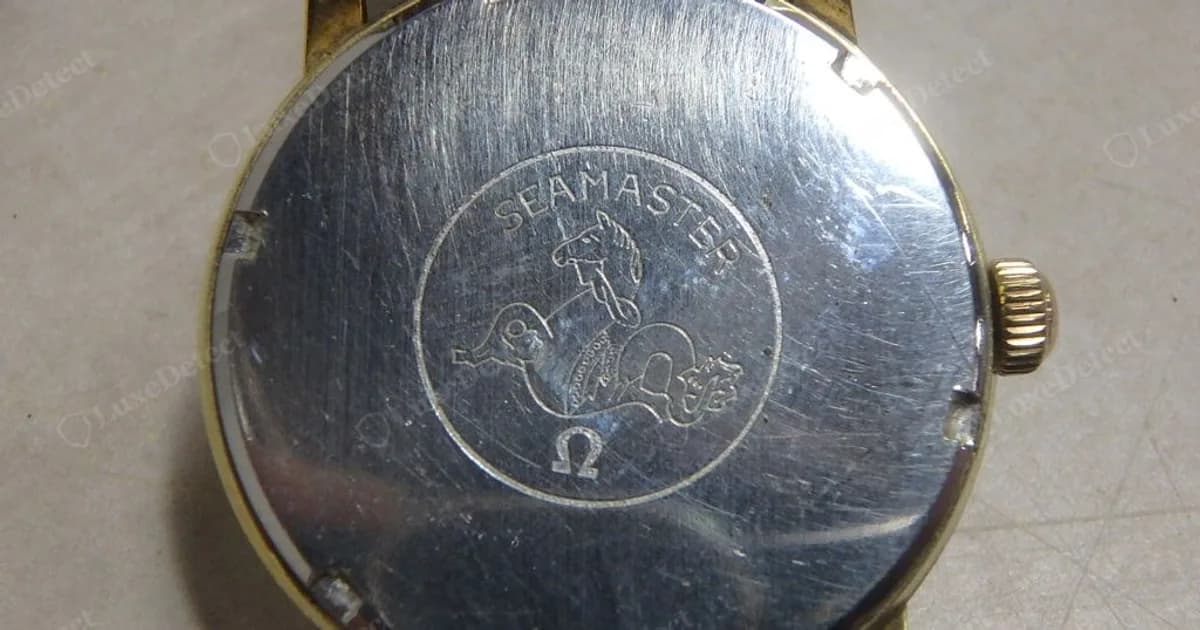
The dial on all three is usually the fake's strongest point. Printing "TUDOR GENEVE," a shield, and a model name onto a disc is cheap and can be done well. The caseback is where the pattern breaks down. A caseback is a machined, engraved piece of steel, and every one of these fakes we've seen reuses a generic, shallow-cut plaque, sometimes the exact same one on watches that are supposed to be a chronograph, a dive watch, and a dress watch. That mismatch between a convincing dial and a generic caseback is the throughline of this guide.
Because the three models look nothing alike, this guide is organized around each one individually rather than one universal checklist. If you know which model you're looking at, jump straight to its section. If you're not sure, the caseback tells still apply across all three.
What to check, ranked by reliability
| Checkpoint | Reliability | What it tells you |
|---|---|---|
| 1. The Caseback: Engraving Depth Is the Tell Across All Three Models | ★★★★★ | Shallow, uneven engraving and coarse brushing catches every fake in our sample regardless of model. |
| 3. Grantour Chrono: Subdial Layout and the Red Accent Hand | ★★★★★ | A stepping quartz seconds hand on a watch sold as a mechanical Grantour Chrono is decisive on its own. |
| 2. Pelagos: Dial Printing and the Calibre Manufacture Caseback | ★★★★★ | Correct dial wording is easy to copy; case material and caseback engraving quality carry more weight. |
| 4. Prince Date: The Dress Watch Fakes Get Confident About | ★★★★★ | Stone setting quality helps, but caseback wording for this long-running vintage line is not fully verifiable. |
| Model Reference Before You Start | ★★★★★ | Confirms which of the three model lines you're looking at; will not catch a good fake of that model. |
Model Reference Before You Start
Confirm which watch you actually have in front of you. Tudor's naming gets flattened in resale listings ("Tudor watch," "Tudor diver") in a way that hides which specific model, and which era, you're evaluating.
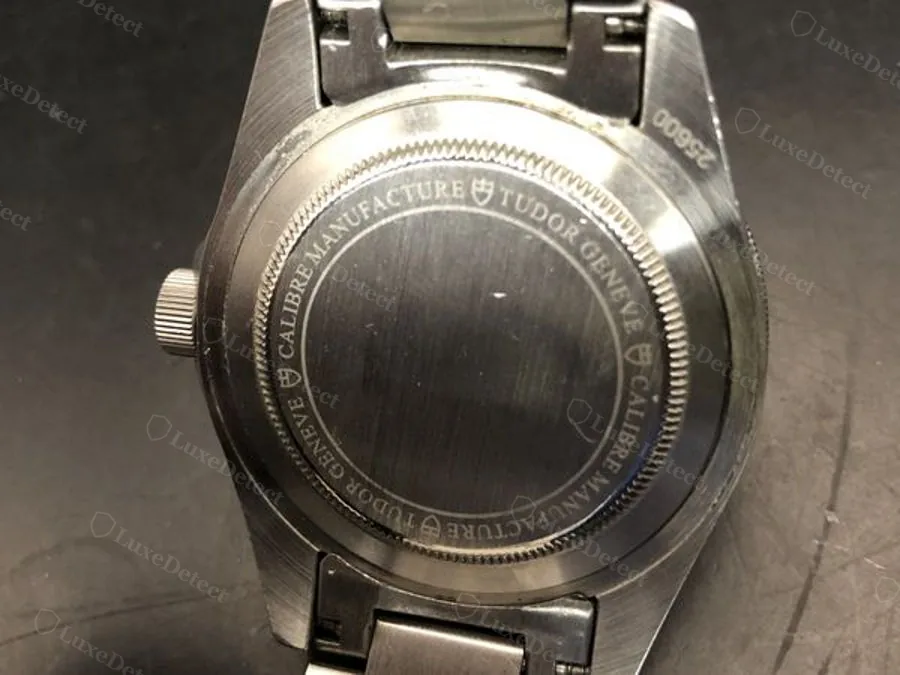
- Pelagos — modern titanium or steel dive watch, matte blue or black dial, printed "PELAGOS" beneath the shield logo, in-house Calibre Manufacture movement, screw-down caseback engraved "CALIBRE MANUFACTURE TUDOR GENEVE" with a reference number (25600 for the steel Pelagos).
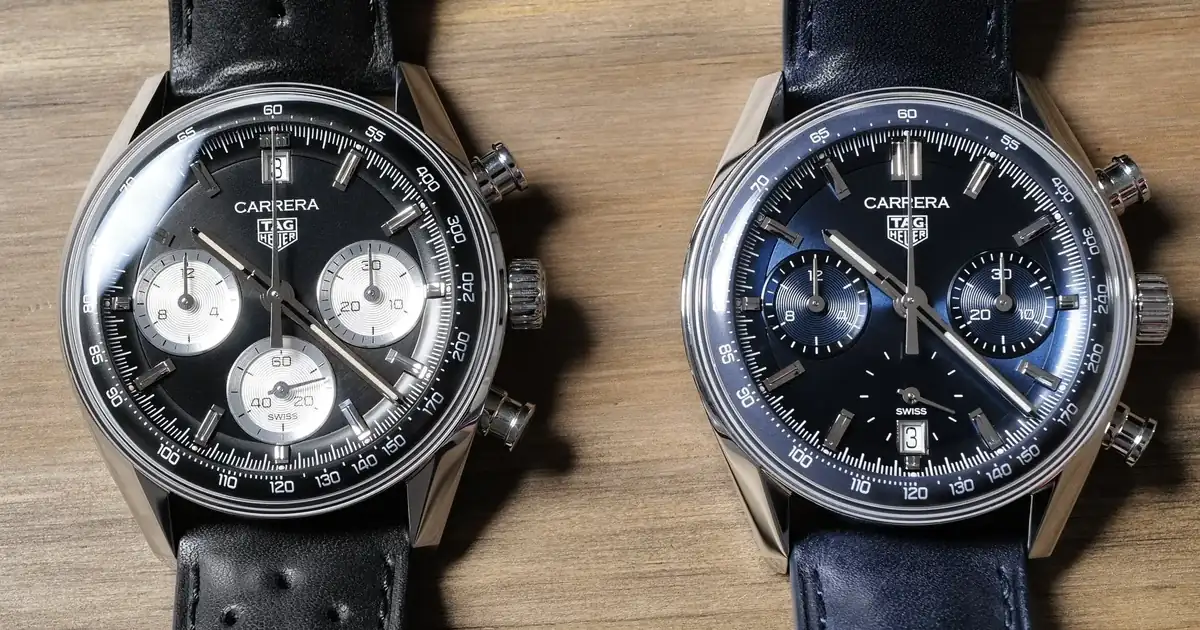
- Grantour Chrono — discontinued chronograph (produced roughly 2010-2016), three-subdial layout, pentagon-shaped hour markers, available in black or white dial with a red accent hand. Ref. 20300.
- Prince Date — vintage-to-1990s dress watch line, dial reads "TUDOR PRINCE DATE," fluted bezel, diamond or baton hour markers, date window at 3 o'clock, self-winding rotor movement.
These are not the only Tudor models counterfeited, but they are the three this guide is built around, because they're the three we have verified fake examples of. If you're holding a different Tudor reference (Black Bay, Submariner-era Oyster Prince, Ranger), the caseback and printing checks below still apply as general Tudor tells, but treat the model-specific dial details as reference points only, not a checklist for your watch.
The Caseback: Engraving Depth Is the Tell Across All Three Models
This is the single most reliable check across every Tudor fake we've examined, regardless of which model the dial is copying, because a caseback is expensive to tool correctly and cheap to fake badly.
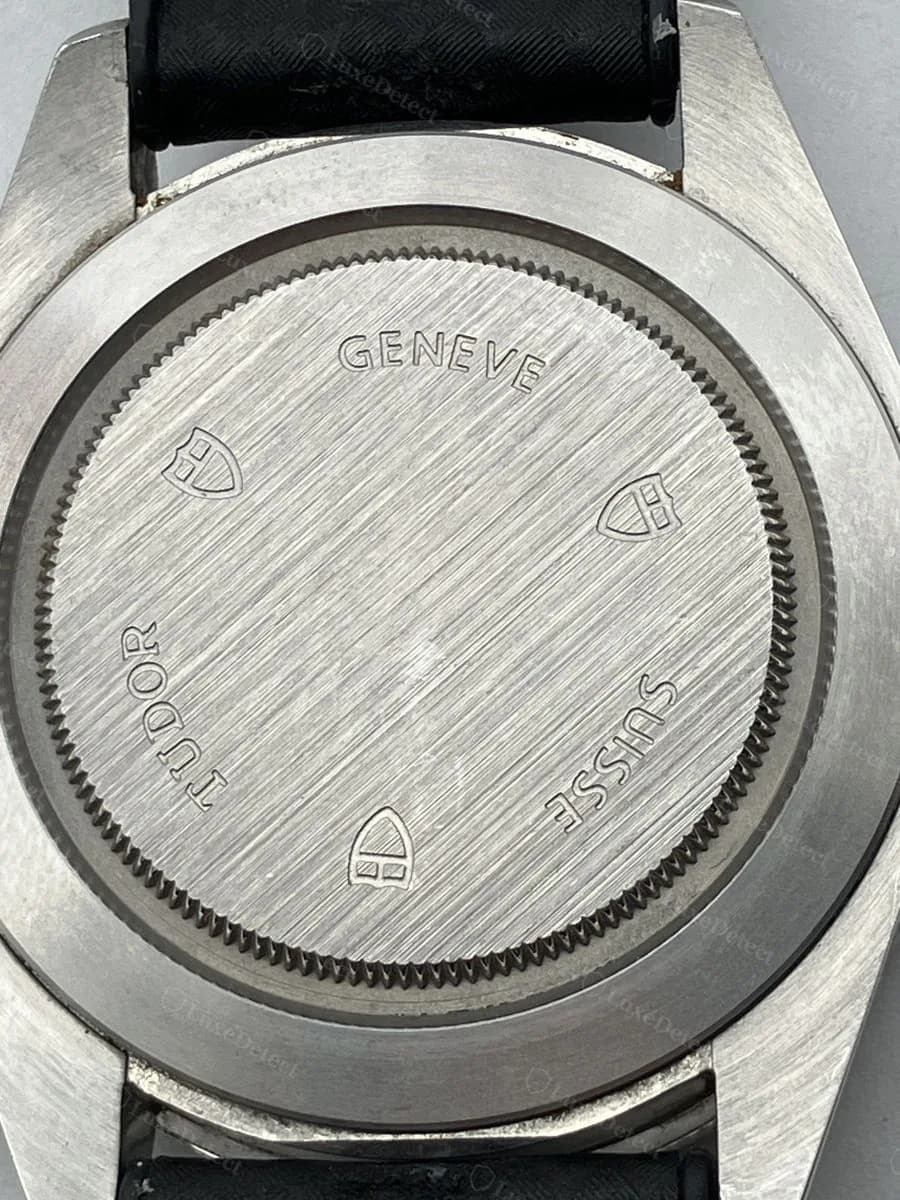
A genuine Tudor caseback is machined and stamped, not just engraved as an afterthought. The circular brushing radiates cleanly from the center, the lettering ("TUDOR," "GENEVE," "SUISSE," or "CALIBRE MANUFACTURE TUDOR GENEVE" on newer in-house models) sits at a consistent, shallow-but-crisp depth, and the small shield logos stamped between the words are sharp-edged, not soft or rounded.
On the fakes we've examined, the caseback text is present and spelled correctly, which is exactly why this check gets skipped, but the engraving is shallow and slightly uneven in depth from letter to letter, and the brushed finish underneath it looks like a single pass rather than the fine, consistent radial brushing of a genuine case. On the Pelagos fake, a plausible reference number ("25600," a real Pelagos reference) is engraved along the lug, which is a level of research effort that makes the caseback text alone unreliable as a check, you need to look at the *quality* of the engraving, not just whether the right words are there.
| Element | Authentic | Counterfeit |
|---|---|---|
| Brushed finish | Fine, consistent radial lines from center | Single coarse pass, or visibly uneven |
| Engraving depth | Even depth across every character | Shallow, and depth varies letter to letter |
| Shield logo stamps | Sharp edges, consistent size | Slightly soft or rounded edges |
| Reference number (if present) | Laser-fine, consistent stroke width | Can be accurate but often slightly heavier or uneven stroke |
Red flag
Correct caseback text is not the same as a correct caseback. A plausible reference number and correctly spelled "TUDOR GENEVE SUISSE" text is not sufficient on its own — every fake in our sample got the wording right and failed on engraving quality and brushing consistency instead.
Pelagos: Dial Printing and the Calibre Manufacture Caseback
The Pelagos is Tudor's flagship dive watch, and it's also the fake we've seen with the most careful dial work, because a matte dive dial is one of the easier finishes to replicate convincingly in a photo.
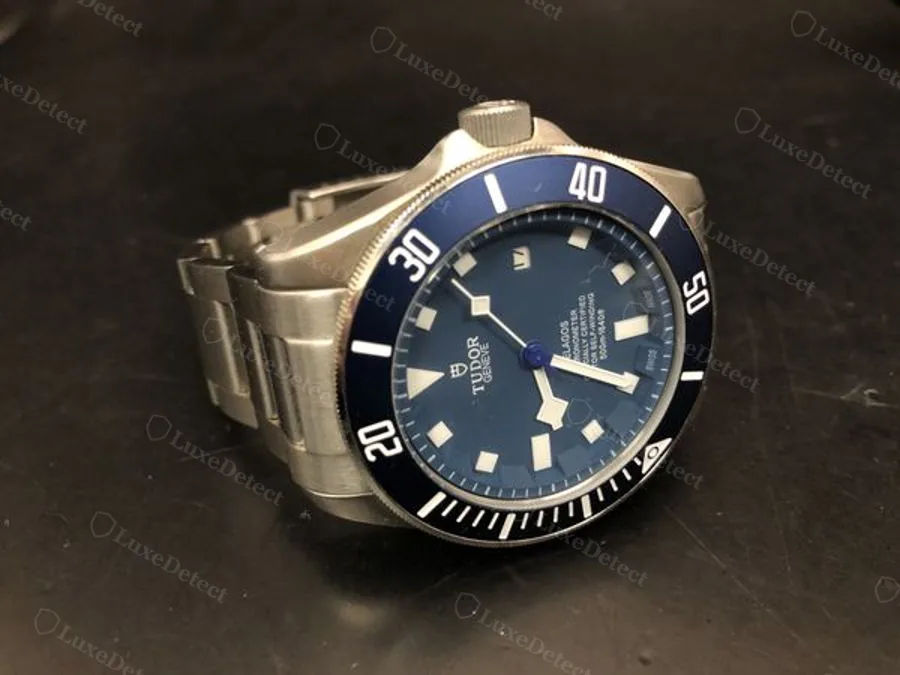
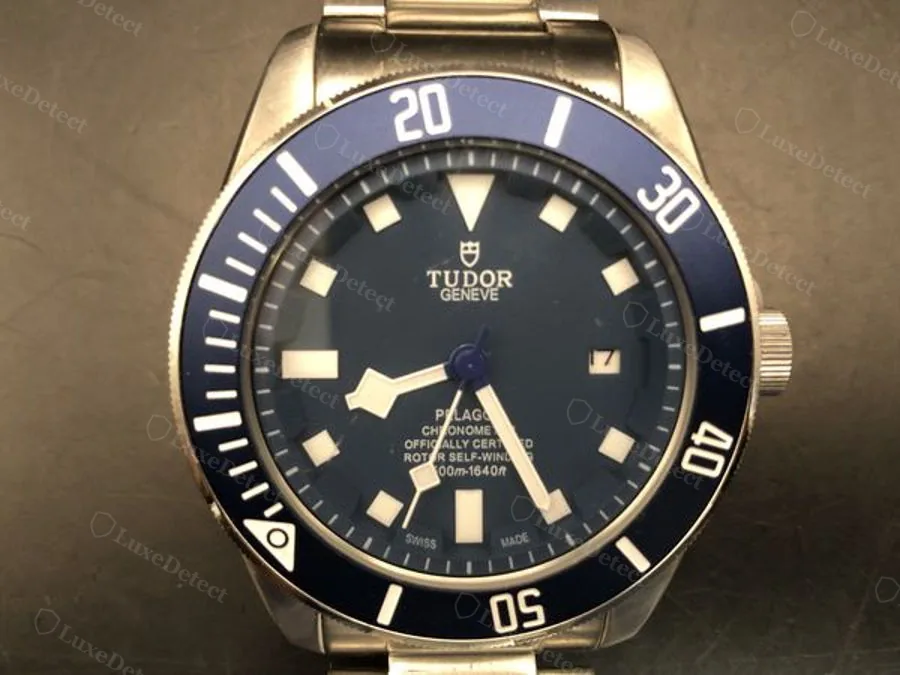
The dial text on a genuine Pelagos reads, in order beneath the shield: "TUDOR / GENEVE," then "PELAGOS," then "CHRONOMETER OFFICIALLY CERTIFIED," then "ROTOR SELF-WINDING," then "500m-1640ft." Every line has to be present, correctly spaced, and legible without the letters bleeding into each other under magnification. The fake we examined got the wording right, which tells you dial text alone won't separate a good fake from a genuine piece; you need the caseback and bracelet in addition.
The Pelagos's defining engineering feature is its titanium case and its in-house Calibre Manufacture movement (on modern references), reflected in the caseback text "CALIBRE MANUFACTURE TUDOR GENEVE." A steel case where the listing or seller claims "titanium" is an immediate red flag unrelated to any printing check; weigh it if you can. A steel Pelagos will weigh noticeably more than a titanium one of the same case size.
| Element | Authentic | Counterfeit |
|---|---|---|
| Case material | Titanium (modern Pelagos) or steel, matches listing | Sometimes steel dressed up as titanium claims |
| Dial text order | Shield, TUDOR GENEVE, PELAGOS, certification line, depth rating | Present but check spacing/kerning under magnification |
| Bezel action | Firm, unidirectional, crisp click | Loose, mushy, or reverses freely |
| Caseback engraving | Calibre Manufacture text, fine and even depth | Shallower, less even depth (see check 1) |
Worth knowing
A correct depth rating and certification line on the dial confirms the counterfeiter did their homework, not that the watch is genuine. Dial text is the easiest thing on this watch to copy correctly; treat it as a starting point, not a verdict.
Grantour Chrono: Subdial Layout and the Red Accent Hand
The Grantour Chrono was discontinued years ago, which is exactly why it shows up as a fake: a discontinued model has no current retail price to compare against, so a seller can claim almost any price and a buyer has no recent reference point to sanity-check it.
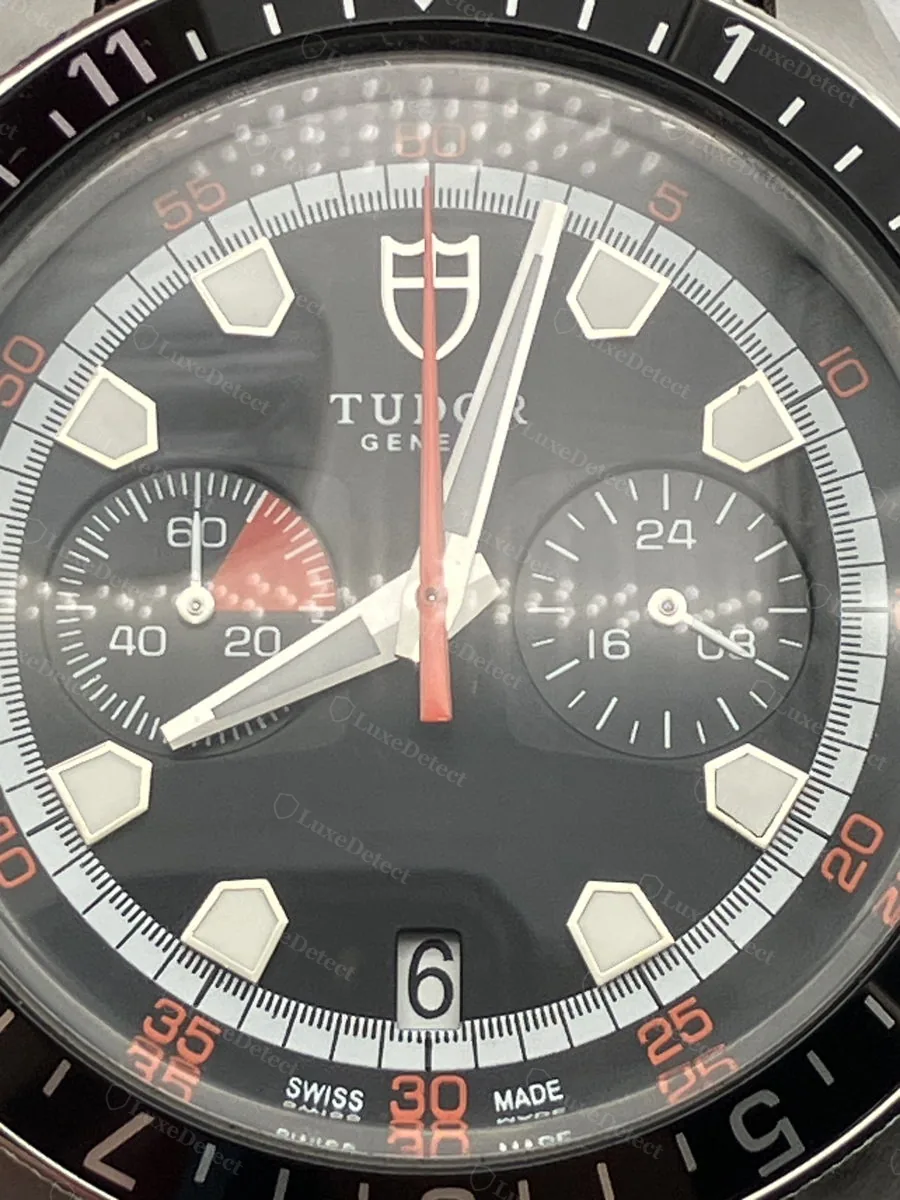
The genuine Grantour Chrono dial has two sub-registers (a 60-minute counter at 9 o'clock, a 24-hour counter at 3 o'clock), pentagon-shaped luminous hour markers, and a red accent on the central chronograph seconds hand. It was produced in black and white dial colorways, both with the same layout. We've examined fakes of both colorways, and the subdial and marker geometry was copied closely on both.
The place a fake Grantour tends to slip is the chronograph pushers and crown action. A genuine Grantour uses a modified ETA/Valjoux-based chronograph movement with a firm, defined click when you start, stop, and reset the chronograph. A fake quartz chronograph movement (common in replicas of discontinued mechanical models, since a convincing automatic chronograph movement is expensive to source) will have pushers that move the subdial hands instantly rather than the sweeping motion of a mechanical reset, and the seconds hand ticks in discrete steps rather than sweeping continuously.
| Element | Authentic | Counterfeit |
|---|---|---|
| Movement type | Mechanical chronograph, sweeping seconds hand | Often quartz; seconds hand ticks rather than sweeps |
| Pusher action | Firm, defined click, hands sweep to zero on reset | Loose, or hands jump instantly to zero |
| Hour markers | Pentagon shape, crisp edges, even lume fill | Pentagon shape often close, but edges softer |
| Caseback | Flat stamped plaque, TUDOR GENEVE SUISSE, even engraving | Same wording, shallower/uneven engraving (see check 1) |
Red flag
Watch the seconds hand for one full rotation. A stepping, ticking seconds hand on a watch sold as a mechanical Grantour Chrono means it is running a quartz movement, which ends the inspection on its own — no genuine Grantour Chrono has a quartz movement.
Prince Date: The Dress Watch Fakes Get Confident About
The Prince Date is a vintage-to-1990s self-winding dress watch, and it's the model where fakes lean hardest on "it's old, so nobody has current photos to compare it to." Don't let the vintage framing lower your guard; the checks are the same.
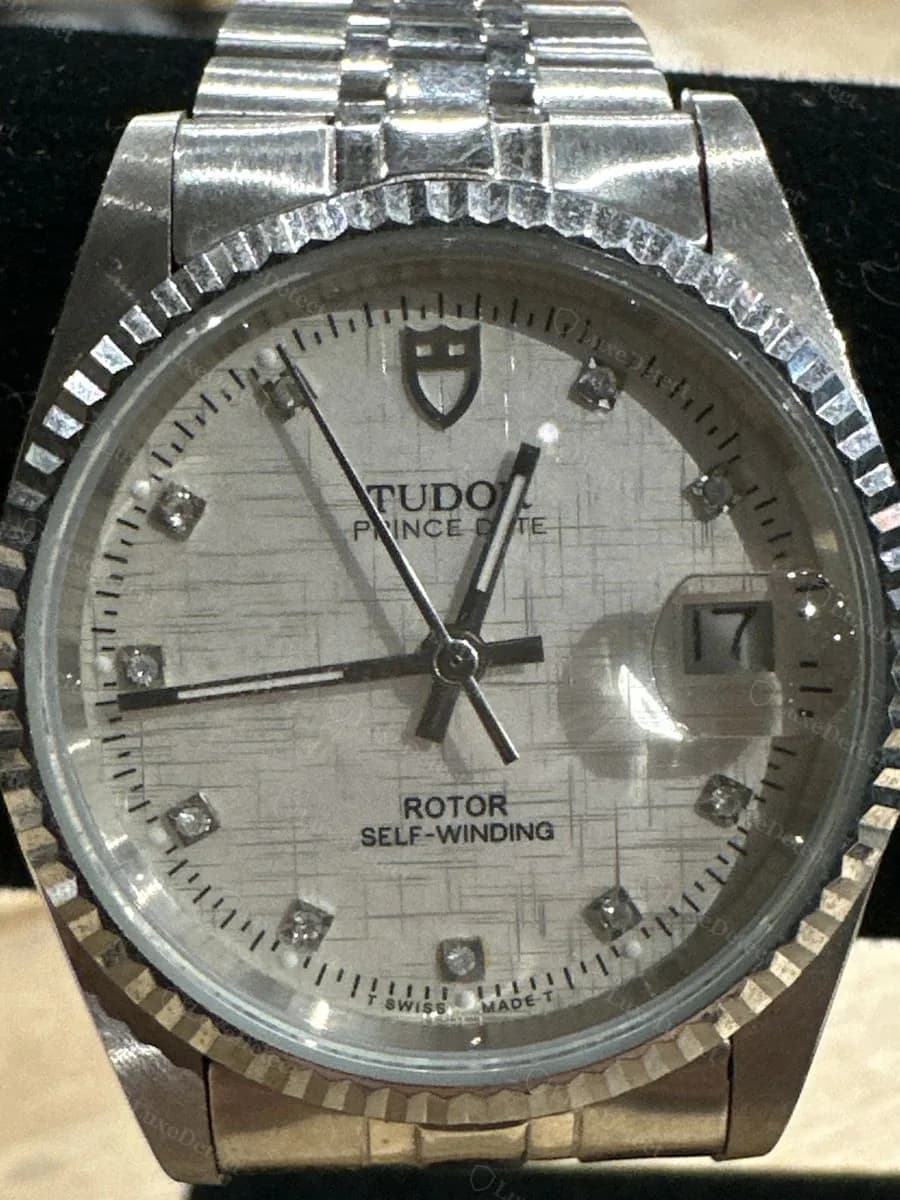
The dial text reads "TUDOR / PRINCE DATE" beneath the shield, followed by "ROTOR / SELF-WINDING" lower on the dial, with a date window at 3 o'clock. Genuine examples use applied baton or diamond hour markers set with real stones on the higher trims; loose-set or crooked stones, or stones set proud enough to catch on a fingernail, are a workmanship tell no legitimate manufacturer would ship.
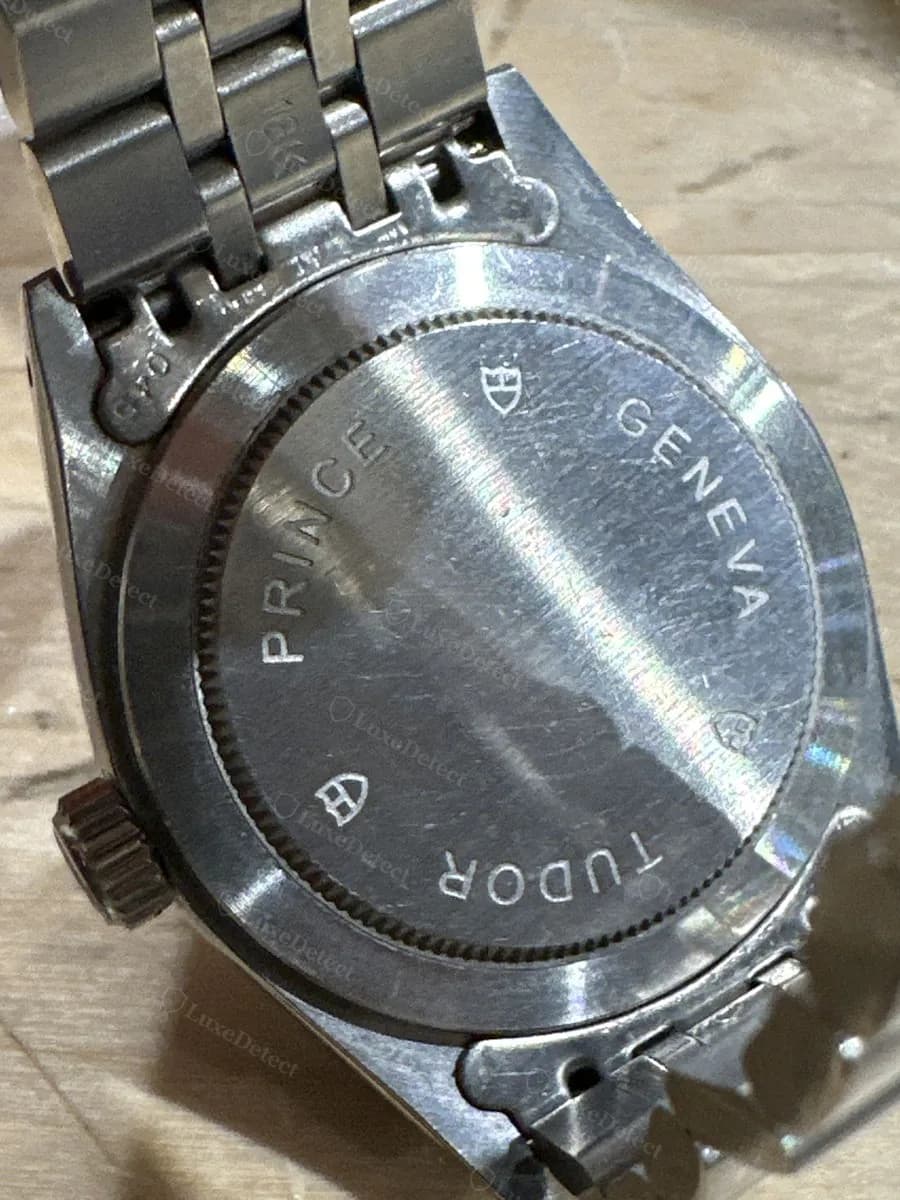
The caseback on the fakes we examined reads "PRINCE / GENEVA / TUDOR" arranged around the edge. That is close to genuine Tudor case-back language for this era, but pay attention to word choice and order rather than assuming any plausible-sounding arrangement is correct: a real Prince Date case-back from this era is more commonly marked with the full "Oyster Prince" case designation somewhere on the back or the movement, not "Prince" standing alone. Treat a bare "PRINCE" caseback as a prompt to look closer at everything else, not as a standalone red flag; we can't confirm every case-back variant Tudor used across this line's long production run, so this is a note, not a verdict.
| Element | Authentic | Counterfeit |
|---|---|---|
| Hour markers | Applied, flush-set stones on jeweled trims | Loose, crooked, or proud-set stones |
| Fluted bezel | Even, sharp flutes, consistent width | Flutes can look close but check depth consistency |
| Date window | Centered numeral, flush crystal, no magnification unless specified | Off-center numeral, or numeral sits too deep/shallow |
| Caseback wording | Varies by era; verify against the specific reference, not assumption | "PRINCE" alone, unverified against reference (see note) |
Worth knowing
We examined two separate Prince Date fakes with the same caseback wording and dial layout, which tells you this is a template a counterfeiter is reusing, not a one-off. Consistency across multiple fakes is itself a signal that a specific fake template exists for this model — worth knowing if you're comparing against other listings, not just the watch in hand.
Where This Guide Is Limited
This guide is built from five confirmed-fake Tudor watches in our archive: two Grantour Chronos (one black dial, one white dial), one Pelagos, and two Prince Dates. That's a real, if small, sample, and it's why the guide is organized around exactly these three models rather than Tudor as a whole. We do not have a verified authentic example of any of these three specific models in our own photo archive to run a direct side-by-side against; the authentic Tudor pieces we hold on file are vintage Oyster and Oyster Prince models plus a Black Shield chronograph, none of which are the same reference. Where this guide states a specific authentic detail (dial text order, caseback engraving standard, movement behavior), it's drawn from Tudor's own published specifications and general watchmaking construction standards, not from a matched photo pair. If you're authenticating a Pelagos, Grantour Chrono, or Prince Date and want a second opinion against real comparison data, that's exactly the gap our verification service is built to close.
Quick Authentication Checklist
- Identify the specific model and reference before you check anything else; the three fake clusters in this guide look nothing alike.
- Examine the caseback engraving depth and brushing consistency under strong light, not just the wording (check 1).
- For a Pelagos: confirm case material (titanium vs. steel) and the Calibre Manufacture caseback text.
- For a Grantour Chrono: watch the seconds hand for a full rotation to confirm a mechanical sweep, not a quartz tick.
- For a Prince Date: check that any set stones sit flush, and don't take a bare "PRINCE" caseback marking as confirmation on its own.
- Weigh the watch if you can; a case claimed as titanium that weighs like steel is a fast disqualifier.
Any single failure on the caseback engraving check (1) or the Grantour movement check (3) is sufficient on its own to reject the watch. A failure on dial text alone is not, since dial printing is the easiest of these elements for a counterfeiter to get right.
When to Get a Professional Opinion
Dial printing on Tudor fakes has gotten good enough that judging a listing from photos alone is genuinely hard, especially for the Prince Date, where "it's vintage" gives a seller cover for wear, patina, and case-back variation that would otherwise raise questions. The caseback engraving-quality check in this guide requires either the watch in hand or a very sharp macro photo lit to show brushing texture, which most listing photos don't provide.
If you're buying sight unseen or the seller can't provide macro shots of the caseback and movement, LuxeDetect's watch authentication starts at $45 for a 24-hour turnaround (up to $110 for 30-minute service), and includes a Certificate of Authenticity you can use to resell or insure the piece with confidence.
FAQ
How can I tell a real Tudor from a fake by the caseback alone?
Look at the engraving depth and the brushed finish, not just the wording. Genuine Tudor casebacks have even engraving depth across every character and fine, consistent radial brushing from the center. Fakes we've examined get the text right, "TUDOR," "GENEVE," "SUISSE," or the Calibre Manufacture wording, but the engraving is shallower and less even, and the brushing looks like a single coarse pass rather than fine radial lines.
Is the Tudor Grantour Chrono still made?
No, the Grantour Chrono (ref. 20300) was discontinued years ago, which is part of why it gets counterfeited: there's no current retail price to check a listing's asking price against. If you're offered one, verify the movement is mechanical (a sweeping seconds hand, not a stepping tick) and check the caseback engraving quality as described in this guide.
What does the Tudor Pelagos caseback say?
A genuine modern Pelagos caseback reads "CALIBRE MANUFACTURE TUDOR GENEVE" with a reference number (25600 for the steel Pelagos) engraved along the case. Correct wording alone doesn't confirm authenticity; check the engraving depth and, if possible, the case weight against titanium or steel depending on what the listing claims.
Why is the Tudor Prince Date harder to authenticate than modern models?
It's a discontinued line with a long production run and case-back variations across eras, so there isn't one single "correct" caseback template to check against the way there is for a current-production watch. Focus on workmanship quality, flush-set stones, sharp fluting, centered date window, rather than assuming any specific caseback wording is definitively right or wrong.
Does a correct shield logo and "TUDOR GENEVE" signature mean the watch is genuine?
No. Every fake we examined for this guide had a correctly spelled, reasonably well-placed shield logo and "TUDOR GENEVE" text. That text is cheap to reproduce accurately. The caseback engraving quality and, on the Grantour, the movement behavior are what actually separate these fakes from genuine pieces.
Can I authenticate a Tudor watch from photos alone?
Often, yes, for the checks in this guide that don't require handling the watch: dial text and layout, hour marker shape, bezel condition. The caseback engraving-quality check and confirming a mechanical versus quartz movement are harder to judge from a typical listing photo and are where a professional opinion earns its keep.
Are all Tudor fakes copying discontinued models?
No, but discontinued or vintage models (Grantour Chrono, Prince Date) show up disproportionately in our sample, likely because there's no current retail price for a buyer to sanity-check against. Current-production models like the Pelagos are also faked, but a buyer has an easier time comparing against official pricing and current photos.