Watch Authentication Specialist
Watch authentication specialist. Focuses on movement inspection, case finishing, and serial verification.
Last updated October 2026 · Published July 2026 · Contact
Why the MoonSwatch Gets Faked
The Omega x Swatch "MoonSwatch" collaboration reimagines Omega's Speedmaster Moonwatch in Swatch's proprietary Bioceramic material, across 11 solar-system-themed colorways (Mercury, Venus, Earth, Mars, Jupiter, Saturn, Uranus, Neptune, Pluto, Sun, and Moon), plus later special editions. It retailed for roughly $260 but sold out within hours of its March 2022 launch, and resale prices spiked well above retail — especially for the colorways that were hardest to get at launch.
Where resale premium exists, counterfeits follow. MoonSwatch fakes range from obviously wrong to genuinely convincing, but the Bioceramic material, Swatch movement, and specific construction details give you clear, checkable tells.
What the MoonSwatch Is — and Is Not
Before authenticating, get the framing right: the MoonSwatch is a Swatch product, not an Omega product. It uses a Swatch Bioceramic case, a Swatch quartz movement, and Swatch manufacturing standards. It borrows the Speedmaster's design language — the case shape, sub-dial layout, tachymeter bezel — but contains no Omega components.
This matters for authentication because:
- Looking for an Omega movement inside is the wrong test — it should be a Swatch quartz movement
- Finishing standards are Swatch-appropriate, not Omega's co-axial chronometer standards
- The price paid and the watch received should both reflect that reality
Fakes typically try to pass as a genuine MoonSwatch (the case this guide addresses) rather than as an actual Omega Speedmaster, since the price gap between a $260 MoonSwatch and a $7,000+ Speedmaster is too large to plausibly misrepresent.
Bioceramic Case — The Primary Material Tell
Swatch's Bioceramic is a proprietary material, roughly two-thirds ceramic powder and one-third bio-sourced plastic, with specific tactile and visual properties.
Weight: Bioceramic is lighter than steel but heavier than standard ABS plastic. A genuine MoonSwatch should feel substantive in the hand — noticeably lighter than a steel Speedmaster, but not hollow or toy-like.
Texture: The surface has a matte-smooth finish — not glassy like polished metal, not grainy like ceramic tile, and not hollow-feeling like cheap plastic.
Color consistency: Each colorway's pigment runs through the material, not just on the surface. A chip or scratch on a genuine MoonSwatch reveals the same color underneath. A chip on a fake often reveals white or grey base plastic with color only on the surface layer.
Scratch resistance: Bioceramic is a ceramic-and-plastic blend and it scuffs like one, so do not use a scratch test to judge it: a mark proves nothing either way and you could damage the watch. Weight, feel and what a chip reveals are the safer checks.
Dial and Sub-Dials
The MoonSwatch dial mirrors the Speedmaster's tri-compax layout — three sub-dials (running seconds, 30-minute counter, 12-hour counter) plus the central chronograph hands.
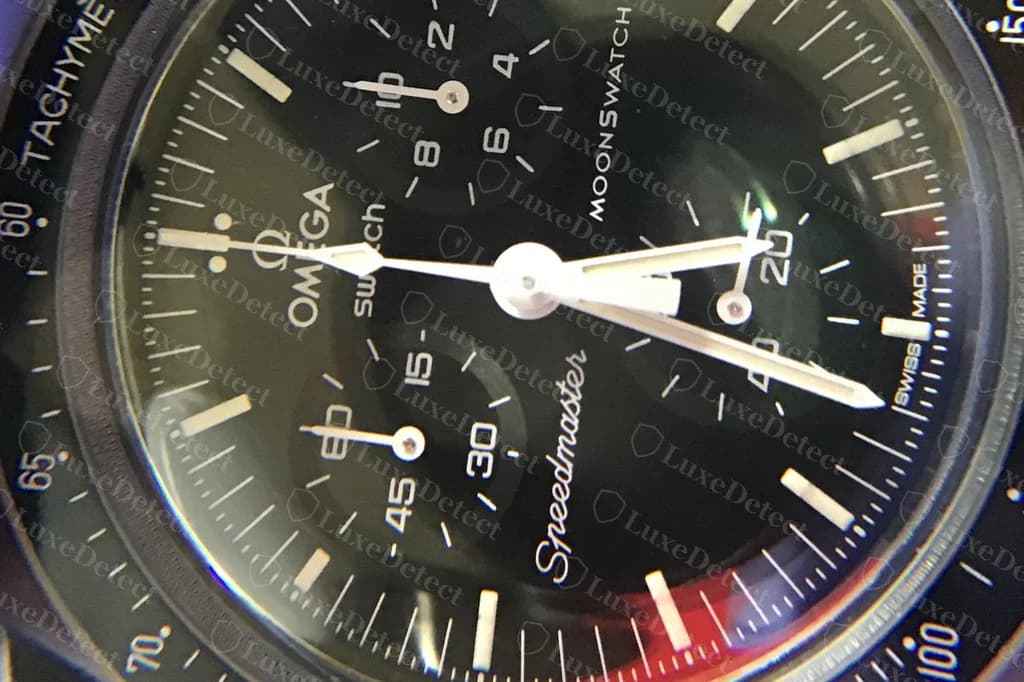
Text quality: "SWATCH" and "OMEGA" branding both appear on the dial in specific positions and font weights. Text should be crisp and sharply printed under magnification. Fakes frequently show slightly blurred text or an incorrect font weight, especially on the smaller sub-dial text.
Sub-dial alignment: All three sub-dials should be evenly spaced and perfectly aligned to the dial's vertical/horizontal axes. Misaligned or unevenly sized sub-dials indicate a lower-quality reproduction.
Colorway-to-case match: Each of the 11 (or later special-edition) colorways has its own official combination of case, bezel, dial and strap colors, and the dial is not always the same color as the case. "Mission to Mars", for example, is a red case on a white dial, while "Mission to the Moon" is grey and black throughout. Check the exact combination against Swatch's own listing for that colorway: a case, dial or strap color that is not part of any official colorway is a strong fake indicator.
Applied vs. printed elements: Hour markers and sub-dial rings should show clean, precise printing with no bleed or misregistration. Under a loupe, genuine printing has hard edges; fakes often show soft or slightly smeared edges.
Bezel and Tachymeter Scale
The MoonSwatch's bezel carries the tachymeter scale associated with the Speedmaster.
Scale printing: Numerals should be evenly spaced, consistently sized, and sharply printed around the full bezel. Fakes often show uneven spacing or numerals that fade in sharpness toward one side of the bezel (a sign of poor pad-printing quality control).
Bezel-to-case fit: The bezel should sit flush against the case with no visible gap or lip. A gap, wobble, or uneven seam is inconsistent with genuine Swatch assembly tolerances.
Movement — Confirming It's a Swatch Quartz
The MoonSwatch uses a Swatch quartz chronograph movement — not an Omega mechanical caliber. Most MoonSwatch models have a solid caseback (no movement view), so this check applies mainly if the specific model or a modified example has a transparent caseback.
What you should see (if visible): A Swatch quartz movement, not an Omega mechanical movement. Any caseback claiming to show an "Omega movement" through a transparent window is inconsistent with how the MoonSwatch was manufactured and sold.
Second-hand movement: Because it's quartz, the seconds hand moves in discrete one-second ticks, not the smooth sweep of Omega's mechanical Speedmaster. A smooth-sweeping seconds hand on a watch sold as a MoonSwatch is a red flag — either a heavily modified piece or a misrepresented item.
Crown and Pushers
The MoonSwatch crown and chronograph pushers are Bioceramic or Bioceramic-adjacent in construction, matching the case material and colorway.
Crown operation: Should turn and pull with clean, moderate resistance. Gritty, loose, or overly stiff operation suggests lower manufacturing quality consistent with a fake.
Pusher feel: Chronograph pushers should have a distinct, positive click when starting/stopping/resetting. Mushy or inconsistent pusher feel is a quality tell.
Strap and Velcro Closure
Most MoonSwatch models ship on a textured strap with a Velcro-style hook-and-loop closure, colorway-matched to the case.
Stitching quality: Stitching along the strap edges should be even, tight, and consistent in thread color. Loose threads, uneven stitch length, or a mismatched thread color are common on fakes.
Velcro closure strength: The hook-and-loop closure should fasten securely and hold under normal wrist movement. A closure that doesn't grip firmly or releases easily suggests lower-grade materials.
Case-to-strap color match: The strap color should correspond correctly to the named colorway. A close-but-not-exact color match is a common giveaway on reproductions.
Caseback Engraving
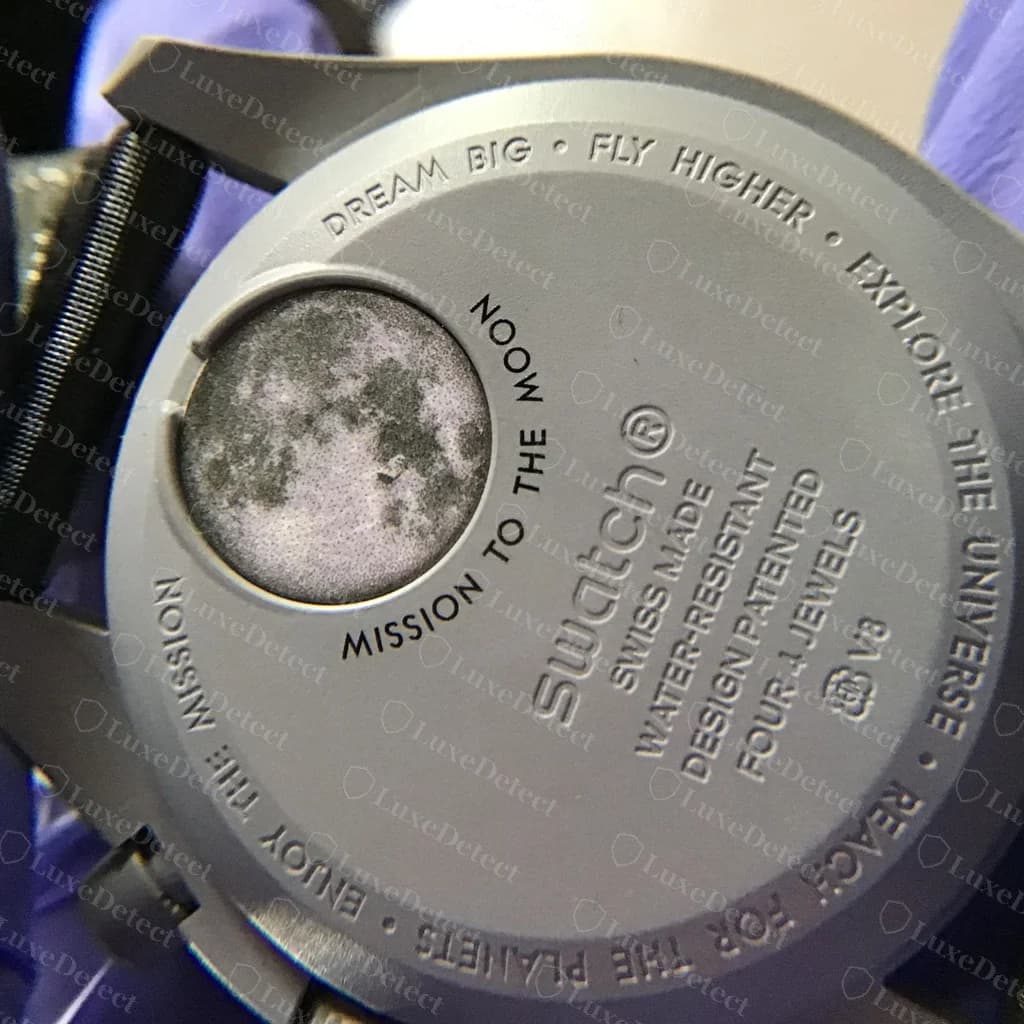
Engraving depth and clarity: The caseback carries mission-specific text and imagery (varies by colorway) that should be crisply engraved or printed with consistent depth. Shallow, blurry, or inconsistently depthed engraving suggests a lower-quality reproduction.
Text accuracy: Check that model names, reference details, and any printed text match official references for that specific colorway — misspellings or incorrect wording are immediate fake indicators.
Packaging and Documentation
Genuine MoonSwatch watches were sold through Swatch's own channels: at launch only in Swatch boutiques, and since then also on Swatch's website in some markets for a limited set of colorways (Swatch asks buyers to log in to deter bots). They were not sold through Omega boutiques, authorized Omega dealers or ordinary watch retailers, and they come in specific MoonSwatch-branded packaging.
Box: Collaborative Omega x Swatch packaging, distinct from standard Swatch packaging and from any Omega packaging.
Documentation: A Swatch warranty card, not an Omega warranty document. Any documentation claiming full Omega warranty coverage on a MoonSwatch is incorrect.
Quick Authentication Checklist
- Bioceramic: matte-smooth texture, correct weight, color consistent through material depth
- Dial: crisp text, correct colorway-to-case color match, clean sub-dial alignment
- Bezel: evenly printed tachymeter scale, flush fit with no gap
- Movement: Swatch quartz (ticking seconds hand, not smooth sweep)
- Crown/pushers: clean resistance, positive pusher click
- Strap: even stitching, secure Velcro closure, correct colorway match
- Caseback: crisp engraving, accurate model text
- Packaging: Omega x Swatch collaborative box, Swatch warranty card
Not sure if your MoonSwatch is genuine? Our watch specialists authenticate MoonSwatch from your photos and return a Certificate of Authenticity within 24 hours — from $15.
Authenticate My MoonSwatch →FAQ
Is the MoonSwatch a real Omega?
No. The MoonSwatch is a Swatch product made in collaboration with Omega. It uses Swatch manufacturing, Swatch materials (Bioceramic), and a Swatch quartz movement. It is not an Omega timepiece and does not carry Omega's warranties or manufacturing standards.
Why does the MoonSwatch sell above retail if it's a Swatch?
Limited supply relative to demand at launch, ongoing scarcity for certain colorways, and the appeal of wearing Speedmaster-inspired design at an accessible price. Resale premiums reflect scarcity and hype, not watchmaking value.
Can a MoonSwatch be mistaken for a real Omega Speedmaster?
Only through deep unfamiliarity with watches or bad-faith misrepresentation by a seller. A genuine Omega Speedmaster Moonwatch starts at several thousand dollars in steel with a mechanical chronograph movement. Weight, material, movement type, and price are all immediately distinguishable from the $260 MoonSwatch.
Where were MoonSwatch watches officially sold?
At launch, only in Swatch boutiques. Swatch has since added limited online sales in some markets, usually for a small number of colorways, and availability varies by country and changes over time, so check Swatch's own site for what is currently offered. They were not sold through Omega boutiques or authorized Omega dealers, so a seller claiming an Omega-dealer purchase is a mismatch.
How do I verify the Bioceramic is genuine and not standard plastic?
Go by weight and feel rather than a scratch test, which proves nothing and risks damaging the watch: Bioceramic feels lighter than steel but heavier than the plastic used in most fakes, and a chip shows the same colour all the way through.
Does every MoonSwatch colorway have the same fake risk?
Not necessarily. Counterfeiters follow resale demand, so the colorways that were hardest to get and carried the biggest resale premium tend to attract the most fakes, but every colorway is copied. Treat any MoonSwatch bought outside Swatch's own channels with the same checks.