Streetwear Authentication Specialist
Streetwear authentication specialist. Focuses on print quality, tagging, and seasonal production codes.
Published September 2026 · Contact
Why "Embroidered vs Printed" Isn't the Whole Answer
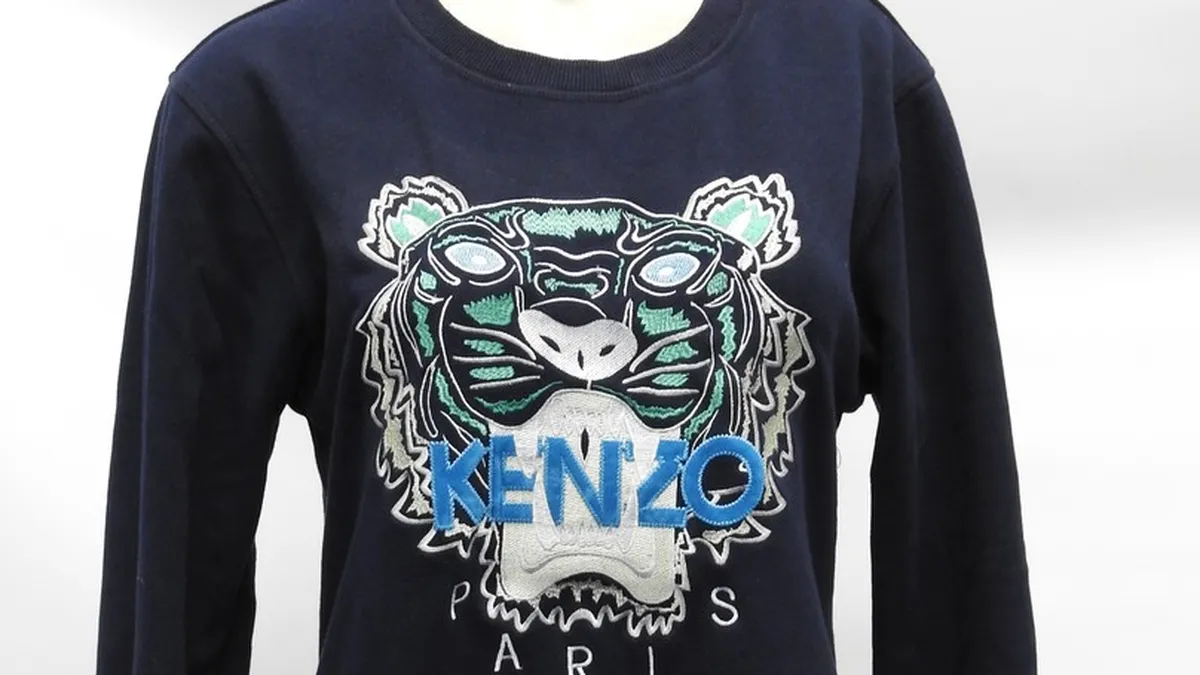
The Kenzo Tiger sweatshirt, with its large tiger-face graphic across the chest, is one of the most recognisable pieces of 2010s streetwear and remains a steady counterfeit target. The common advice is "genuine is embroidered, fakes are printed," and at the cheapest tier that holds: plenty of fakes are flat screen prints with none of the texture of the real thing. But better fakes embroider the tiger too, so treating embroidery alone as proof of authenticity will get you fooled by the mid-tier copies. The real tell is in how the embroidery is organised, not whether it exists.
What to check, ranked by reliability
| Checkpoint | Reliability | What it tells you |
|---|---|---|
| 1. Tiger Face Construction: Color Blocking vs Mottled Fill | ★★★★★ | A tiger face filled with a busy, mottled texture instead of clean color-blocked panels is decisive, even on a genuinely embroidered fake. |
| 2. The Care Tag and Country of Manufacture | ★★★★★ | An implausible country or missing style code supports a fake finding but tags are simple to swap, so weigh this alongside the embroidery check. |
| 3. General Garment Construction | ★★★★★ | Thin fleece or loose ribbing corroborates a verdict but is secondary to the tiger graphic check. |
| Model Reference Before You Start | ★★★★★ | Context on garment range and production only; will not catch a good fake on its own. |
Model Reference Before You Start
- The Tiger graphic appears across multiple garments (crewneck sweatshirts, t-shirts, jackets) and colourways; this guide focuses on the tiger-face construction itself, which applies across them.
- Kenzo garments in this category are commonly produced in Portugal — the care tag should say so, though always confirm this against the specific garment style rather than treating it as a universal rule for every Kenzo product line.
- The "KENZO" wordmark sits as an applique patch across the tiger's muzzle on most Tiger-graphic pieces.
Tiger Face Construction: Color Blocking vs Mottled Fill
This is the check that actually separates the tiers of fake from genuine, and it is more specific than "is it embroidered."
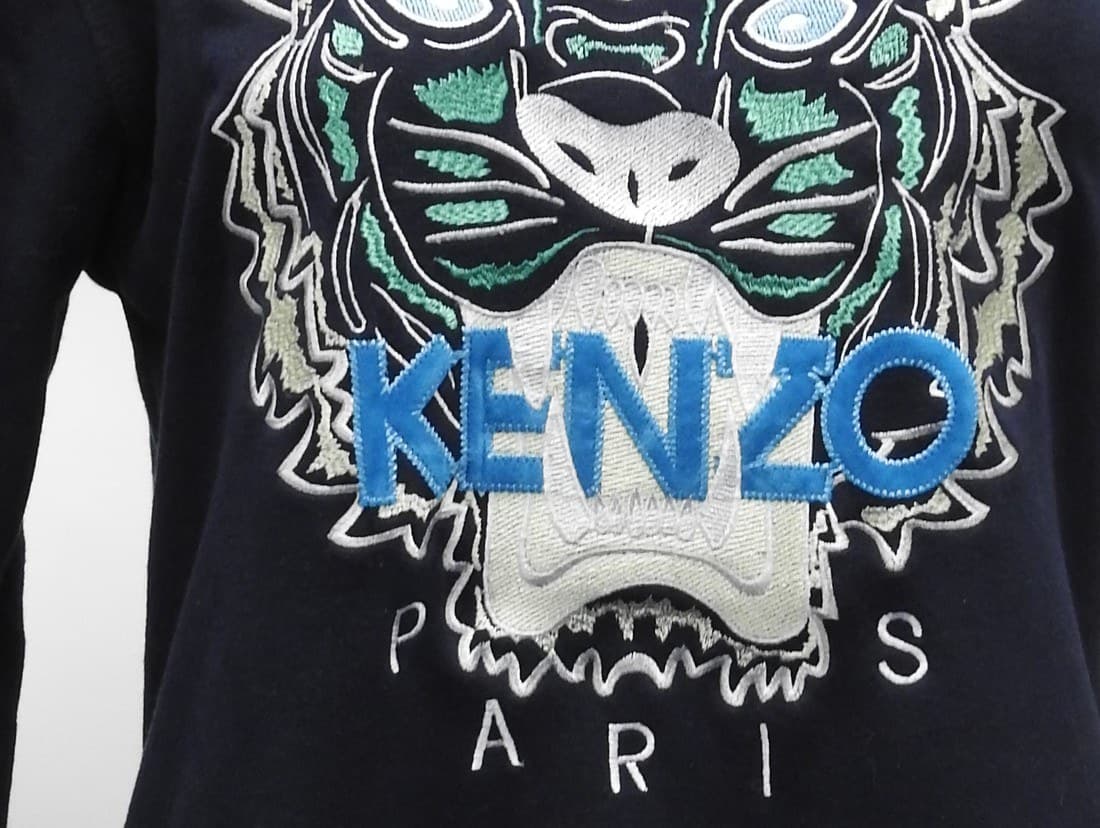
On a genuine Tiger graphic, the embroidery is organised into clean, distinct color-blocked panels — the eyes, brow, muzzle, and surrounding fur areas are each a defined shape in a single flat color (navy, teal, white, grey, or whatever the colorway calls for), giving the design a graphic, poster-like clarity even up close. The stitching itself is a raised satin stitch with a consistent, dense texture, and the "KENZO" wordmark sits as a clean applique patch — a separate piece of fabric edged in satin stitch — laid across the muzzle.
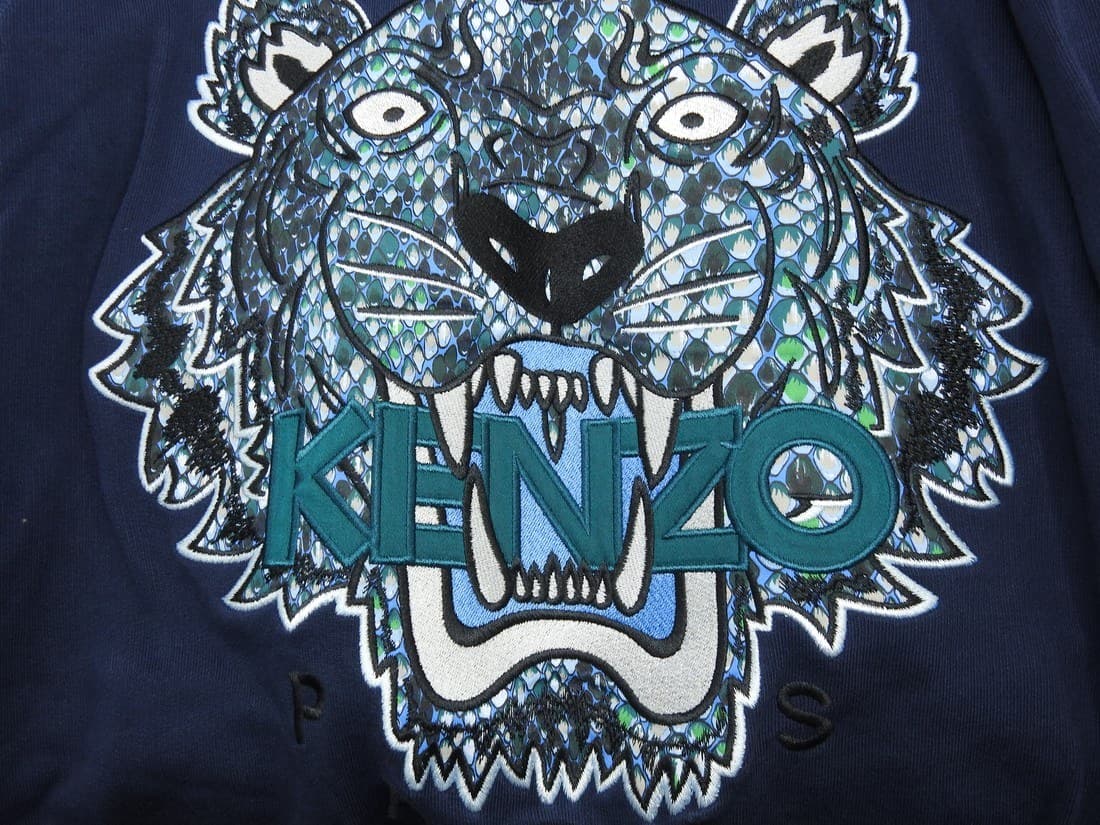
A convincing embroidered fake gets the stitching technique right but gets the organisation wrong: instead of clean color blocks, the tiger's face is filled with a busier, mottled, all-over textured pattern that reads more like a snakeskin or camouflage texture than distinct shapes. It is genuinely embroidered, with real thread and real texture, but it does not resolve into the same clean graphic panels.
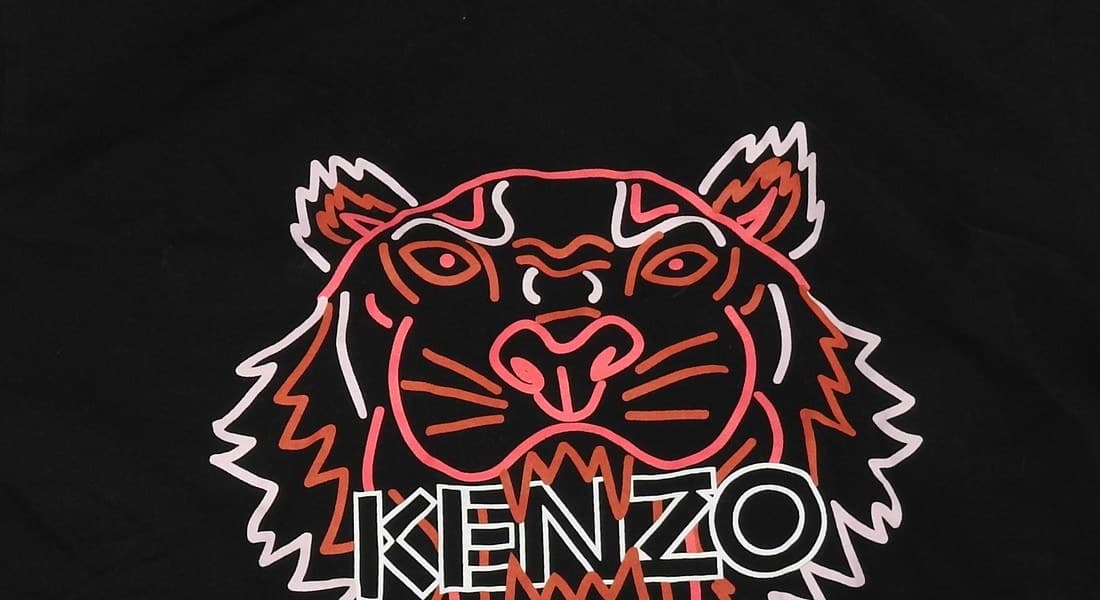
A cheaper fake skips embroidery entirely: the tiger is flat screen-printed, with visibly different line quality — the outlines are rougher and thicker than the fine, consistent embroidered edge, and there is no raised texture to feel at all.
| Element | Authentic | Counterfeit |
|---|---|---|
| Face organisation | Clean, distinct color-blocked panels | Busy, mottled, all-over textured fill (better fakes) |
| Technique | Raised satin-stitch embroidery | Sometimes embroidered too — check organisation, not just texture |
| Cheap-tier fakes | N/A | Flat screen print, rough thick outlines, no texture |
| KENZO wordmark | Clean applique patch, satin-stitch edge | Often part of the same busy fill, less distinct |
Red flag
A tiger face filled with a busy, mottled, all-over texture instead of resolving into clean, distinct color-blocked panels — even if it is genuinely embroidered. Do not rely on "is it embroidered" alone; the better fakes in circulation embroider the tiger too.
The Care Tag and Country of Manufacture
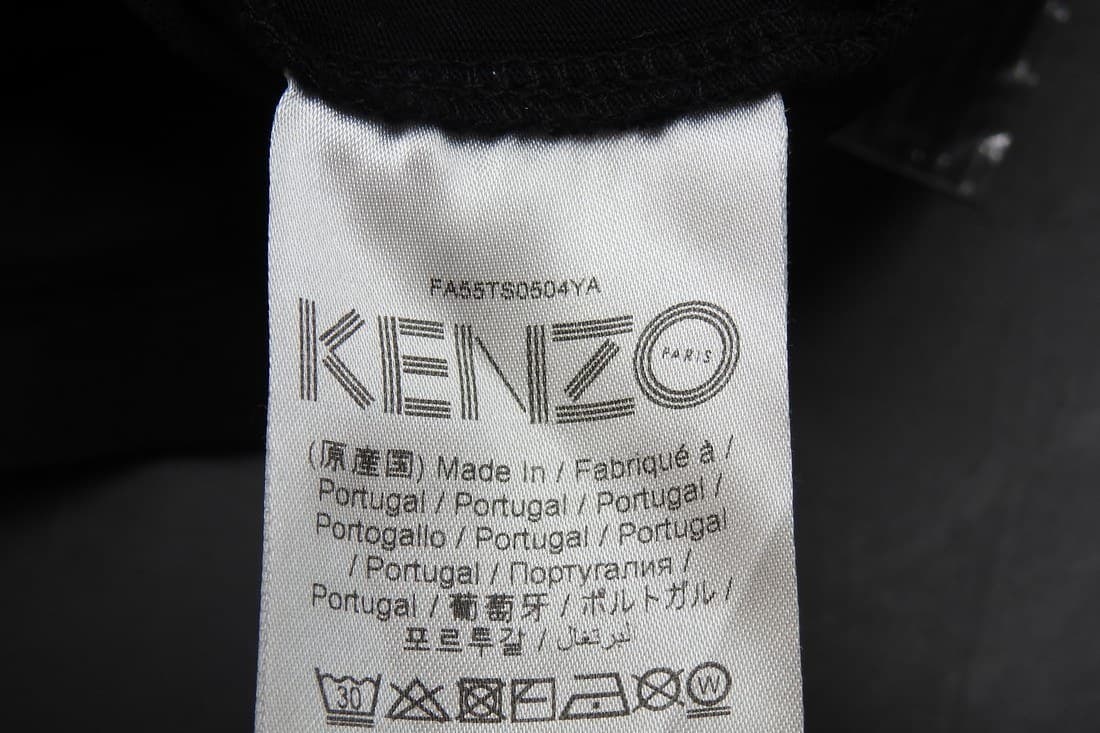
Kenzo care tags for Tiger-graphic garments consistently show "Made In / Portugal" printed in multiple languages alongside the wash symbols and a style/reference code (a format like "FA##TS####YA"). This detail held consistent across every genuine tag checked for this guide, across different garment types and at least two different tag-design generations.
Treat a completely different, implausible country of manufacture on the care tag, or a tag with no style code at all, as a supporting red flag rather than a standalone one — care tags are easy to swap or fabricate, so weigh this alongside the embroidery check rather than instead of it.
| Element | Authentic | Counterfeit |
|---|---|---|
| Country of manufacture | Commonly Portugal on Tiger-graphic garments | A country the specific style doesn't use, or missing entirely |
| Style code | Present, alphanumeric reference format | Missing, malformed, or absent |
Worth knowing
The care tag supports a verdict; it does not settle one by itself. A tag is simple to fabricate or swap between garments, so weigh it alongside the tiger embroidery check, not as a replacement for it.
General Garment Construction
Away from the tiger graphic itself, the base garment quality is still informative.
Genuine sweatshirts use a substantial, evenly brushed cotton fleece with clean, tight ribbing at the cuffs and hem, and neck and hem seams that are straight and evenly stitched. Fakes trend toward a thinner or unevenly textured fleece, ribbing that looks stretched-out or loosely knit, and stitching that wanders at the seams.
| Element | Authentic | Counterfeit |
|---|---|---|
| Fleece | Substantial, evenly brushed | Thin, unevenly textured |
| Ribbing | Clean, tight knit | Stretched-out, loose |
| Seams | Straight, even stitching | Wandering, inconsistent |
Quick Authentication Checklist
- Look at the tiger's face — does it resolve into clean color-blocked panels, or a busy mottled texture?
- If it's screen-printed with no raised texture, that alone settles a cheap fake
- Check the care tag for "Made In Portugal" and a style code, as supporting evidence
- Check general fleece weight, ribbing, and seam quality
Two or more failures means walk away. A mottled, all-over textured tiger face is on its own close to sufficient, even on a piece that is genuinely embroidered.
When to Get a Professional Opinion
The cheapest fakes fail at a glance once you know to look past "is it embroidered." The harder cases are the mid-tier embroidered copies, where the stitching technique is convincing and only the organisation of the color blocking gives it away — a detail that is easy to miss in small listing photos and rewards a closer look or a second opinion.
LuxeDetect authenticates Kenzo from $15 with a verdict and Certificate of Authenticity within 24 hours. Send a close, well-lit photo of the full tiger graphic and the care tag.
FAQ
How can I tell if my Kenzo Tiger sweatshirt is real?
Look closely at how the tiger's face is organised, not just whether it's embroidered. Genuine pieces resolve into clean, distinct color-blocked panels; convincing fakes are also embroidered but fill the face with a busy, mottled, all-over texture instead of clean blocks. Cheaper fakes skip embroidery entirely and screen-print the design flat.
Is a printed (not embroidered) Kenzo Tiger graphic always fake?
For the classic raised-embroidery Tiger sweatshirt style, yes — a flat screen-printed tiger with no raised texture and rougher outline linework is a cheap-tier fake. But don't flip this into "embroidered means real": some fakes embroider the tiger too, just with the wrong internal organisation.
Where are Kenzo Tiger sweatshirts made?
Commonly Portugal, based on care tags across multiple genuine Tiger-graphic garments and colourways. Always check the specific garment's own tag rather than assuming every Kenzo product uses the same country, since manufacturing location can vary by product line.
What does a fake Kenzo care tag look like?
It may show an implausible country of manufacture for the style, be missing the alphanumeric style/reference code entirely, or simply not match the garment it's sewn into. Treat a tag issue as supporting evidence alongside the tiger embroidery check, not as decisive on its own, since tags are simple to swap.
Does the KENZO wordmark on the tiger's muzzle help authenticate it?
Somewhat. On genuine pieces it's a clean applique patch with a satin-stitch edge, distinct from the surrounding graphic. On busier, mottled fakes, the wordmark tends to blend into the same messy fill rather than standing apart as a distinct patch.
Are all Kenzo Tiger fakes cheap and obvious?
No. The cheapest copies are flat prints that are easy to spot, but mid-tier fakes are genuinely embroidered with real satin-stitch texture. The distinguishing detail at that tier is the internal organisation of the tiger's face — clean color blocks versus a busy, mottled fill — not the embroidery technique itself.