Luxury Leather Goods Authentication Specialist
Luxury leather goods specialist. Works on Italian house construction, hardware, and interior stamping.
Published October 2026 · Contact
Why the Label Inside Matters More Than the Weave
Bottega Veneta built its name on having no logo. The house's old line was "when your own initials are enough", and most bags carry nothing on the outside beyond the intrecciato weave. That is good news for a buyer in one way, because there is no monogram to misspell. It is bad news in another: the weave, the leather and the hardware are exactly what a modern counterfeit factory has learned to copy, and they are the checks most listings invite you to make from a few photos.
Across the counterfeit Bottega bags in our authentication archive, the copies got the silhouette, the pattern, the zip pulls and even the heat stamp close enough that a single photo of any of them would not alarm you. Where many of them slipped was the small fabric tag sewn inside. Genuine bags carry one in every era, and counterfeiters know it is expected, so they sew one in too. What they get wrong is the print: the code, the colour of the ink and, on older bags, the wording. This guide starts there, then covers the other checks in honest order of how much each one proves.
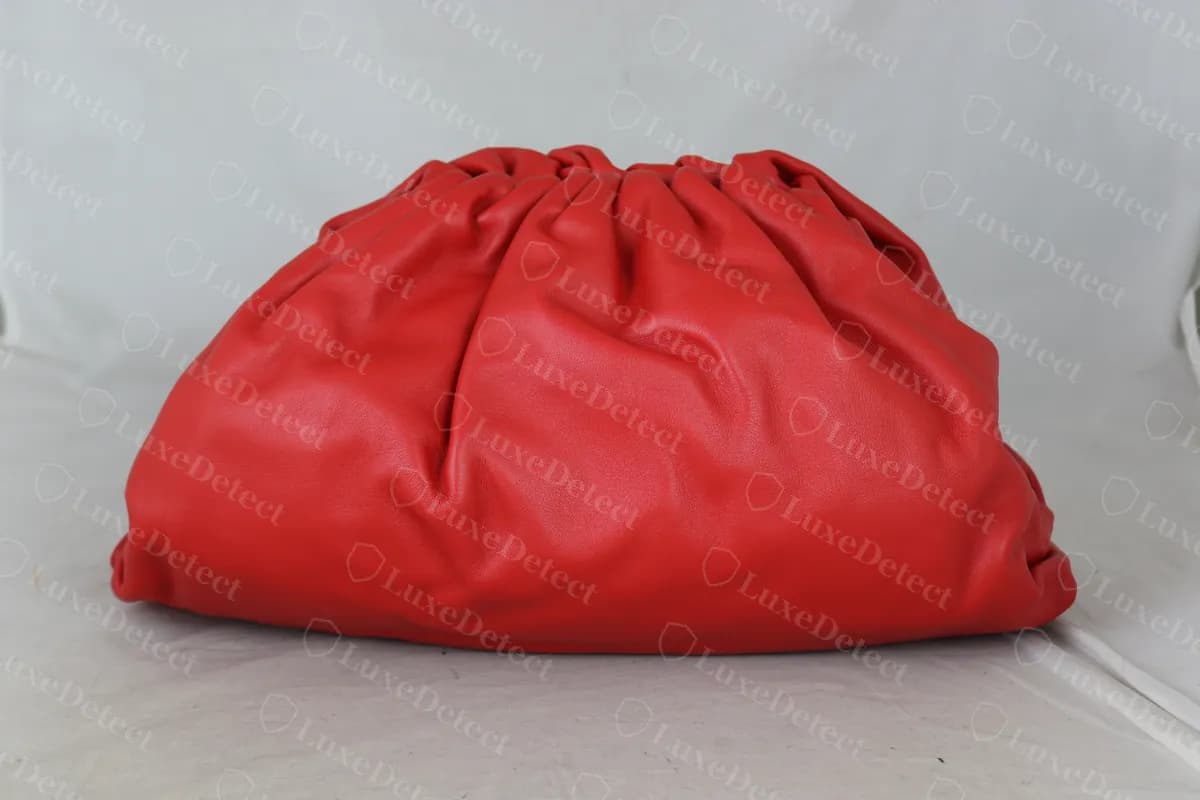
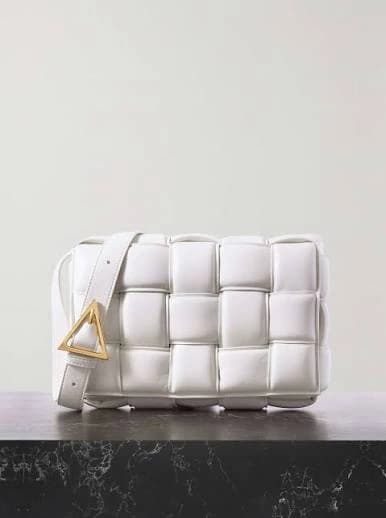
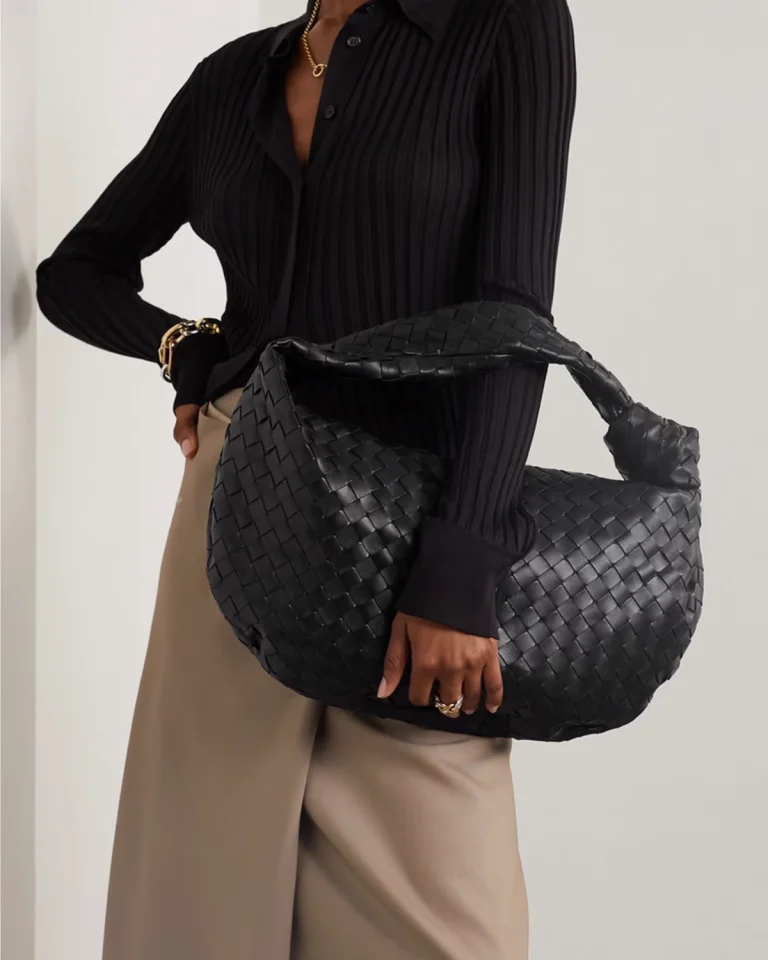
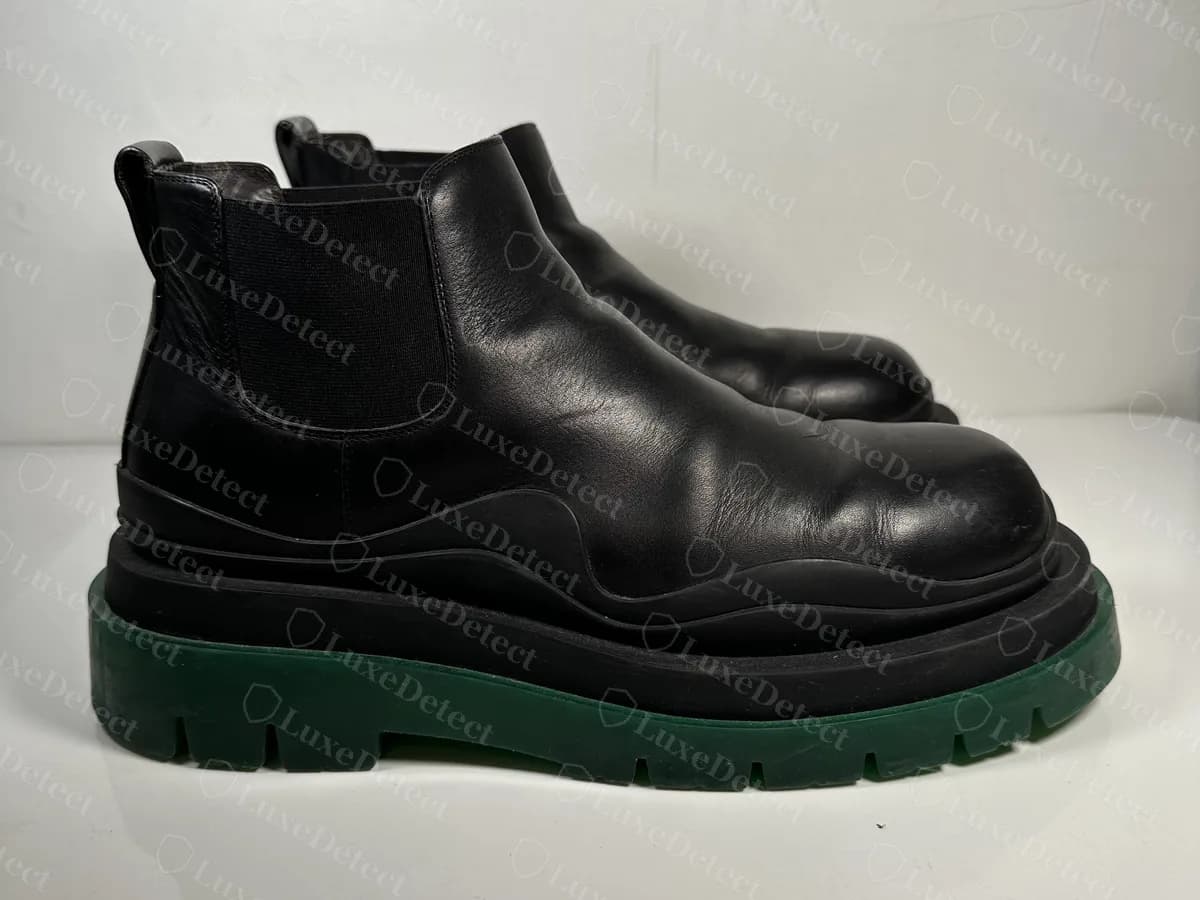
If you are checking a specific model, our guides to the Cassette, the Jodie and the Sardine go deeper on model-specific details. For two popular items, see our guides to the Pouch and the Tire, Lug and Puddle boots. This one covers what applies across bags and small leather goods.
What to check, ranked by reliability
| Checkpoint | Reliability | What it tells you |
|---|---|---|
| 1. The Originality Certified Tag on Recent Bags | ★★★★★ | A code known to circulate on counterfeits is a strong warning, not proof; a clean tag clears nothing. |
| 2. The Older Certificato di Originalità Tags | ★★★★★ | A gold or red heading, or a second line ending 1319 A, rejects the bag; a correct tag proves little. |
| 3. The Country of Origin Label | ★★★★★ | A Made in China label is decisive but rare; a clean Italian label proves very little. |
| 5. The Intrecciato Weave and the Leather | ★★★★★ | Worth checking in the hand; from photos, good counterfeits reproduce the pattern closely. |
| 4. The Brand Label, Plaque and Heat Stamp | ★★★★★ | Misspellings or ink would be decisive, but counterfeits copy the label, plaque and stamp closely. |
| 6. Hardware and Zips | ★★★★★ | Zip pulls and engraving are copied closely, so good hardware proves little. |
| Model Reference Before You Start | ★★★★★ | Makes sure you compare against the right interior set; will not catch a good fake. |
| What the Box and Dust Bag Do and Do Not Prove | ★★★★★ | Packaging is context only and never evidence. |
Model Reference Before You Start
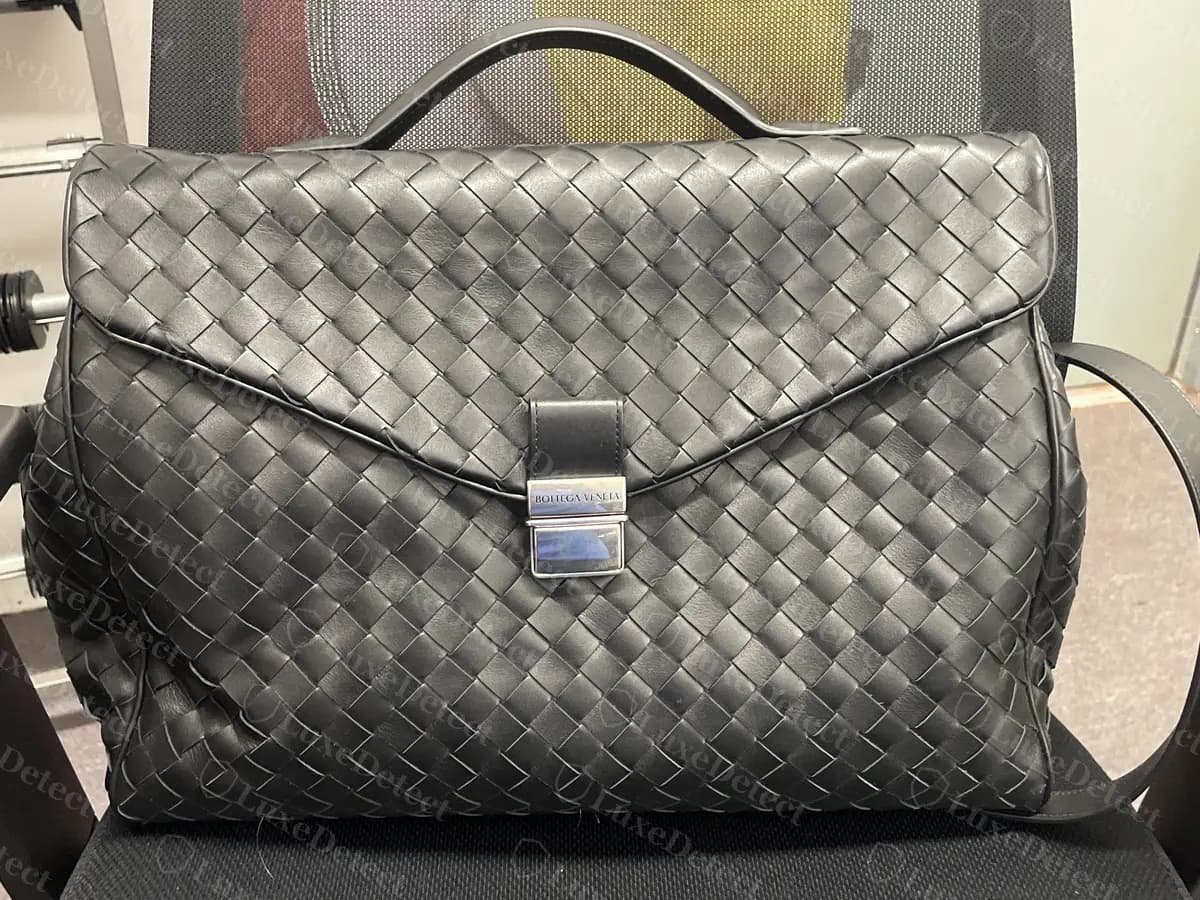
Bottega Veneta bags are made in Italy, and the labels inside say so. Know which kind of bag you are holding before you compare it with anything, because the interior set changes with the era and with the model.
- Classic intrecciato: the fine woven leather on hobos, totes, clutches and briefcases, usually with a metal plaque or a woven label inside.
- Maxi intrecciato: the wide woven squares on the Cassette and its padded versions.
- Smooth leather shapes: the Pouch, the Jodie, the Loop, the Sardine and the Andiamo family, often with a heat stamp or a fabric label rather than a plaque.
- Small leather goods: wallets and card cases, which carry the same tag set in a smaller form.
- Exceptions to "no logo": some men's bags and lock plates carry the name engraved on the hardware. A raised metal logo stuck on the front of a bag that is not known to have one is a different matter.
Listings often call any woven Bottega bag by the wrong model name, so match the photos, not the title.
The Originality Certified Tag on Recent Bags
Inside a recent Bottega Veneta bag, usually sewn into a lining seam near the zip, you will find a small white woven tag. One side reads "BOTTEGA VENETA / MADE IN ITALY". The other reads "ORIGINALITY CERTIFIED" in brown capitals, with a code underneath in grey or black. On the recent genuine tags we read at full size the code is a letter, eight digits and a closing letter, in a plain, evenly spaced typeface.
Some guides call this tag a counterfeiter's invention. It is not. It is a genuine feature of the house's bags, and a recent bag without one is a question to ask rather than a point in its favour. Because counterfeiters know the tag is expected, the printing is where they slip.
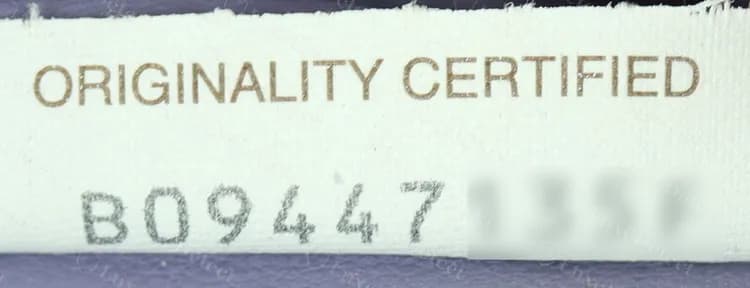
Recycled codes. The clearest pattern in the counterfeits is the same code printed on many different bags. B07916185B turned up on counterfeit bags of different models and colours, including Cassettes. B09366688J and B07797248C did the same. Counterfeiters copy codes from real bags, so a code that keeps turning up on different counterfeits is a warning sign. It is not proof on its own: the genuine bag a code was copied from carries it too.
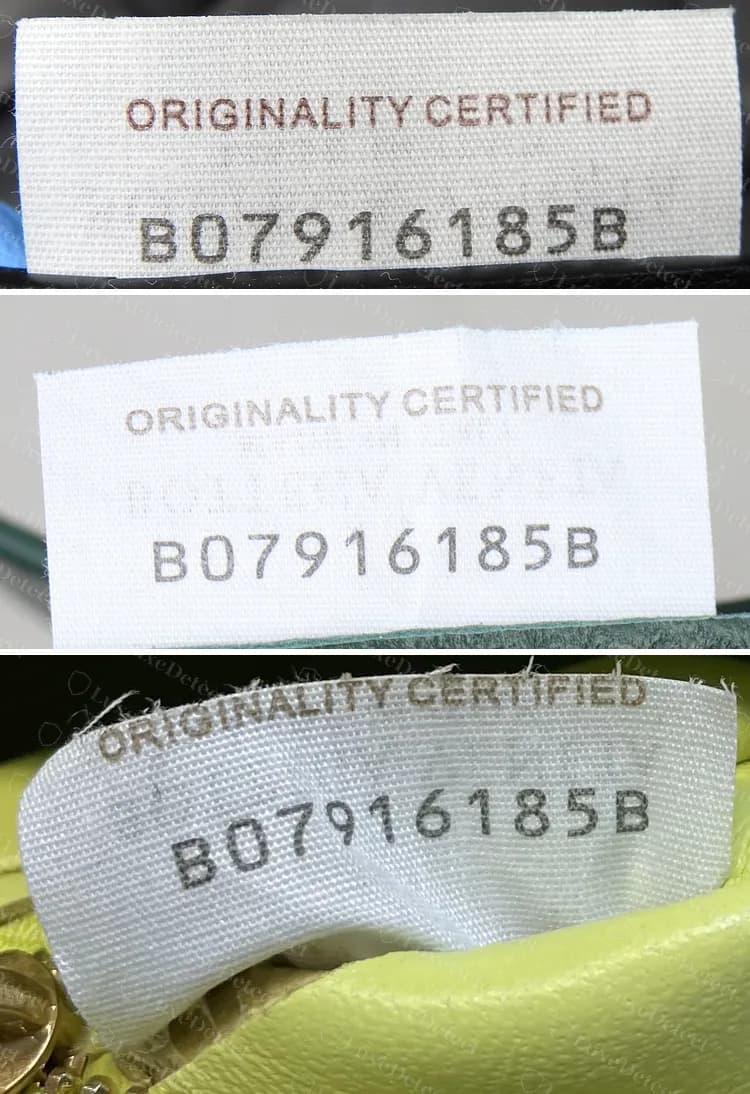
Among the counterfeit tags we could read in full, roughly two in three carried a code that appeared on another counterfeit. None of the genuine tags we read shared a code with another genuine bag. The rest of the counterfeits carried a code of their own in the right format, which is why a code that matches nothing known clears nothing.
| Element | Authentic | Counterfeit |
|---|---|---|
| Tag present | White woven tag in a lining seam | Usually present; fakes copy it |
| Heading | "ORIGINALITY CERTIFIED", brown | Same wording, copied closely |
| Code | Letter, eight digits, letter; unique to the bag | Often a code seen on other counterfeits |
| Everything else | Plain, even print | Print can be perfect; the code is the tell |
Red flag
A tag whose code is B07916185B, B09366688J or B07797248C. Each appeared on several counterfeit bags of different models and colours, and on no genuine bag we read. Treat any of them as a strong sign of a fake, and confirm with the other checks, because a code copied from a real bag could in principle also be on a genuine one.
Worth knowing
A clean tag does not clear the bag. Counterfeiters also copy codes from real bags, so a match between two bags only tells you that at least one of them is not genuine. Bottega Veneta does not publish a code lookup. Our [Bottega Veneta serial number checker](/bottega-veneta-serial-number) reads the format and the era of a code but cannot confirm that a code belongs to your bag.
The Older Certificato di Originalità Tags
Older bags carry an older tag, and the counterfeits copy those too. The years printed on the genuine labels we read run from 2007 to about 2011, and those bags have a bilingual label headed "CERTIFICATO DI ORIGINALITÀ", with the English sentence "this label certifies that the product is an original trademark product of Bottega Veneta" below it, then two lines of numbers. The second line starts with EPEV, followed by a year and a lot number. A middle version keeps the English "ORIGINALITY CERTIFIED" heading over the same two lines of numbers. Still older bags use a cream label with a yellow security pattern behind the print.
On every genuine example of the bilingual label that we read, the heading was brown and the numbers were printed in a dark ink, blue-grey or near black.
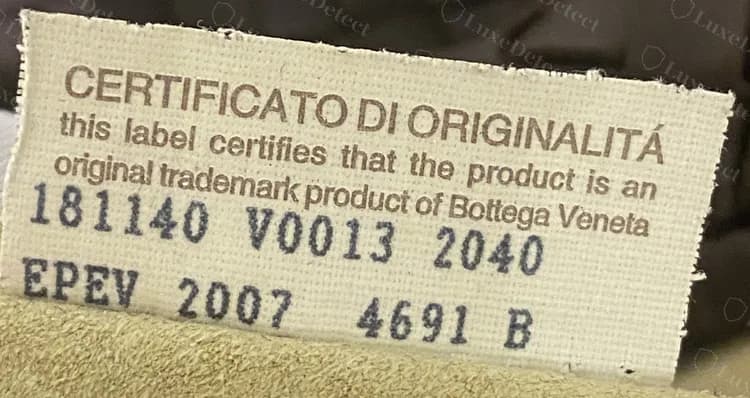
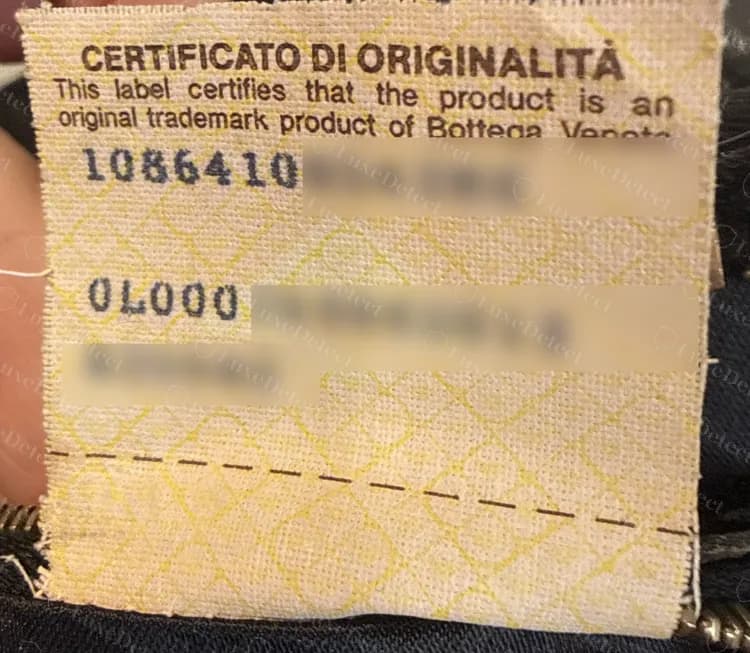
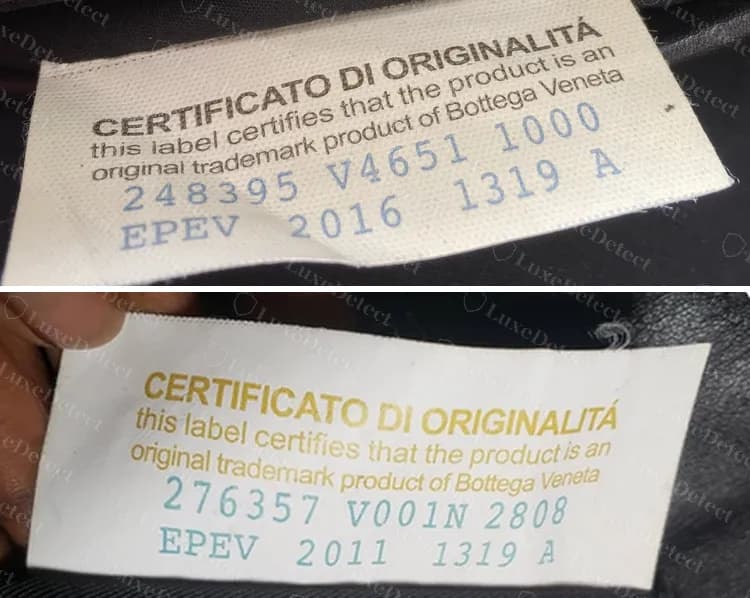
The counterfeits that copy this label got the wording and the layout right and the print wrong. Several printed the heading in gold or yellow instead of brown, and another used a dark grey. More tellingly, the same ending, 1319 A, appeared on the second line of the numbers on several different counterfeit bags, with different years in front of it.
Another counterfeit tag printed its heading in red, dropped the accent from "ORIGINALITÀ" and misspelled "label" as "iabel".
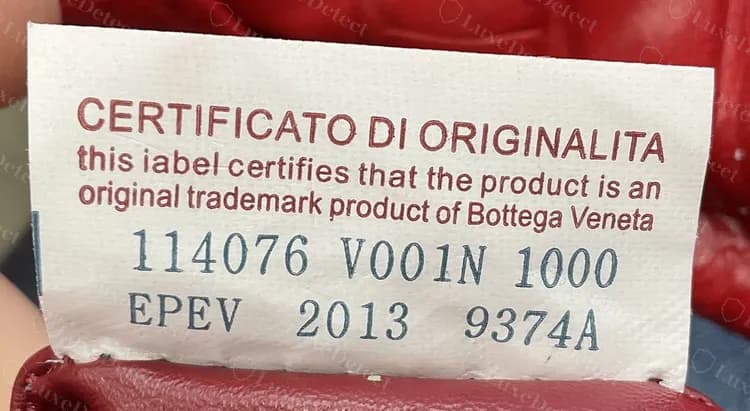
| Element | Authentic | Counterfeit |
|---|---|---|
| Heading | Brown | Gold, yellow, red or dark grey on the counterfeits we read |
| Last group on line two | Different on every bag | 1319 A on several different bags |
| Wording | "ORIGINALITÀ" with the accent, "label" spelled correctly | Accent missing, "iabel" |
Red flag
A Certificato di Originalità tag with a heading in gold, yellow or red, or with a second line that ends 1319 A. Each of these appeared on counterfeit bags and on none of the genuine tags we read.
Worth knowing
Counterfeit factories also copy whole tags from real bags, so a perfect brown tag with plausible numbers still does not make a bag genuine. Use this check to reject, not to approve.
The Country of Origin Label
Genuine Bottega Veneta bags and small leather goods are made in Italy, and every genuine label we read said so. A handful of counterfeit bags carried a plain white woven label printed "MADE IN CHINA" in grey capitals, on a bag whose other labels and plaque carry the Bottega Veneta name.
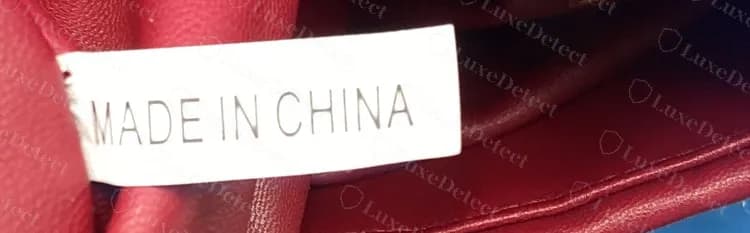
Most counterfeits do not carry a Chinese label at all. The great majority print "MADE IN ITALY" on every label they have, so a clean Italian label proves very little. This check rejects the careless fakes and nothing more.
Red flag
Any label inside the bag that reads "MADE IN CHINA", or any other country besides Italy. The genuine bags we checked had none.
The Brand Label, Plaque and Heat Stamp
Depending on the model and the year, a genuine bag has one of three interior brand marks: a white woven label printed "BOTTEGA VENETA / MADE IN ITALY", a metal plaque with the same words, or the same words pressed into the lining leather without ink. Some bags have more than one.
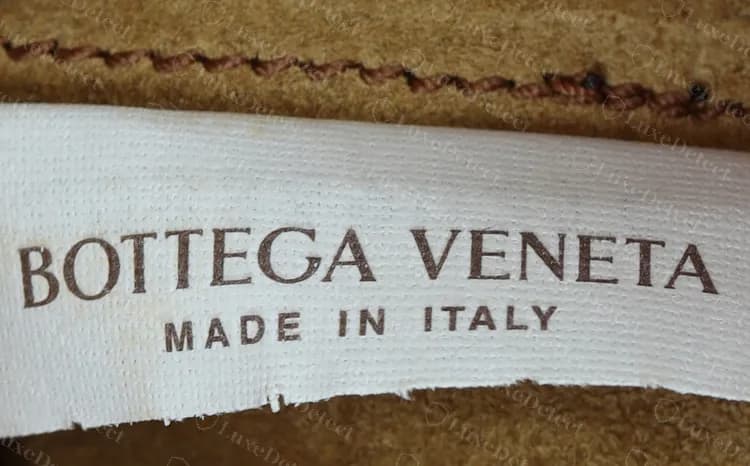
The counterfeits copy all three closely. Their plaques come in the same silver and gold finishes, with the same two lines of text, and a stamp or label that is a little deeper, tighter or shinier than a photo you found online is not evidence, because genuine plaques and stamps differ by era, leather and model.
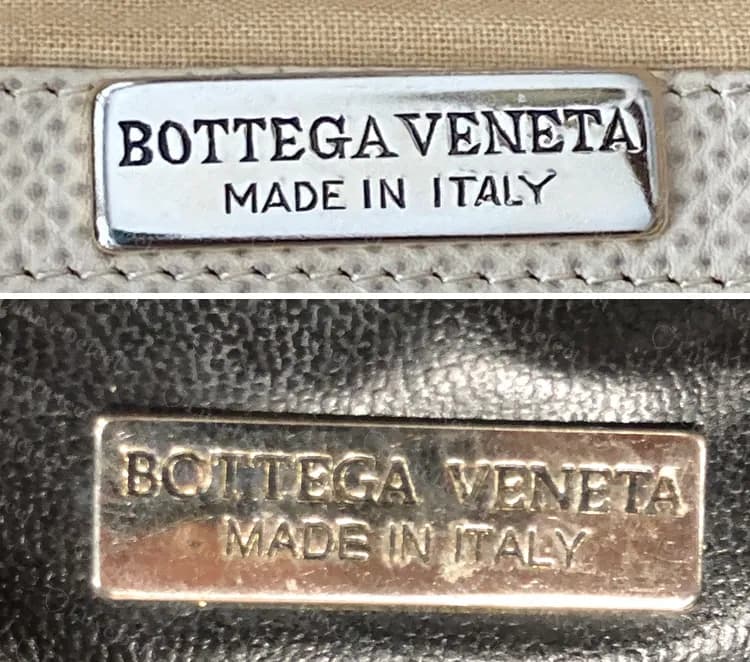
| Element | Authentic | Counterfeit |
|---|---|---|
| Wording | BOTTEGA VENETA / MADE IN ITALY | The same, copied closely |
| Format | Label, plaque or stamp, depending on era and model | All three are copied |
Worth knowing
Read the mark for a misspelling, a missing line, ink where there should be a blind stamp or a wrong country, any of which would be decisive. Beyond that, a correct label or plaque only tells you the bag claims to be Italian.
The Intrecciato Weave and the Leather
The weave is what most guides, and most sellers, point to first. We rank it below the interior labels for a plain reason: in the photos in our archive, counterfeit classic bags reproduced the pattern well, and we could not separate them from genuine ones on the weave alone. The better counterfeits get the pattern, the strip width and the colour right. What is left is in the hand, and a photo rarely carries it.
What to check in person:
- Strip width: strips on a classic bag should stay the same width across the panel, with no strip noticeably wider or narrower than its neighbours.
- Flatness and depth: strips should lie flat and interlock, without lifting at the crossings or showing glue.
- Corners and seams: the weave should wrap the corners and meet the seams cleanly, without gaps or a patch of flat, non-woven leather.
- The leather: genuine lambskin and nappa are soft, with body, and dye through the cut edge. A coated, plasticky or board-stiff hand is a warning.
On the Cassette, the weave is more diagnostic because the squares are large and few: the model guide covers it in detail.
Worth knowing
A weave that looks right in photos is not evidence. Treat a weave that looks wrong, such as uneven strips or a flat embossed pattern, as a reason to look harder at everything else.
Hardware and Zips
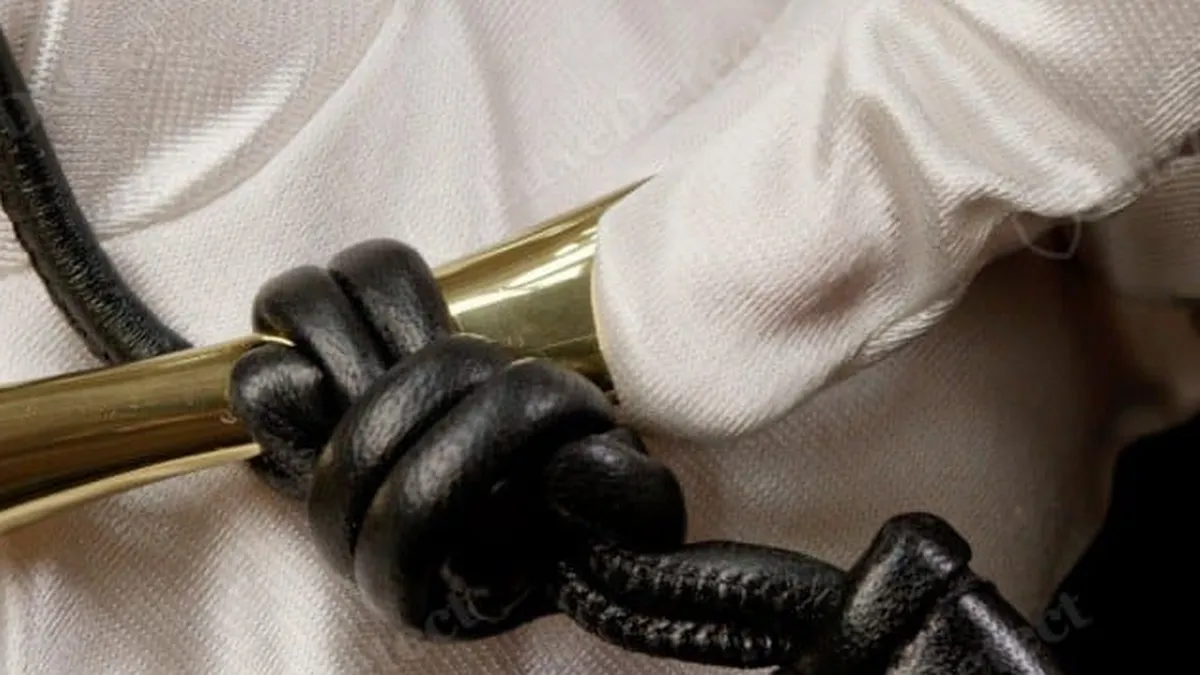
Bottega Veneta's hardware is plain and heavy: a gold or silver zip pull, often with a triangle cut-out, an engraved lock or buckle on some bags, and a hook or ring for the strap. Counterfeits copy the shapes and the engraving, and the zip pulls in particular come out as close copies.
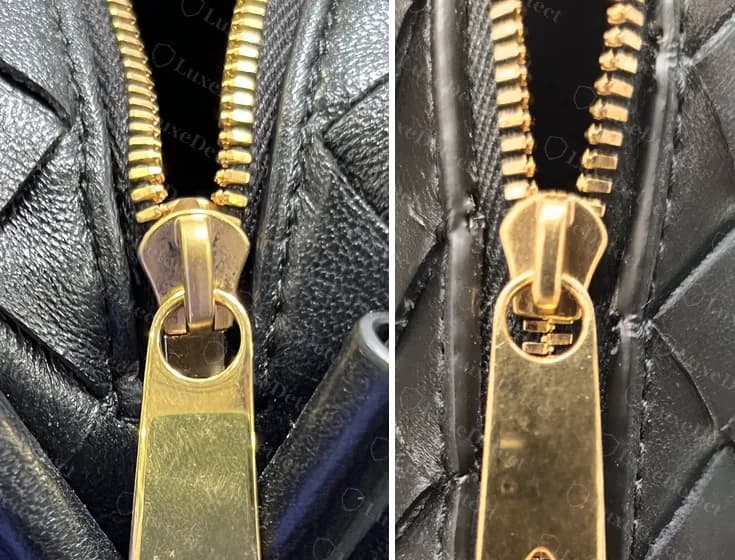
Good hardware proves little. What helps is checking that the metal tone matches across the bag, that the zip runs smoothly, and that any engraving is crisp and spelled correctly. For model-specific hardware details, such as the Jodie's zip pull, see the Jodie guide.
Worth knowing
The triangle on a zip pull is a genuine design feature on several models, not a fake tell. Judge the finish and the engraving, not the presence of the shape.
What the Box and Dust Bag Do and Do Not Prove
Recent Bottega Veneta bags come in a box and a soft dust bag printed with the name, and some come with a card. Counterfeit sets come with matching boxes, dust bags and cards, and genuine bags are often resold without any packaging at all.
Packaging is context, not evidence. Its one use is cross-checking: if a receipt, card or box label names a different model or colour from the bag in front of you, ask why.
Where This Guide Is Limited
This guide rests on hundreds of genuine and counterfeit Bottega Veneta bags and small leather goods that came through our authentication queue, not on a factory reference set. The tag tells above are the ones that repeated in the counterfeits we saw. Other factories will make other mistakes, and the best copies made none of the ones listed here. We did not find a repeatable weave or hardware tell that works from photos, and we would rather say so than invent one. Treat a clean result as "no known problem found", not as proof.
Quick Authentication Checklist
- Find the Originality Certified tag (recent bags) or the Certificato di Originalità label (older bags) and read every character.
- Look hard at any bag whose code is B07916185B, B09366688J or B07797248C; each has been found on several counterfeits.
- On an older label, check the heading is brown and that the second line of numbers does not end in 1319 A.
- Read every label and plaque for the country of origin. Anything but Italy ends the check.
- Check the brand label, plaque or heat stamp for misspellings, a missing line or ink where it should be blind.
- Handle the leather and look at the weave in person: even strips, no glue, soft lambskin with body.
- Check the hardware tone, the zip action and any engraving.
- Cross-check the model, the colour and any card against the bag.
A gold or red heading, a second line ending 1319 A or a Chinese label is enough on its own, and a recycled code is a strong warning that needs one more failing check to be sure. A bag that passes every check above can still be a good counterfeit, which is why the next section matters.
When to Get a Professional Opinion
Bottega Veneta is one of the harder houses to call from photos, because the better counterfeits copy every visible feature, and the recycled-code tell only catches the ones that share a code. If the tag is clean and the bag looks right but the price, the seller's story or the feel of the leather is off, get a second opinion before money changes hands.
LuxeDetect authenticates Bottega Veneta handbags from $25 with a verdict in 24 hours and a Certificate of Authenticity for genuine items. Send the front and the back, the bag opened to show the lining, a sharp close-up of the tag with the full code legible, the brand label or plaque, and the zip pull.
FAQ
Does a real Bottega Veneta bag have an "Originality Certified" tag?
Yes. Genuine recent bags carry a white woven tag printed "ORIGINALITY CERTIFIED" with a code, next to a "BOTTEGA VENETA / MADE IN ITALY" label. Counterfeiters copy it, so its presence does not prove a bag is genuine, but on a recent bag its absence is worth questioning. Older bags carry a bilingual "Certificato di Originalità" label instead.
Can I check a Bottega Veneta code online?
Not against the brand. Bottega Veneta does not publish a lookup for the codes on its tags. What you can do is read the tag carefully and compare it with the patterns above. Our serial number checker reads the format and era of a code, but it cannot confirm that a code belongs to your bag.
Where is the Originality Certified tag?
Usually sewn into a seam of the interior lining, often next to the zip or under the frame. Look inside the main compartment and under any pocket flap.
Is "Made in China" ever on a real Bottega Veneta bag?
Not on any genuine bag or small leather good we have checked. Bottega Veneta leather goods are made in Italy, and every genuine label we read said so. A label that reads "MADE IN CHINA" on a bag sold as Bottega Veneta is a strong reason to walk away.
Does a real Bottega Veneta bag have a logo on the outside?
Most do not. The house avoids external logos, and a metal "BV" plate on the front of a bag that is not known to carry one is a bad sign. A few bags, mostly men's bags and some lock plates, carry the name engraved on the hardware, so check the specific model before you decide.
Is the intrecciato weave a reliable way to spot a fake?
It helps in the hand but not much from photos. Counterfeit classic bags in our archive reproduced the pattern well. Uneven strips, glue, lifting crossings or a flat embossed pattern are warnings, but a convincing weave does not prove a bag is real.
Can I authenticate a Bottega Veneta bag from photos?
Often, if the photos are sharp. The most useful shots are close-ups of the tag with the full code readable, every label and plaque inside the bag, and the zip pull. Because the best counterfeits copy the visible features well, a professional check is worth it for any purchase you cannot return.