Fashion Authentication Specialist
Streetwear authentication specialist. Focuses on print quality, tagging, and seasonal production codes.
Published October 2026 · Contact
Why Saint Laurent Clothing Cannot Be Judged From the Label Alone
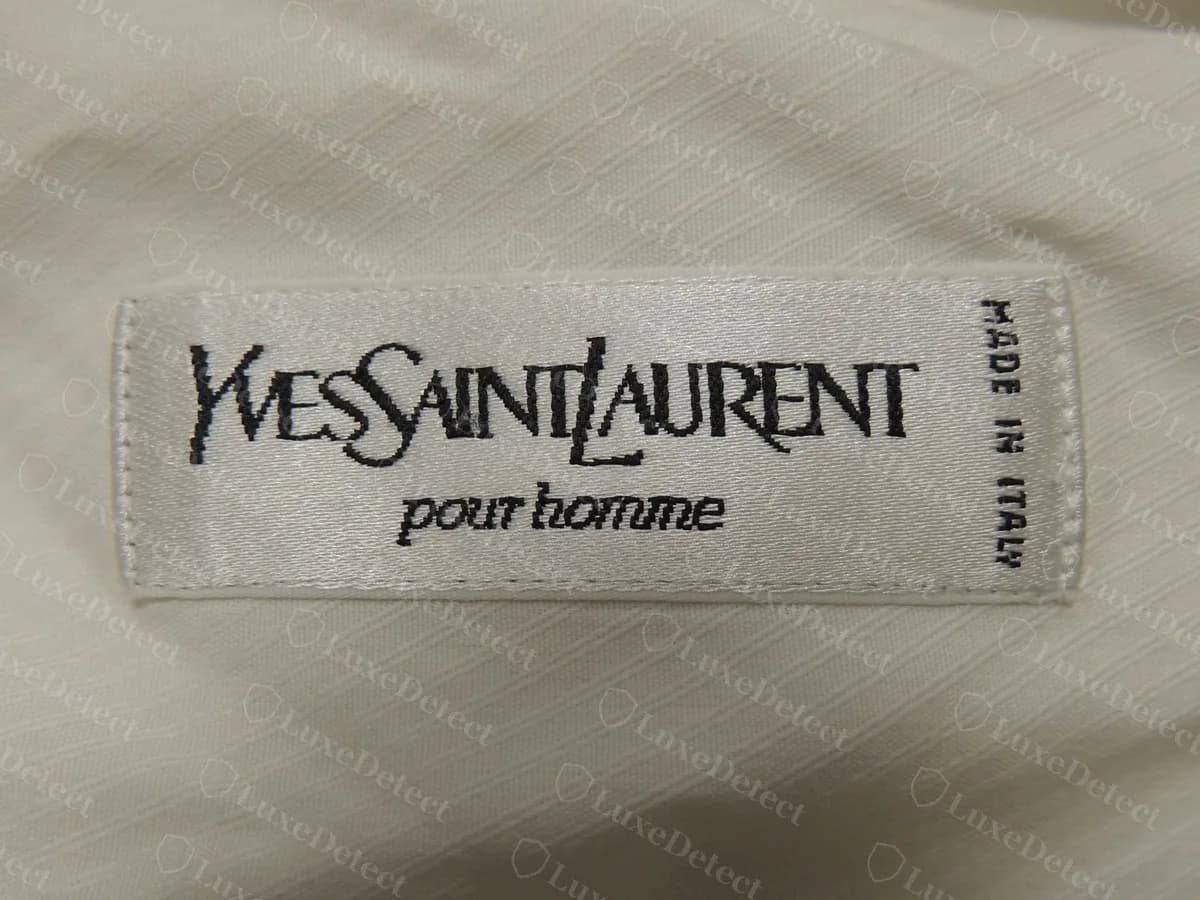
On a Saint Laurent shirt, jacket or pair of jeans, the label is the first thing a buyer checks and the first thing a counterfeiter copies. In our own order archive the counterfeit garments carry the same label families as the genuine ones: the woven "pour homme" and "rive gauche" neck labels, the multi-company legal label, and the "SAINT LAURENT PARIS" care label with its code lines. Photographed at ordinary phone distance, we could not separate them from genuine labels by the wordmark alone.
That shapes this guide. It is a reference for what genuine Saint Laurent clothing labels look like across the brand's two names and several decades, and it is honest about the one label detail that gives a little more than the wordmark does: the code line on the modern care label. It does not claim a decisive fake tell, because the photos do not support one.
Worth knowing
This guide is built from genuine garments in our archive and from a comparison with counterfeit ones, and the comparison found no label tell that appears on several fakes and is absent from genuine pieces of the same type and era. We say so rather than invent a checkpoint table. The modern care label in particular rests on only a handful of genuine examples, which is why it is described as a consistency check and not a verdict.
Two Names, Several Label Families
Saint Laurent clothing is sold under two names. Most garments made before the 2012 rebrand carry "Yves Saint Laurent" with a script-style wordmark (the earliest rive gauche pieces carry a plain "SAINT LAURENT rive gauche" label); after the rebrand under Hedi Slimane the house shortened to "Saint Laurent Paris" in plain block capitals. Both are in active resale, and a buyer comparing two genuine pieces can see completely different labels without either being wrong. The same applies to the shoes; see our Saint Laurent shoes guide.
| Label family | Where it is usually found | What it looks like |
|---|---|---|
| Yves Saint Laurent pour homme | Men's shirts, jackets, knitwear, ties | Woven wordmark with "pour homme" in script underneath; cream with black lettering, or black with white |
| Yves Saint Laurent rive gauche | Women's clothing, jeans, some men's pieces | Wordmark with "rive gauche" and two small squares; earlier versions have red or pink squares |
| Yves Saint Laurent Paris New York | Men's shirts and ties | Black label with copper or gold lettering and the place names |
| tricots pour homme | Knitwear | Blue-bordered woven label |
| Saint Laurent Paris | Garments from the rebrand onward | Usually white capitals on black, hang tag in the same style, care label with a code block (a cream care label with black print also exists) |
Pour Homme Labels
The men's line is one of the most common labels in our genuine archive. It appears in two colourways, and both are genuine: black lettering on a cream woven label, with "MADE IN ITALY" printed vertically along one edge on the shirt version, and white lettering on a black label, which turns up on jacket linings and often has the size as a separate small tab beneath it.
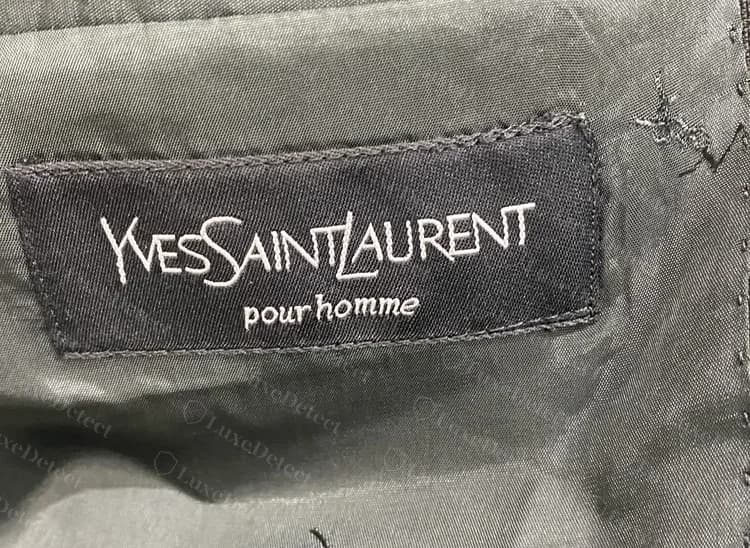
The cover image shows the cream version on a shirt. What stays constant across both is the narrow, tightly joined lettering of the wordmark and the lowercase italic "pour homme" under it. Those details are easy to copy, and counterfeit garments in our archive reproduce them, so treat a correct pour homme label as the starting point of an inspection and nothing more.
Worth knowing
Country of manufacture varies on genuine pieces and is not a tell. We have genuine garments marked Italy, France, Japan, Romania, Poland and Hong Kong, depending on the era and the line.
Rive Gauche Labels
Women's clothing and some denim carry the rive gauche label, and it changed over time, so two genuine rive gauche pieces from different decades can look unlike each other.
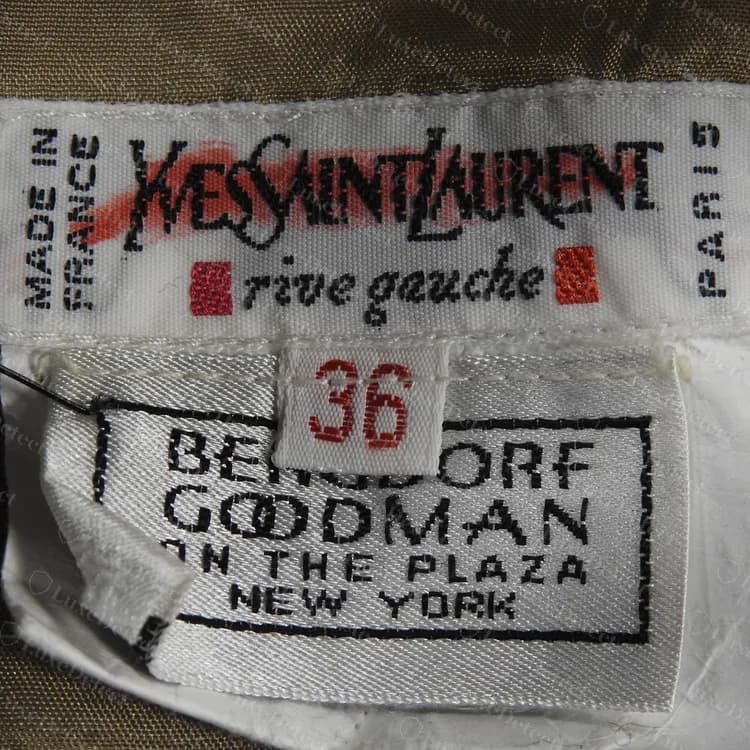
Earlier versions are woven labels with "rive gauche" beneath the wordmark, red or pink squares, "MADE IN FRANCE" and "PARIS" printed up the sides and the size often in red below. The wordmark is either the plain-capitals "SAINT LAURENT" with a pink square, or, as on the skirt below, the "Yves Saint Laurent" script with a red square either side of "rive gauche". It often sits above a retailer's own label, as on this skirt sold through a New York department store.
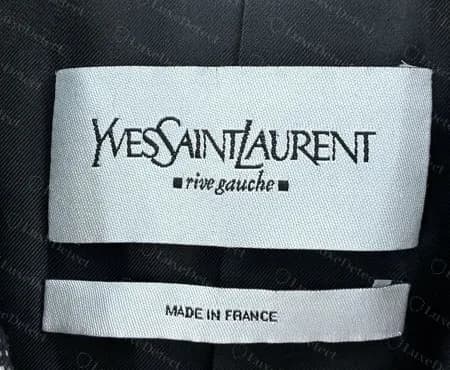
The later version uses the "Yves Saint Laurent" wordmark with "rive gauche" and two small dark squares, and the country of manufacture moves to a separate strip below or beside it. On a blazer lining it shows as a wide white label over a narrower "MADE IN FRANCE" label.
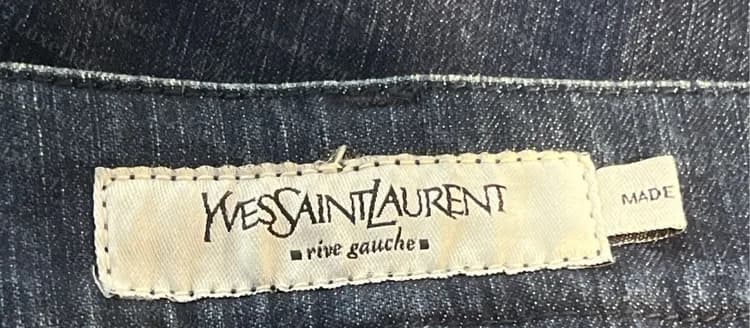
On jeans the same label sits at the inside of the waistband, with the manufacturing strip attached at its end.
Two labels stacked at the neck are normal on genuine later rive gauche pieces, so their presence is not a reason to doubt a garment.
Paris New York and Tricots Labels
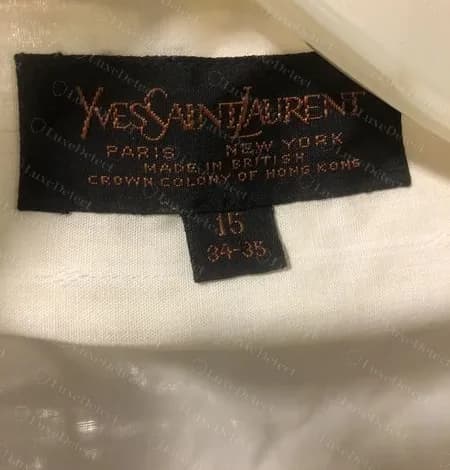
Two older families are easy to mistake for fakes by buyers who only know the modern brand. The black "Yves Saint Laurent Paris New York" label, with copper lettering, was used on men's shirts and ties, and the one below reads "MADE IN BRITISH CROWN COLONY OF HONG KONG", a colony name that no longer exists, which would look wrong on a modern piece but is correct here.
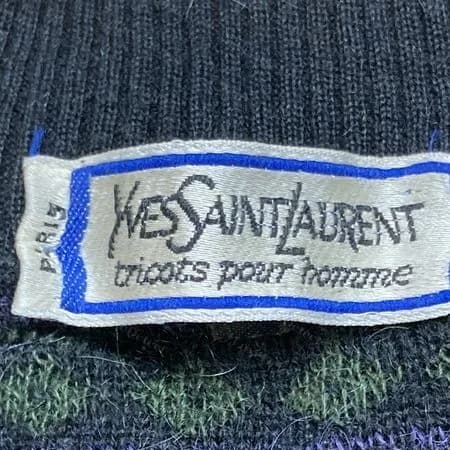
Knitwear carries its own woven label: a pale label with a blue border, the wordmark and "tricots pour homme", with "PARIS" printed up the left edge.
The Modern Care Label: Where the Detail Is
Garments from the Saint Laurent Paris era usually carry a black care label (a cream one with black print also exists) that holds more information than the older woven labels. A genuine one has these parts: the size and body measurement (for example a size number and a measurement such as 175/76A), the wordmark "SAINT LAURENT PARIS", the made-in line repeated in several languages, then two code lines and "YSL.COM". The size can sit above the wordmark or below the language block.
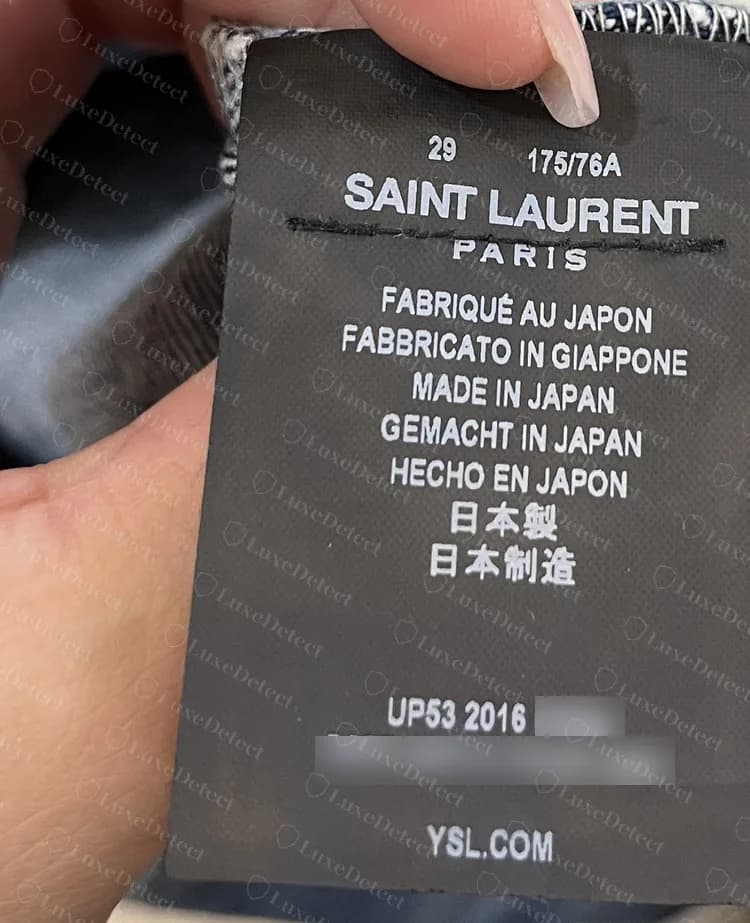
The first code line is a four-character group (a leading letter, then P and two digits), a four-digit year, and a five-digit running number. In the example above the group begins with U and the year printed is 2016. The second code line holds a four-character group, a six-digit number, a five-character group and a four-digit group. We blur the running number and the second line in our images, because a complete genuine code should not be published.
Two things change with the era, and we can see both on genuine labels.
- The leading letter differs between years. On the few genuine labels we could read, the letter was U on 2014, 2016 and 2018 labels, J on a 2020 label and Y on a 2021 label. We have not established what the letter stands for, whether the year alone or also the product line, so we give no rule.
- The made-in block grows. The 2016 and 2018 labels carry French, Italian, English, German and Spanish lines plus Japanese and Chinese. From 2020 on, the genuine labels we saw add Russian, Korean, Arabic and Portuguese lines.
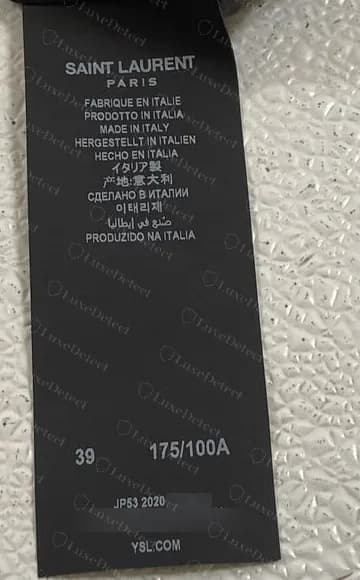
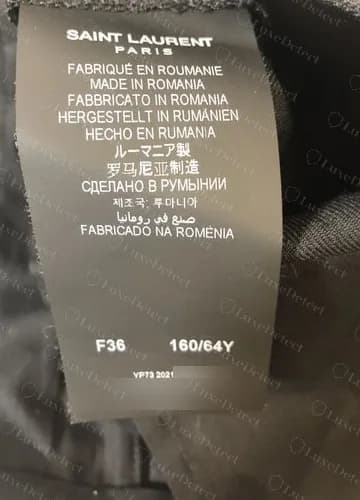
How much weight this deserves is the important question. The genuine labels we read and most of the counterfeit labels we looked at show the same pairs of letter and year, because counterfeiters copy real labels. A matching pair therefore proves nothing. A pair that looks out of place, or an old-style label with the short language block carrying a recent year, is a reason to look closer, not a rule, and we cannot call it a red flag on this evidence. A code which looks right can be a copy of a real one.
Worth knowing
The code line is a consistency check, not a verdict. A genuine label's language block fits its era, and counterfeit labels can copy that too. We could not establish what the leading letter means, so we do not use it as a test.
Hang Tags and Legal Labels
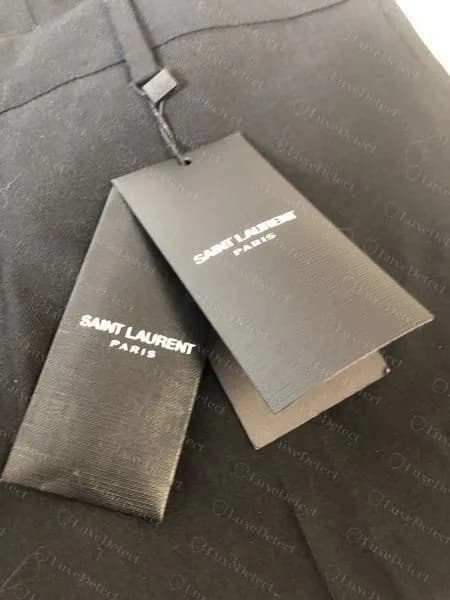
The modern hang tag is a black card with "SAINT LAURENT PARIS" in white capitals, often two tags together. Hang tags are routinely removed, so their absence means little, and a plain black tag in this style is simple to reproduce.
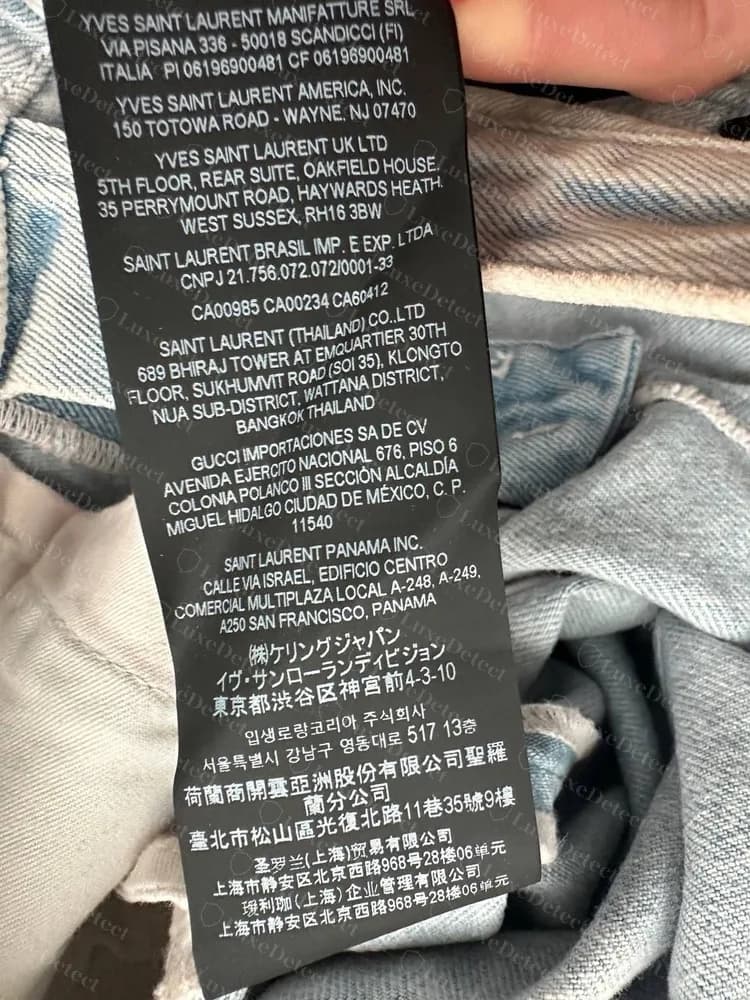
Some garments also carry a long legal label listing the importing companies for different markets, in several scripts. We saw legal labels like this on genuine and on counterfeit garments, so its presence or absence is not a tell.
What Is Not a Tell
- A label that matches these photos. Counterfeit garments reproduce every family above.
- The country of manufacture. Genuine pieces were made in Italy, France, Japan, Romania, Poland and Hong Kong.
- Two labels stacked at the neck. Genuine later rive gauche pieces carry them.
- The legal label. Present on genuine and counterfeit garments.
- A missing hang tag. Tags are removed in normal use.
- A correct-looking code. Codes are copied from real garments.
This guide does not cover buttons, zips, stitching or prints. We looked, and could not establish a hardware or construction tell that holds across genuine and counterfeit pieces of the same type, so we publish none.
Quick Reference Checklist
- Identify which label family and era the garment claims, and check it is consistent with the rest of the piece (a modern care label on something sold as 1980s, or the reverse, is an inconsistency).
- On a modern care label, check that the made-in block's languages suit the year printed (the short language block on a label printed 2020 or later is worth a second look). Do not treat the letter at the start of the code as a test.
- Compare the label set as a whole: neck label, care label and size tab should belong to the same era.
- Treat a repeated code, or a code you can find on another listing, as a warning.
- Do not treat the label, the legal label, the hang tag or the country of manufacture as proof.
- If the piece is valuable, or the label is the only thing you have, get a professional opinion.
When to Get a Professional Opinion
Because the label cannot settle the question, the decision rests on the garment: the cloth, the cut, the finishing, the print, and how all of those fit the label's era. Those are things an authenticator judges from photos of the whole piece and its construction, not from the tag. If you are buying a piece where the money matters, send clear photos of the garment, the neck label, the care label and the inside seams for a Certificate of Authenticity. See also our Saint Laurent serial number guide for bags and the Saint Laurent shoes guide.
A code that checks out doesn't prove the item is real. Counterfeiters copy genuine codes.
Our authenticators check the labels, stitching and fabric of your Saint Laurent against verified references, from $15. You get a verdict within 24 hours, and a Certificate of Authenticity if the item passes.
Authenticate My Saint Laurent →FAQ
Should Saint Laurent clothing say "Yves Saint Laurent" or "Saint Laurent Paris"?
Either can be genuine. Most garments made before the 2012 rebrand carry "Yves Saint Laurent", usually with pour homme or rive gauche (the earliest rive gauche pieces say plain "SAINT LAURENT"); later garments carry "Saint Laurent Paris" in block capitals. A label should fit the era of the garment's style.
How do I read the code on a Saint Laurent care label?
The first line has a four-character group, a year and a five-digit running number; the second line has a four-character group, a six-digit number, a five-character group and a four-digit group. The letters and years we read on genuine labels also appear on counterfeit labels, because counterfeit labels copy real codes. The code is a consistency check and not proof.
Does a Saint Laurent label need to say Made in Italy or Made in France?
No. We have genuine pieces made in Italy, France, Japan, Romania, Poland and Hong Kong. The country on its own tells you nothing.
Is a missing hang tag or legal label a red flag?
Not by itself. Hang tags are removed after purchase, and the legal label appears on both genuine and counterfeit garments in our archive.
Can a fake Saint Laurent shirt have a perfect label?
Yes. In our archive, counterfeit garments carry labels that look like the genuine ones at normal photo distance. That is why a label that looks right should not end the inspection.
Why does my older Saint Laurent label look different from the modern ones?
The house changed its name and label system over time. A pour homme, rive gauche, Paris New York or tricots label is a different generation from the black Saint Laurent Paris care label, and each can be genuine for its own period.