Fine Jewelry Authentication Specialist
Fine jewelry authentication specialist. Focuses on hallmarks, stone setting, and metal finishing.
Published November 2026 · Contact
What a Genuine Hermès Farandole Looks Like
The Farandole is a fine silver chain set with small open links in the shape of the chaîne d'ancre, the anchor-chain motif Hermès has used for decades. It is sold as a long necklace that can be worn single or doubled, and as a bracelet that closes with a toggle bar and ring. Almost everything that identifies a piece sits on the small links and on the ring, so this is a guide to reading those marks.
This guide is built from two genuine pieces in silver: a long Farandole necklace and a Farandole bracelet, both photographed in detail. Other lengths, years and workshops can differ in small ways, so compare with the same version where you can.
Worth knowing
This is a genuine reference guide. Both pieces pictured passed authentication. We do not have a set of confirmed counterfeit Farandoles to compare against, so there are no red-flag checks below. If that changes, this guide will be upgraded. Until then, use it to learn what genuine looks like, not as a test that can clear or fail a piece. For the stamp and clasp checks that apply to other Hermès jewelry, see our [Clic Clac bracelet guide](/blog/authenticate-hermes-clic-clac-bracelet-guide) and [ring guide](/blog/authenticate-hermes-ring-guide).
The Overall Piece
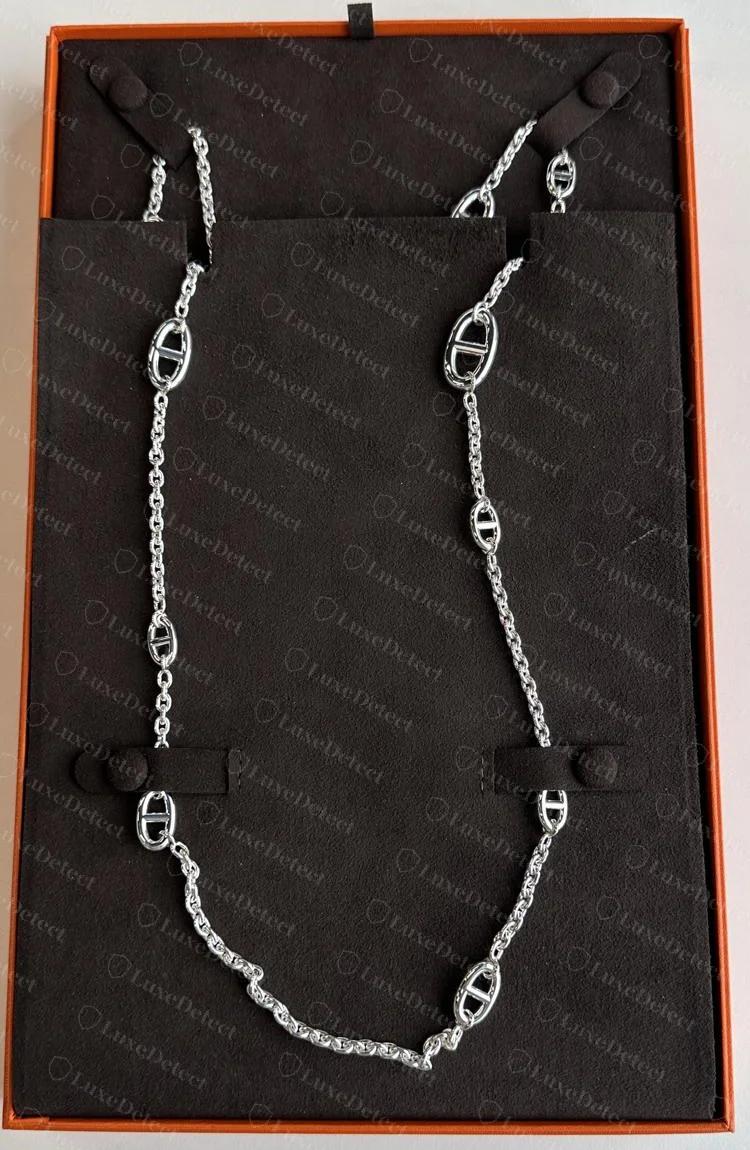
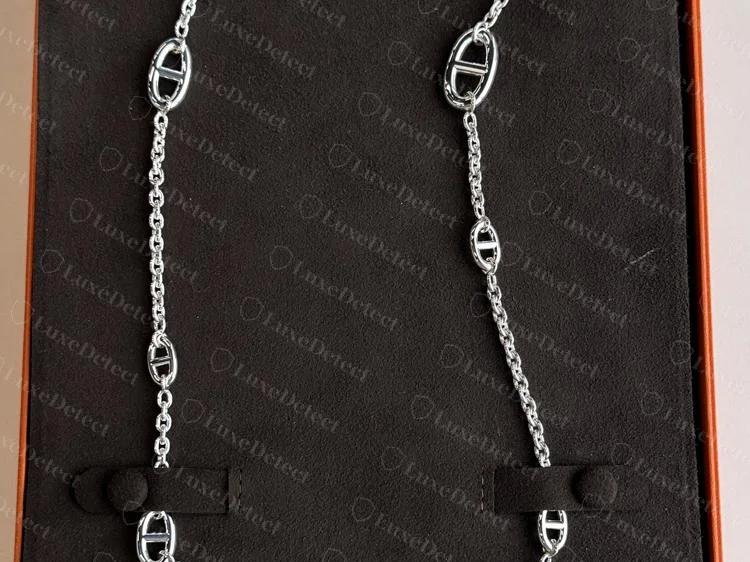
The chain is fine and even, with the open anchor-chain links spaced along its length and a plain round link chain between them. The metal is bright polished silver throughout, and the chain lies flat and smooth in the box, with no stiff or kinked stretches. The genuine necklace above arrived in an orange Hermès box with a dark brown suede insert that holds the chain in place.
The Link Engraving
Each open anchor-chain link has a bar across the middle. On the genuine pieces the bar carries HERMÈS, with an accent on the È, in fine capital letters engraved across the bar, and the edge of the link carries further small marks.
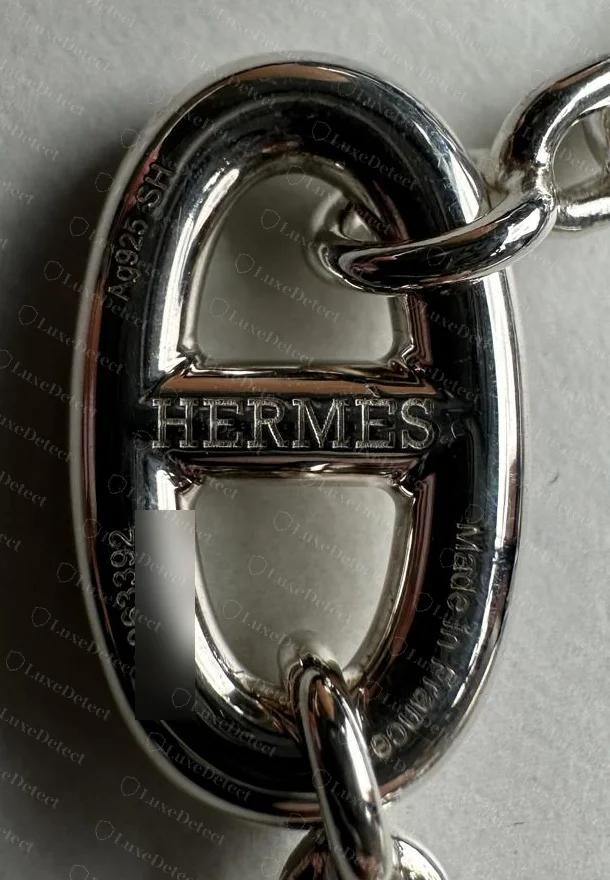
On the bracelet the left edge reads Ag925 SH over a code, and the right edge reads Made in France. The letters are small, crisp and evenly cut, and they stay legible right to the edges of the link.
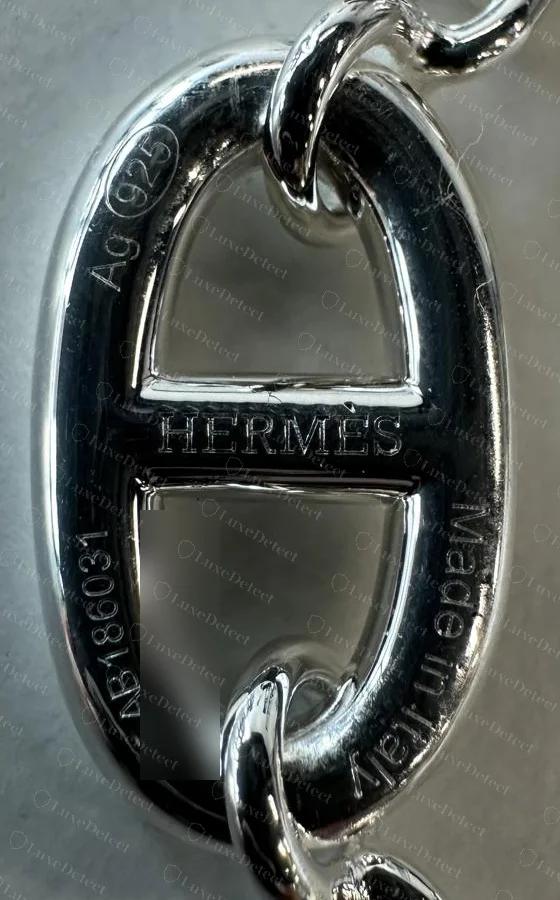
On the necklace the same link reads Ag with 925 in a small circle over a code, and Made in Italy on the other edge. So two genuine pieces differ in how the silver mark is drawn and in the country they name. That is why no single line is a test: compare the layout against a verified piece of the same version, and treat "Made in" as a plain fact, not as proof, because counterfeits print it too.
The Silver Mark and the Code
Both pieces carry a silver mark on the link (Ag925 or Ag 925) and, beside it, a short code of two digits, two letters and six digits. The code is engraved, not printed, and it sits along the curve of the link in the same small capitals as the rest of the marks.
Counterfeiters copy a silver mark and a code that looks right with no effort, so neither clears a piece. What counts is how they are cut: shallow, even strokes with clean edges, the same depth on every character, and a layout that matches the version you are comparing.
The Toggle Ring Hallmarks
The ring that closes the bracelet, and the ring on the necklace, carry a row of tiny hallmarks on the inside of the band.
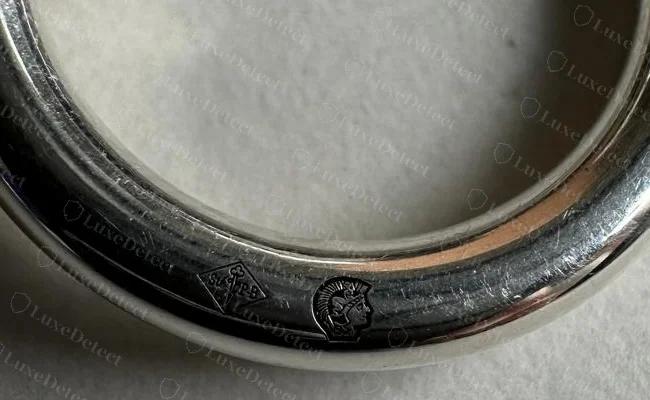
On the bracelet ring there is a lozenge-shaped mark and a small head in profile, struck cleanly on the inner curve.
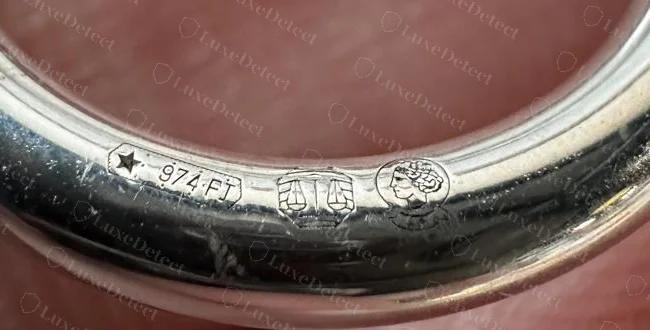
On the necklace ring there are three hallmarks in a row: a star with 974 FT, a pair of scales and a head in profile. As with the link, the two rings are not marked alike, so do not expect one fixed set of hallmarks on every Farandole. Look at whether the hallmarks are crisp, sit in a neat line on the inside of the band, and are small enough that no detail is smeared.
The Packaging
A genuine Farandole comes in the Hermès orange box. The necklace above sat on a brown suede insert with a fixing strap at each side, and the bracelet was shown around a brown suede cuff in its box. Packaging helps you read the story of a piece, but a box is easy to supply, so a genuine box does not clear the chain inside it, and a box lost over the years does not condemn a piece.
A code that checks out doesn't prove the item is real. Counterfeiters copy genuine codes.
Our authenticators check the hallmarks, engravings, clasp and settings of your Hermès against verified references, from $45. You get a verdict within 24 hours, and a Certificate of Authenticity if the item passes.
Authenticate My Hermès →What a Matching Mark Does and Does Not Prove
This guide can show you what a genuine Farandole looks like. It cannot clear yours. An engraved HERMÈS, a silver mark, a code and a row of hallmarks can all be copied, and a match proves nothing on its own. A piece that matches every detail above can still be a good counterfeit.
What carries more weight is how the whole piece agrees with itself: a link engraved cleanly with the same depth on every character, hallmarks that suit the version and sit neatly inside the ring, silver that is bright and even, links that move freely, and a chain that matches a verified Farandole of the same length and year. That takes a careful side-by-side comparison, and weight and feel are checks done with the piece in hand.
When to Get a Professional Opinion
If you are buying a Farandole and the price matters, a second opinion costs far less than a mistake. LuxeDetect's jewelry authentication starts at $45 for a 24-hour turnaround, which includes the Hermès house surcharge, and includes a Certificate of Authenticity. Start an authentication with clear photos of the whole piece, the engraved link straight on, both edges of that link, the toggle ring and its hallmarks, and the box.
Related guides
FAQ
How can I tell if my Hermès Farandole is real?
Compare the small parts with the genuine examples above: the HERMÈS engraving on the link bar, the silver mark and the code on the link edge, the hallmarks inside the toggle ring and the box. They should look like these and agree with each other. None of them is proof on its own, so for a piece you are about to pay for, get it authenticated.
Does a genuine Farandole say Made in France or Made in Italy?
The genuine pieces we looked at differ: the bracelet reads Made in France and the necklace reads Made in Italy. The country is not a test, because a counterfeit can print either.
Is the silver mark the same on every Farandole?
No. The bracelet reads Ag925 SH and the necklace reads Ag with 925 in a circle, so the layout of the mark varies. Compare it with a verified piece of the same version.
Can I authenticate a Farandole from photos alone?
Yes. What decides it is how the engraving, the silver mark, the code, the hallmarks and the finish of the chain fit together against verified pieces. Clear, sharp photos of the link, its edges and the inside of the ring make that possible. For an expensive piece, a professional review is the safer route.
Do you have a list of fake Farandole tells?
Not yet. We do not have enough confirmed counterfeit Farandoles to publish a list we would stand behind, so this guide shows genuine pieces only.