Hermès Authentication Specialist
Handbag authentication specialist. Has reviewed submissions across Hermès, Chanel, Louis Vuitton, and Dior since 2019.
Published September 2026 · Contact
Why Exotic-Skin Authentication Is Its Own Discipline
A calfskin Birkin and an alligator Birkin share the same silhouette, the same turn-lock hardware, and largely the same stitching. They do not share the same stakes. An exotic-skin bag can sell for three to ten times what the identical shape costs in Togo or Epsom leather, which means a convincing exotic fake is worth far more to a counterfeiter than a convincing calfskin one, and the leather itself introduces checks that don't exist on a standard bag at all.
This guide covers what's specific to exotic skins: telling a genuine scale or pore pattern from an embossed imitation, what CITES paperwork should and shouldn't tell you, and how the hardware and construction checks that apply to any Birkin or Kelly play out differently when the leather is alligator, crocodile, ostrich or lizard. For the symbol system stamped next to the blind stamp that identifies which species a bag is claimed to be, see our guide to Hermès special stamps. For the turn-lock plate, strap construction and stitching checks that apply to every Kelly regardless of leather, see our Hermès Kelly authentication guide.
What to check, ranked by reliability
| Checkpoint | Reliability | What it tells you |
|---|---|---|
| 1. Scale or Pore Pattern: Does It Match the Claimed Species | ★★★★★ | A surface missing the species-specific features (navel scar, visible pore, quill bumps) is very likely misrepresented leather, the single hardest and most valuable thing to fake convincingly. |
| 4. The Padlock and Clochette Leather Match | ★★★★★ | A padlock or clochette in a visibly different or smoother leather than the bag is a corner real Hermès production does not cut. |
| 3. The Turn-Lock Plate Engraving | ★★★★★ | A blank plate or inconsistent letter depth is disqualifying on its own, but a correct engraving alone does not confirm the bag. |
| 2. Scale Alignment Across Panel Seams | ★★★★★ | Consistent scale size and direction across the front and side seams reflects careful, expensive pattern-matching; judge the primary panels, not every internal seam. |
| 5. What CITES Paperwork Does and Doesn't Prove | ★★★★★ | Corroborating evidence only, a certificate photo does not prove it belongs to the specific bag; cross-check reference numbers against the bag's own tags. |
| What the Box and Dust Bag Do and Do Not Prove | ★★★★★ | Packaging is context only, useful for cross-referencing, never as evidence. |
Which Skins This Guide Covers
Hermès uses four exotic leathers regularly enough to matter for authentication:
- Alligator (Alligator mississippiensis) — American alligator, large even belly scales, a navel scar visible on the central underside scales. Available matte or glazed (Alligator Brillant).
- Porosus crocodile (Crocodylus porosus) — saltwater crocodile, fine uniform scales with a visible central pore in each one, Hermès's most prestigious and expensive skin.
- Niloticus crocodile (Crocodylus niloticus) — Nile crocodile, larger and more rectangular scales than Porosus, more visual variation.
- Ostrich — small, evenly spaced raised quill follicle bumps across the whole surface, not a scale pattern at all.
Lizard (Varanus niloticus, ring lizard) appears in this guide's photo set too, but mostly on smaller pieces; the checks below apply to it the same way they apply to the scaled crocodilians. This guide focuses on Birkin and Kelly specifically, since the turn-lock plate and strap-keeper construction checks are shared between the two models and the leather checks don't depend on silhouette at all.
Scale or Pore Pattern: Does It Match the Claimed Species
The single most decisive check on any exotic bag is whether the skin's surface texture actually matches what the listing claims it is. This has to be checked visually against the specific species, not just "does it look scaly."
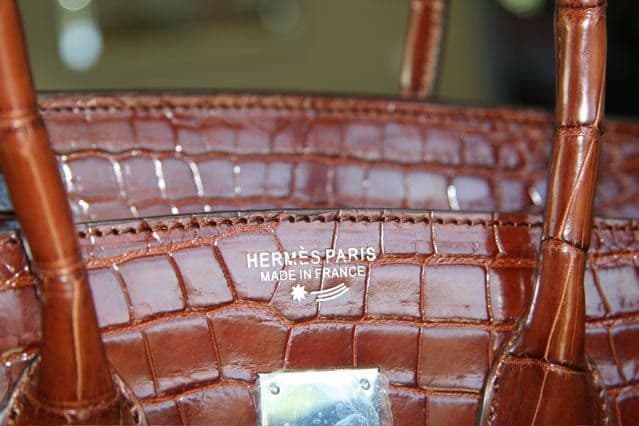
Alligator belly scales are large, smooth-edged and arranged in a relatively regular grid, with a small circular navel scar visible on a handful of the central scales, a genuine anatomical feature that has no reason to appear on an embossed imitation. Porosus crocodile scales are fine, uniform, and each one shows a visible central pore, the follicle mark, evenly distributed across the panel. Niloticus scales are larger, more rectangular, with less uniform spacing than Porosus. Ostrich isn't a scale pattern at all: it's a field of small raised bumps (the quill follicles), evenly spaced, present across the entire panel including areas a scale-based skin wouldn't have marking.
| Element | Authentic | Counterfeit |
|---|---|---|
| Alligator navel scar | A small circular mark on a few central belly scales, an anatomical feature | Absent, or a random circular tool mark not seated in a specific scale |
| Porosus pore | A distinct dot visible inside each individual scale | Smooth scale interior, or a printed dot with no depth |
| Ostrich quill bumps | Present across the whole surface, size and spacing consistent | Bumps clustered or printed only where a photo is likely to be taken |
| Scale/bump depth | Embossed or genuine texture has real depth under raking light | Printed pattern is flat; texture doesn't change under angled light |
Red flag
A surface claimed as alligator with no navel scar anywhere on the panel, or claimed as Porosus with scales that have no visible pore, is very likely an embossed calfskin or a lower-value exotic passed off as a more expensive one. This is the check that matters most because it's the hardest and most expensive part of the bag to fake convincingly.
Red flag
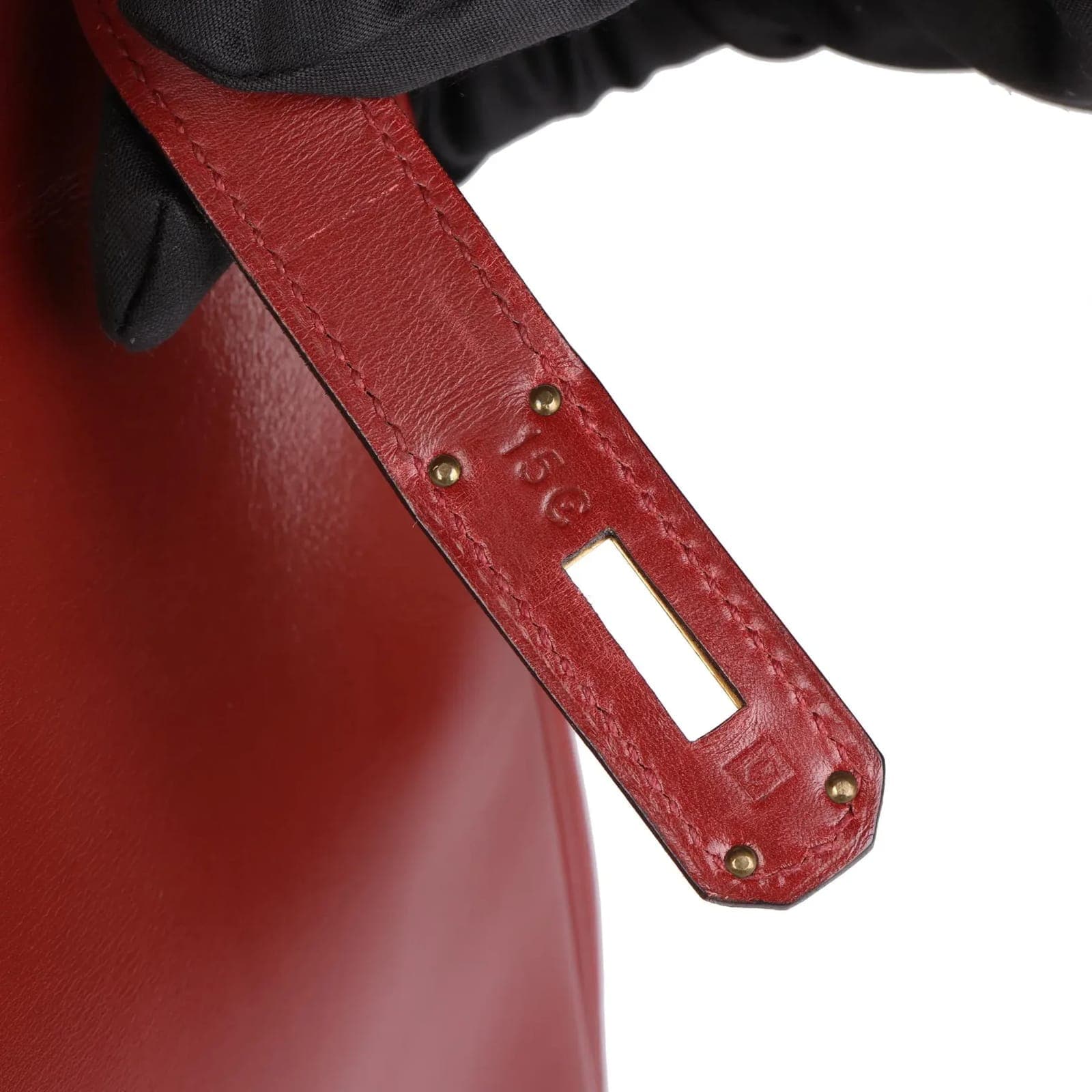
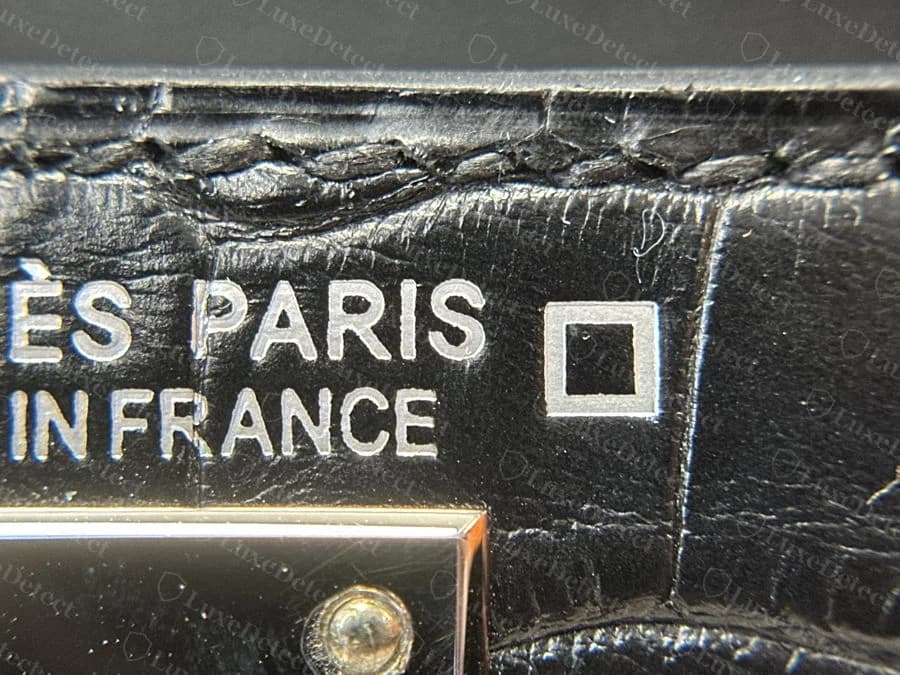
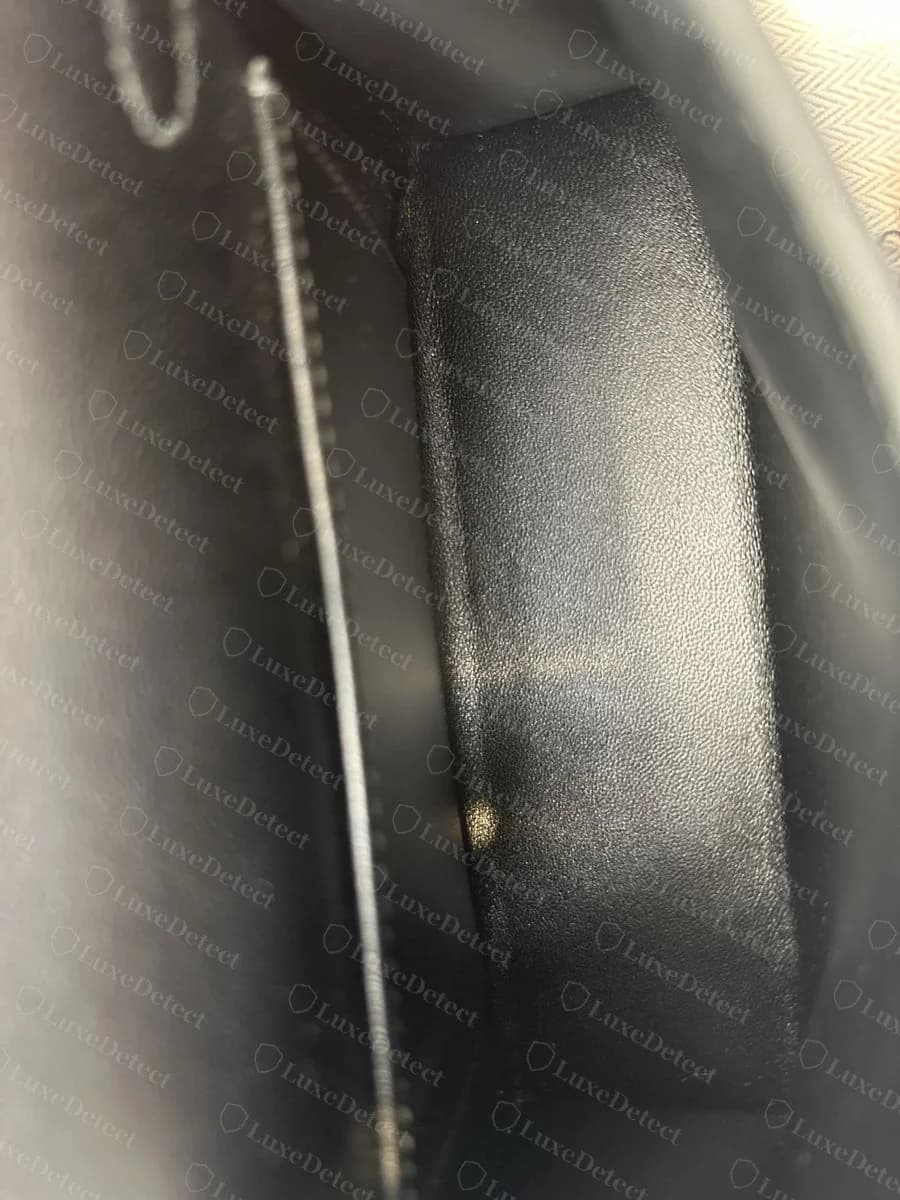
From a listing claiming full alligator throughout: the main panel next to the interior stamp shows correct, genuine-looking scale texture, but a construction detail on the same bag (below) shows completely smooth, unscaled leather with no texture at all, on a part that should be cut from the same hide. A single item where the leather texture is inconsistent between panels is a real tell, whether that inconsistency comes from mixing a genuine exotic front panel with cheaper smooth leather elsewhere, or from a fully embossed fake that happened to miss one spot in finishing.
Worth knowing
We can't determine from photos alone whether this specific bag's mismatch reflects two different leathers used on one item, a repair, or a full fake with inconsistent embossing; what matters for your own inspection is the method, check texture at more than one point on the bag, not just the most visible panel, since that's exactly where effort concentrates on a convincing fake.
Scale Alignment Across Panel Seams
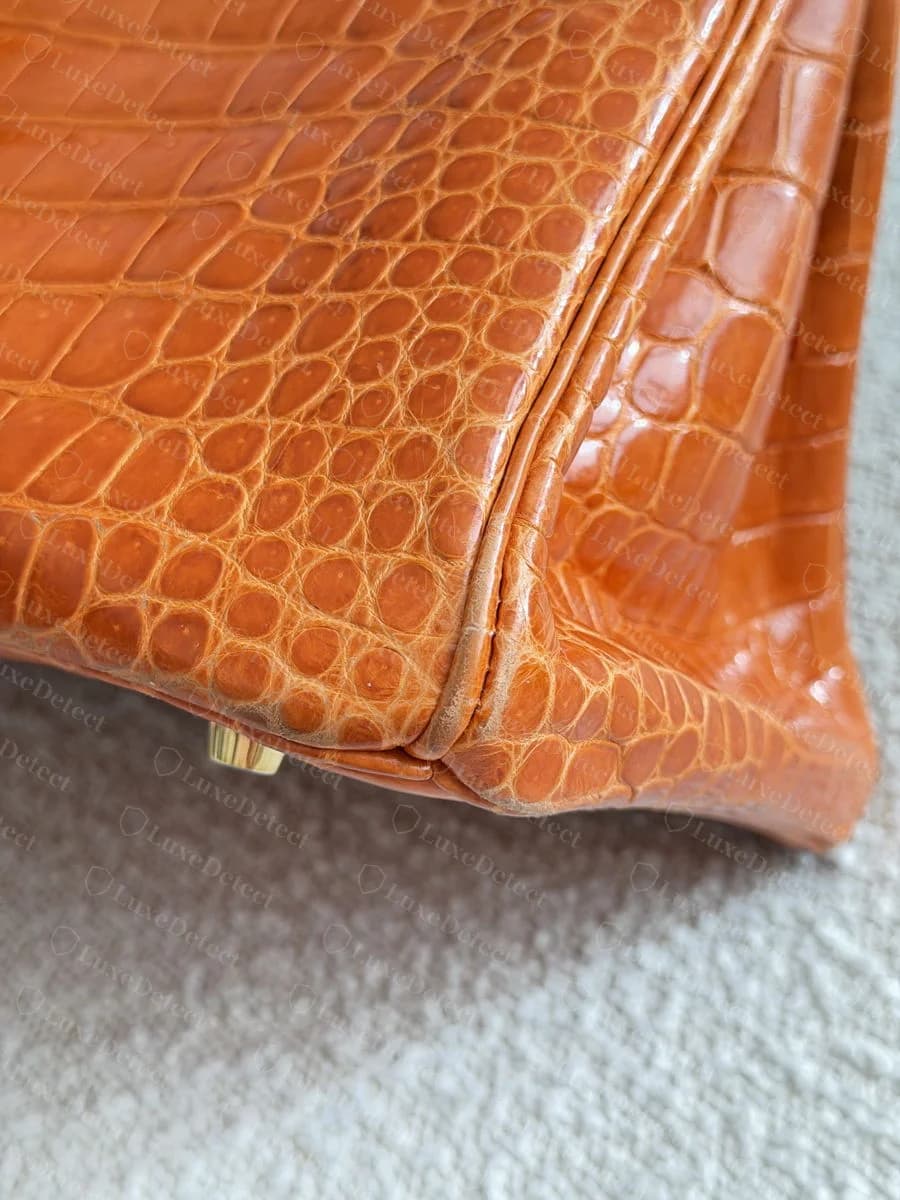
Hermès pattern-cuts exotic skins so the scale rows continue in a consistent direction and, where two panels meet at a seam, the scale size and orientation stay visually consistent rather than jumping abruptly. This is a construction discipline, not a leather-quality one: it reflects how carefully the pattern pieces were selected and matched before cutting, which is expensive to do and easy to skip.
Worth knowing
Perfect scale continuity across every seam isn't realistic even on a genuine bag, since exotic hides aren't uniform and Hermès prioritizes matching the *front* panel above less visible seams. Judge this on the primary front and side panels, not on every internal seam.
The Turn-Lock Plate Engraving
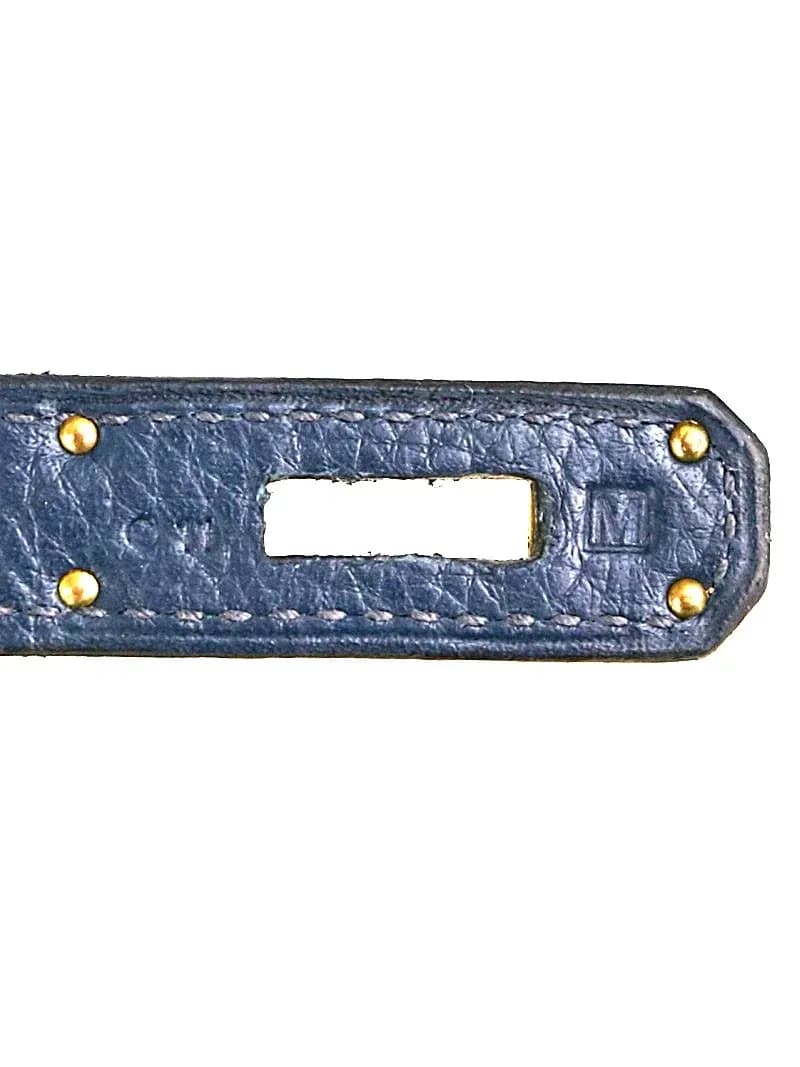
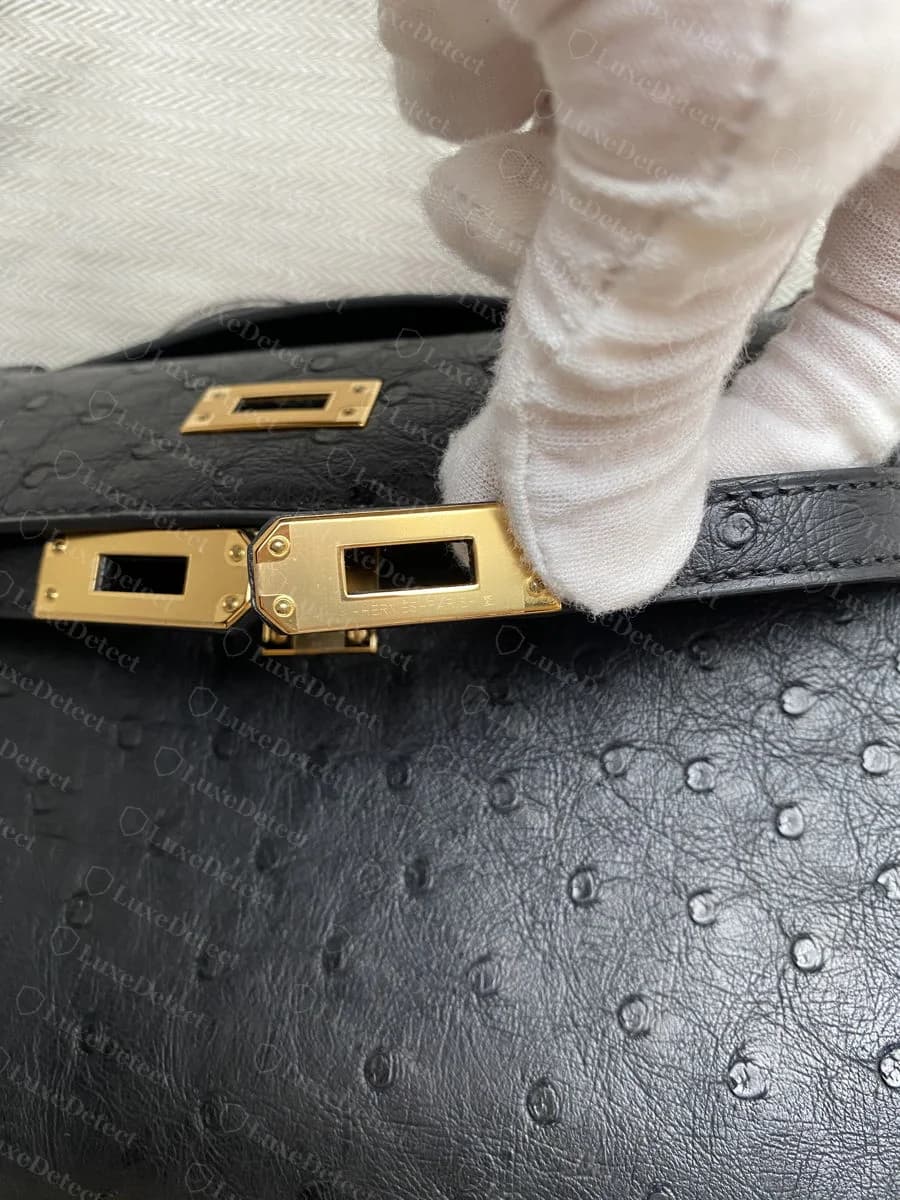
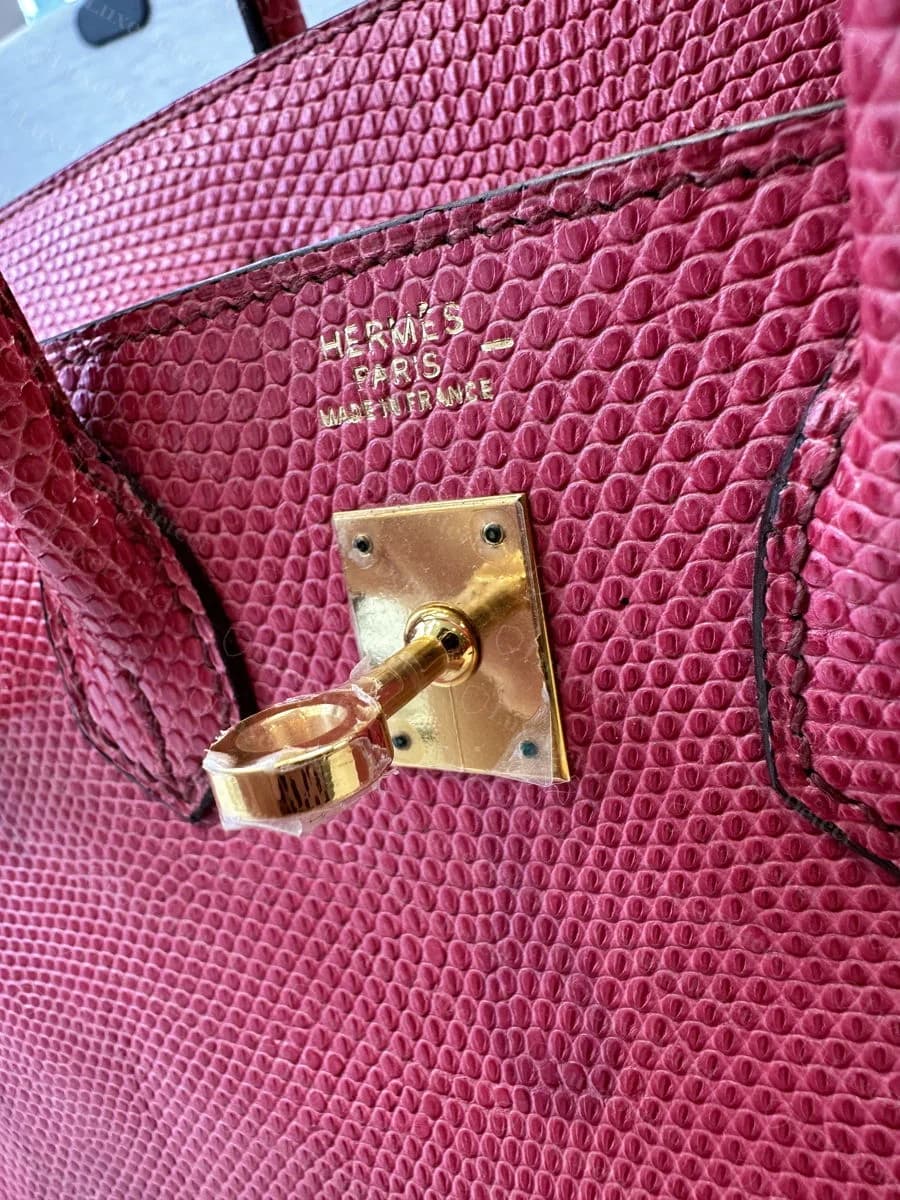
This check applies to any Kelly regardless of leather (see our Kelly guide for the full construction/stitching breakdown), but it's worth restating here because exotic-skin fakes concentrate their effort on the leather and sometimes get lazy with the metal. The rectangular turn-lock plate is engraved "HERMÈS PARIS" (or "-HERMÈS-PARIS-" depending on era), squared and centred, with a small craftsman's mark square beside it on most production.
| Element | Authentic | Counterfeit |
|---|---|---|
| Engraving depth | Crisp, consistent depth across every letter | Shallow, uneven, or letters that look printed rather than cut |
| Plate alignment | Centred and square to the strap | Visibly off-centre or crooked |
| Craftsman's mark | Present as a small distinct square icon | Missing, blurred, or replaced with unrelated marks |
Red flag
A blank turn-lock plate with no engraving at all, or an engraving with visibly inconsistent letter depth across the same line of text, is disqualifying on its own regardless of how convincing the leather looks.
Worth knowing
A correct-looking turn-lock engraving on its own doesn't confirm the bag; it's one input among several. Cross-reference it against the leather-consistency check above and the padlock set below before drawing a conclusion.
The Padlock and Clochette Leather Match
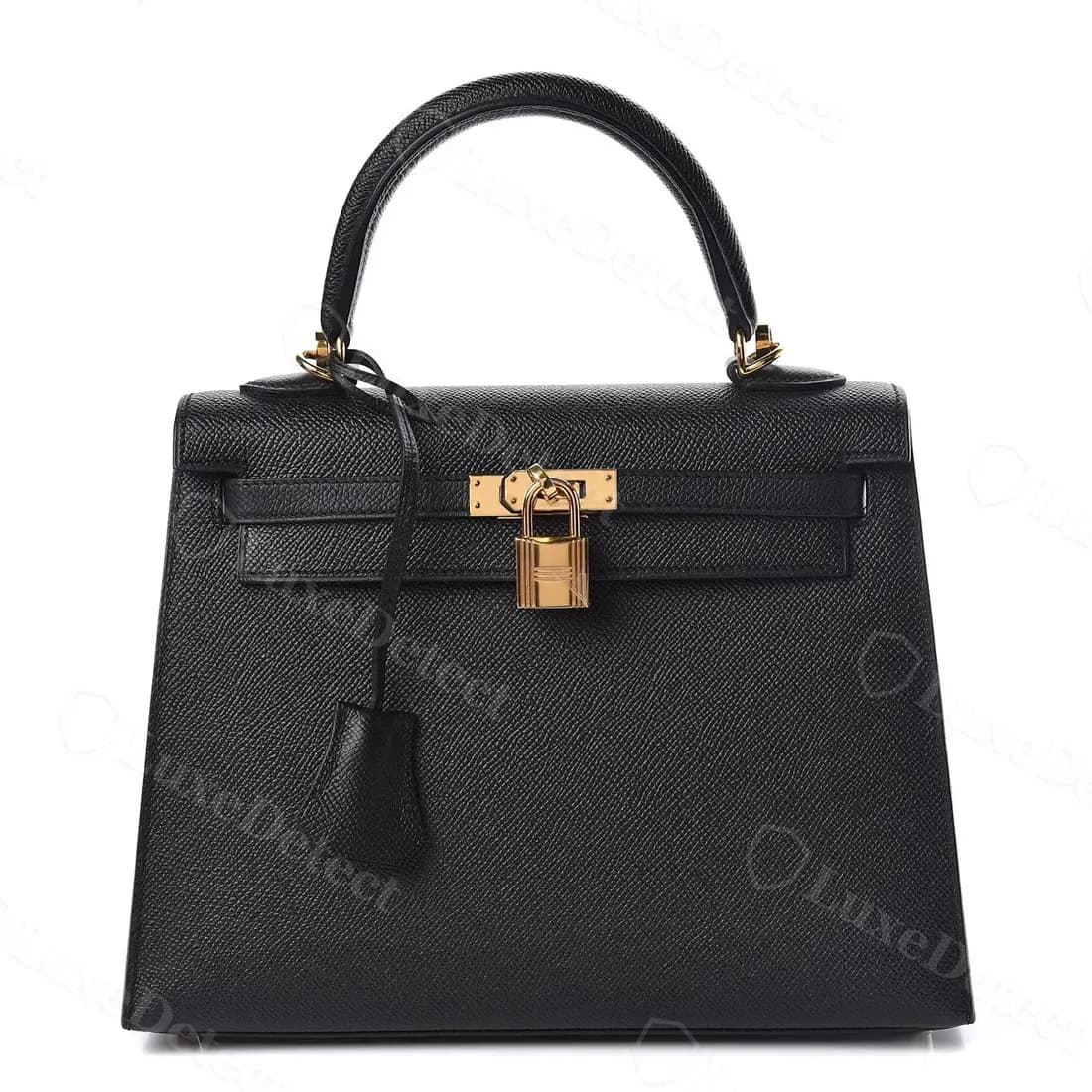
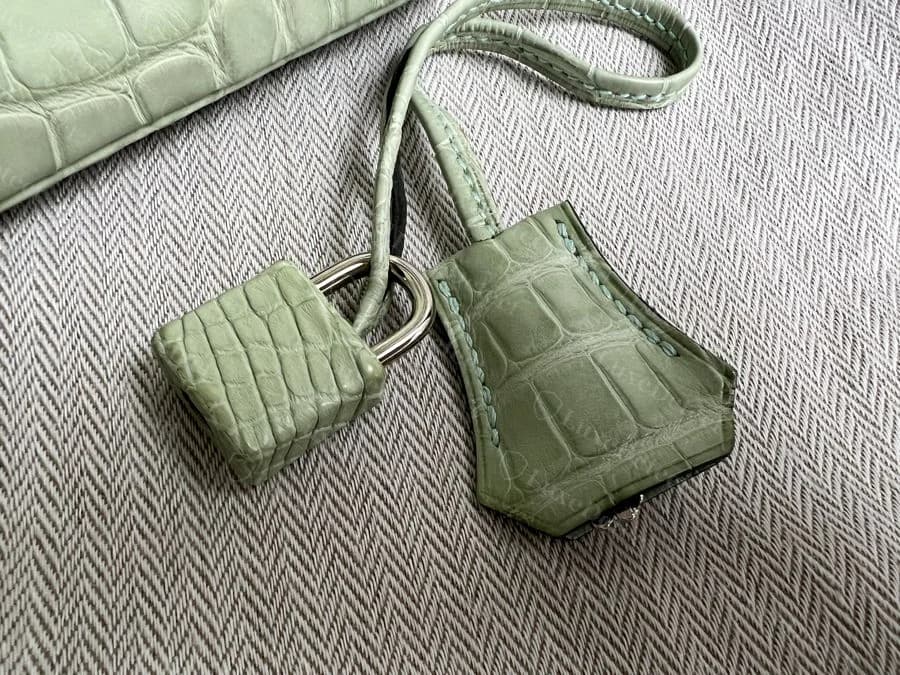
Every Kelly ships with a padlock, a small key, and a clochette (the small leather pouch the key rides in), all covered or accented in the same exotic leather as the bag itself. This is a detail that's expensive to execute well, since it means cutting and stitching a scaled or pored leather onto a tiny curved surface, and it's a place where the same panel-to-panel leather-consistency check from checkpoint 1 applies again on a smaller, easier-to-miss scale.
| Element | Authentic | Counterfeit |
|---|---|---|
| Padlock leather wrap | Scale/pore pattern continues smoothly around the curved surface | Pattern distorted, stretched, or the wrap uses a different, smoother leather |
| Clochette stitching | Fine, even stitches following the leather's natural panel lines | Loose, uneven stitching or visible glue at the seam |
| Leather-to-hardware match | Same finish (matte/glazed) as the bag's main panels | Mismatched sheen between the padlock leather and the bag |
Red flag
A padlock or clochette wrapped in a visibly different or smoother leather than the rest of the bag is a strong sign the small leather goods were sourced separately from a mismatched, cheaper batch, a corner real Hermès production doesn't cut, and it's the same inconsistency pattern shown in checkpoint 1, just on a smaller piece.
What CITES Paperwork Does and Doesn't Prove
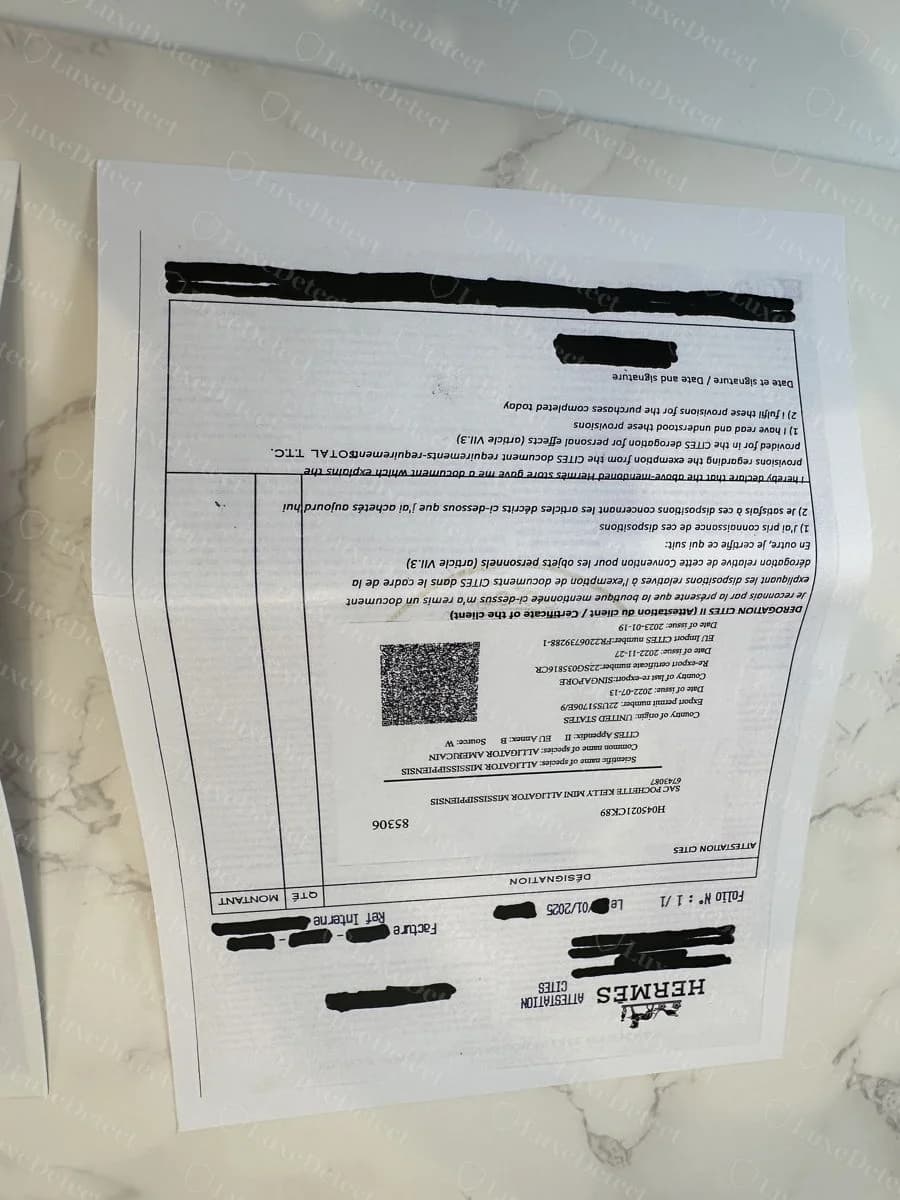
Alligator and crocodile are regulated under CITES (the Convention on International Trade in Endangered Species), and a genuine Hermès alligator or crocodile bag sold through proper channels is typically accompanied by CITES documentation, an export certificate or an attestation for personal effects, tied to a specific tag or reference number.
Use our free Hermès Date Stamp Decoder to identify the production year of any Birkin, Kelly, or Constance — circle, square, or modern alphanumeric format.
Decode Hermès Stamp →Paperwork is corroborating evidence, not proof on its own. A photo of a CITES document doesn't confirm the document belongs to the specific bag in front of you; the reference numbers on the certificate should match markings on the bag itself, and the species named on the certificate should match what you've confirmed visually using the leather check above.
Worth knowing
We found a listing in our research where the same CITES certificate photo appeared to accompany more than one distinct bag listing. That doesn't necessarily mean either bag is fake, sellers sometimes reuse a certificate photo carelessly across relisted or bundled items, but it's a reason to ask for the certificate's actual reference number and cross-check it against the bag's own tags rather than accepting a photo of paperwork at face value.
Ostrich and lizard aren't CITES-regulated in the same way alligator and crocodile are, so the absence of CITES paperwork on an ostrich or lizard bag is normal and not a red flag by itself.
What the Box and Dust Bag Do and Do Not Prove
Packaging, including a felt protector, dust bag, or box, tells you nothing about the leather or the hardware. Exotic-skin Hermès bags ship in the same standard packaging as calfskin ones; premium-looking packaging doesn't correlate with the bag's authenticity or its skin type. Treat it as context for cross-referencing a claimed purchase date against the bag's condition, never as evidence on its own.
Quick Authentication Checklist
- Confirm the scale, pore, or quill-bump pattern matches the claimed species, including species-specific features like the alligator navel scar.
- Check scale continuity across the front and side panel seams.
- Examine the turn-lock plate engraving for depth, centring, and the craftsman's mark.
- Confirm the padlock and clochette leather matches the bag's main panels in both pattern and finish.
- If the skin is alligator or crocodile, ask for the CITES reference number and cross-check it against the bag's own tags, not just a photo of the document.
A failure on the leather-species check (1) is sufficient on its own to reject the bag. A failure on any two of the remaining checks should end the inspection; a single failure elsewhere is a reason for closer review, not an automatic rejection.
When to Get a Professional Opinion
Exotic-skin authentication carries more financial risk per mistake than any other Hermès category, and the leather check in particular takes hands-on experience with multiple confirmed species to apply reliably from photos alone. If you're evaluating a five- or six-figure exotic Birkin or Kelly, a professional review is proportionate to the stakes in a way it might not be for a more modestly priced calfskin bag. LuxeDetect's Hermès handbag review starts at $40 for a 24-hour turnaround (the $25 handbag base rate plus our $15 Hermès surcharge, which reflects the extra specialization Hermès authentication requires generally), with faster turnarounds available; exotic-skin submissions get evaluated against the species-specific checks in this guide plus construction and hardware review, and a Certificate of Authenticity if the item passes.
FAQ
How much more does an exotic-skin Birkin or Kelly cost than the same bag in calfskin?
It varies by skin and by how rare the specific color/finish combination is, but a rough range is three to ten times the calfskin price. A Togo leather Birkin 30 might sell for $30,000-$40,000; the same size and color in Porosus crocodile might sell for $100,000-$200,000, with alligator and Niloticus crocodile typically landing between those two points.
Is ostrich leather as valuable as alligator or crocodile?
No. Ostrich and lizard carry a real premium over calfskin but a smaller one than the crocodilian skins, and they aren't CITES-regulated the way alligator and crocodile are. Don't apply the same paperwork expectations to an ostrich bag that you would to an alligator one.
What's the navel scar on an alligator bag, and why does it matter?
It's a small circular mark visible on a handful of the central belly scales, left from where the animal's navel was. It's a genuine anatomical feature of American alligator belly leather specifically, and it's difficult to fake convincingly because it has to appear in the right scales with the right shape, not just anywhere on the panel. Its presence supports the alligator claim; its total absence across an entire panel claimed as alligator is a real concern.
Can I identify the exotic species without knowing the stamp symbol?
Yes, and you generally should try to, since the stamp symbol itself can be misapplied to the wrong leather. Alligator has large smooth scales with a navel scar; Porosus crocodile has fine uniform scales each with a visible pore; Niloticus crocodile has larger, less uniform rectangular scales; ostrich is a field of small raised bumps rather than a scale pattern at all. For the full stamp-symbol reference, see our Hermès special stamps guide.
Does a CITES certificate guarantee the bag is authentic?
No. It's corroborating evidence that should match the bag's own reference numbers and the species you've independently confirmed by eye, not proof on its own. A photo of a certificate doesn't establish that the document belongs to the specific bag being sold, especially in a listing where the certificate photo could plausibly have been reused.
How many exotic Birkin and Kelly listings is this guide based on?
Photo review across roughly 20 verified genuine and 30 confirmed counterfeit exotic-skin Birkin and Kelly listings, spanning alligator, Porosus and Niloticus crocodile, ostrich, and lizard. That's enough to establish the checks above reliably, but exotic leathers vary more piece to piece than calfskin does; if a specific bag's texture looks unusual in a way this guide doesn't address, that's a reason for a closer professional look, not an automatic verdict either way.