Sneaker Authentication Specialist
Sneaker and streetwear authenticator. Covers Nike, Jordan, Yeezy, and limited collaboration releases.
Published October 2026 · Contact
The Adidas Batch Code, QR Code and Barcode: What You Are Looking At
Buyers search for the "adidas batch code", the "adidas QR code" and the "adidas barcode" hoping one scan will settle whether a pair is real. It will not. These are three separate codes with three separate jobs, and all of them can be copied onto a fake. This guide explains what each one identifies, what a mismatch looks like, and where the real checking happens.
The rule we apply to every code on a shoe: a code that matches proves nothing, and a code that contradicts the shoe or its box is a red flag. A fake can carry a perfectly formatted label. A pair with a label that disagrees with itself is worth stopping on.
Where the Codes Are
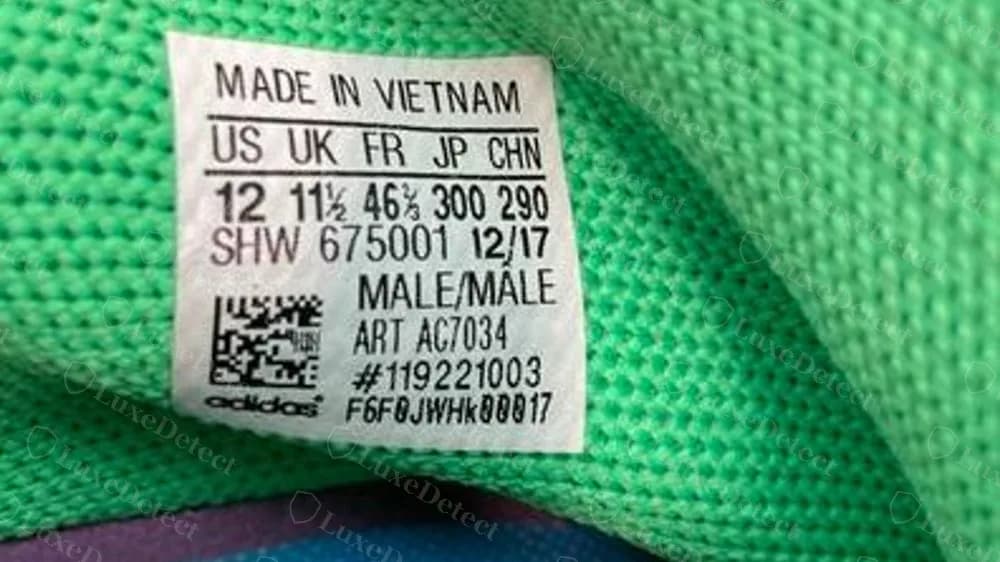
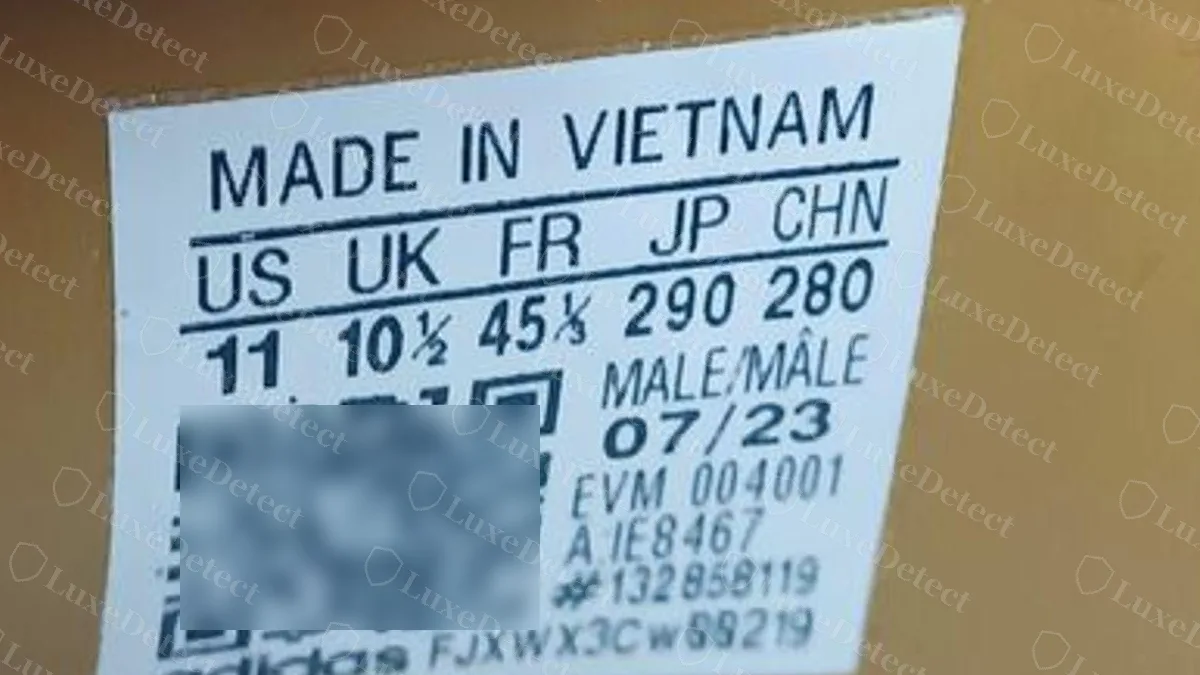
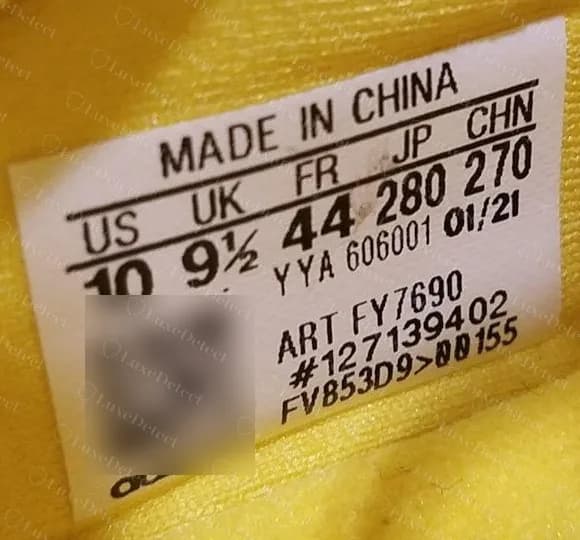
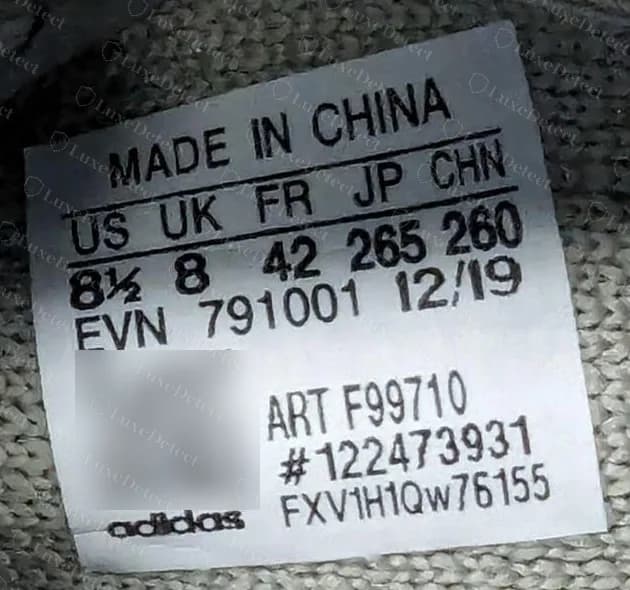
Open the shoe and look at the white label sewn inside, on the tongue or the lining. On the adidas labels we reviewed (Forum, Ultraboost and Yeezy pairs across several years) it holds, in this order:
- A "MADE IN" line.
- A size grid in US, UK, FR, JP and CHN.
- A gender line on some labels.
- A date in month/year form, such as 07/23 or 12/19.
- A short factory-style code beside the date, three letters and six digits on the labels we read.
- The article number, often printed as "ART" followed by a letter and digits, such as F99710.
- A longer number starting with "#".
- A further string of letters and digits beside the logo.
- A QR code on most labels, or a square data-matrix code on others.
The box carries a similar label, and new pairs often carry a paper hangtag as well. That hangtag is where the printed barcode usually sits.
The Adidas Batch Code: There Is No Single "Batch Code"
Adidas does not print a field called "batch code" on the labels we reviewed. When people search for it, they usually mean one of three things:
- The date. The month/year on the label reads as the production date. It is useful in one way: it cannot be earlier than the model. A label dated before the colourway existed does not fit a genuine pair.
- The factory-style code next to the date. This is a production code. We did not find an adidas page that explains how to read it, and we are not going to guess at its meaning. We use it only to check that it looks like the codes on genuine labels of the same period.
- The "#" number and the string beside the logo. These read as production identifiers. As with the factory code, adidas does not publish a decoder, so we do not give one.
There is no public tool where an adidas batch code confirms a pair is genuine. Third-party "adidas batch code check" pages and apps are not adidas tools that we can find, and you cannot tell from them whether the number you typed is a real one or simply a number in the right format.
Worth knowing
Treat the date and the factory code as a consistency check against the model and the box. They are not a lookup that clears a pair.
The Adidas Barcode: A Product Code, Not a Serial
The barcode you see on the hangtag or the box is a UPC. A UPC is a form of GTIN, the Global Trade Item Number system, which Wikipedia describes as an identifier for trade items. GTINs identify a type of product, not an individual unit, so identical pairs of the same model, colour and size share a number.
That is why the adidas barcode cannot prove authenticity. It tells a till which product it is looking at. On the hangtag of a Yeezy pair we judged fake, the barcode, the article number and the size grid were all printed in the right format, and the article number matched the one on the label inside the shoe.
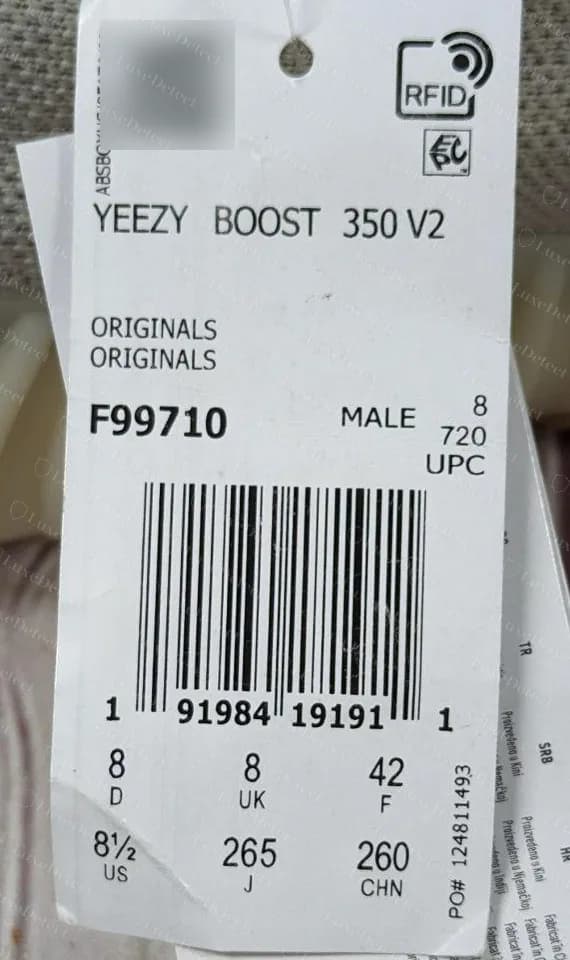
What you can check: the article number on the hangtag, the box and the shoe label should be the same, and the size on all three should match. A box or tag that disagrees with the shoe is a red flag. A box that agrees tells you the box and the shoe belong together, nothing more.
The Adidas QR Code: What a Scan Shows
Most current adidas labels carry a QR code. Scanning it with a phone camera shows the text or link stored in the code. We did not find any adidas page that says what the code is meant to open, and no adidas tool that confirms authenticity from it. The retail and blog pages we found disagree about what a scan returns, and none of them is an adidas statement.
Two points hold regardless:
- A QR code is printed data. Anyone can print a QR code that opens a real adidas page, or one that reads like a genuine label's data. A scan that lands on adidas.com or shows a model name tells you where the code points, not who made the shoe.
- A scan that goes somewhere odd is a red flag. A code that opens a dead link, an unrelated product, or a page that asks for payment or a login, deserves to be treated as a warning on the listing.
On pairs we judged fake, the label was often fully formatted, with the right layout, a plausible date, an article number and a QR code. The Samba and Yeezy fakes we reviewed copy the whole label, so a clean QR does not clear a pair.
What a Mismatch Looks Like
These are the combinations that point away from a genuine pair. None is proof alone, and each is worth following up:
- The article number on the shoe label is different from the one on the box or the hangtag.
- The article number belongs to another colourway or another model when you search it on adidas.com or a retailer.
- The date falls before the model was released.
- The size grid does not match the size printed on the box or in the listing.
- The label is missing a field that every other label of the same period carries.
- The QR code does not scan, or opens something that is not adidas.
For the Samba, the existing adidas Samba guide goes through the label, stripes, insole and sole of that model, and the Yeezy 350 V2 guide does the same for the Yeezy.
Where Real Checking Happens
The codes are the quickest part of a check and the weakest. A genuine check weighs where the pair was bought, the receipt, the label, and then the shoe itself against a confirmed pair of the same colourway: the upper, the stitching, the insole print, the sole. Our Pharrell Hu NMD guide shows the same pattern, with convincing labels on pairs that still failed.
If you want a pair reviewed by a person, you can submit it for an adidas authentication with clear photos of the label, the insole, the sole and the overall shape.
FAQ
What is the adidas batch code?
Adidas does not print a field called "batch code" on the labels we reviewed. People usually mean the month/year date, the short factory-style code beside it, or the "#" number on the label. Adidas publishes no decoder for them, so they work as a consistency check, not a lookup.
How do I do an adidas batch code check?
There is no official adidas batch code check. Compare the article number and size on the shoe label with the box and the hangtag, then confirm the article number belongs to the colourway on adidas.com or a retailer. A match proves nothing, and a mismatch is a red flag.
What does the QR code on adidas shoes do?
It stores text or a link that a phone camera can read. We found no adidas page that explains what it is meant to open, and no adidas tool that confirms authenticity from it. Fakes print QR codes too, so a scan that works does not clear a pair.
Does the adidas barcode prove my shoes are real?
No. The barcode is a UPC, a product code shared by every pair of the same model, colour and size. It can be copied onto a fake box or hangtag. Use it to check that the box and the shoe agree, and treat a mismatch as a red flag.
How do I scan the adidas QR code?
Open your phone camera and point it at the code, or use the camera in a QR app. Treat the result as information about where the code points, not as verification. If it asks you to log in, pay or install something, stop.
Can an adidas scan code check tell me if a shoe is fake?
Not by itself. A scan code shows printed data, and fake labels copy the format. The reliable route is to compare the whole pair with a confirmed pair of the same colourway, or to have it reviewed.