Sneaker Authentication Expert
Sneaker and streetwear authenticator. Covers Nike, Jordan, Yeezy, and limited collaboration releases.
Published September 2026 · Contact
Why the Hardware Is the Tell
Philipp Plein sneakers are built around a small set of recognisable signatures repeated across almost every silhouette: a hexagonal "PP" monogram plaque on the outer vamp, a skull-and-crossbones motif on the heel or tongue, and "PLEIN" or "PHILIPP PLEIN" lettering embossed or printed on the heel counter. Because these elements repeat across the low-top leather trainers, the chunkier Phantom Kick$, and the Plein Sport running-inspired line, they're also the elements counterfeiters have to reproduce every single time — and where the corner-cutting shows up most consistently.
This guide is built from a side-by-side review of one fully documented authentic pair against six separate counterfeit submissions spanning low-top leather trainers, a studded high-top, and a chunky Plein Sport knit trainer. The pattern held across all six: fakes get the general silhouette right from a distance, then lose the hardware, the sole branding, or both up close. That is where this guide concentrates.
What to check, ranked by reliability
| Checkpoint | Reliability | What it tells you |
|---|---|---|
| 1. The Hexagonal "PP" Side Plaque | ★★★★★ | A riveted, screwed-on rectangular plaque in place of an embossed hexagonal panel is enough on its own to reject the pair. |
| 2. The Sole — Branding and Repeating Monogram Tread | ★★★★★ | A blank or generic sole with no brand text or monogram tread is one of the clearest tells across the sample. |
| 3. Heel and Tongue Branding — Lettering and the Skull-and-Crossbones | ★★★★★ | Execution quality (crisp moulded lettering versus pressed or blobby casting) is a useful supporting signal, not decisive alone. |
| 4. The Interior Tag and Insole | ★★★★★ | The least consistent checkpoint in this sample; treat it as a tie-breaker alongside the plaque and sole, not a primary check. |
| Model Reference Before You Start | ★★★★★ | Confirms which Philipp Plein footwear line is shown; will not catch a good fake of that line. |
Model Reference Before You Start
- Low-top leather trainers (the most copied silhouette): smooth leather upper, hexagonal PP plaque on the vamp, skull-and-crossbones on the heel or laces, "PLEIN" lettering embossed into the heel counter.
- Phantom Kick$: chunkier rubber sole unit, mesh or leather upper, hexagonal PP tag stitched to the tongue rather than embossed into the leather.
- Plein Sport: the brand's diffusion sportswear line, knit uppers, toggle laces, "PLEIN SPORT" wordmark on the heel strap rather than the skull-and-PP hardware of the mainline shoe.
- Genuine current-production Philipp Plein footwear is made in Italy; the sole and interior tag both say so. Treat "Made in" claims as one data point, not the verdict, per the note below.
- Watch for size run and box labels that only say "Philipp Plein" with no model name — that alone isn't a red flag, but it means you lean harder on the physical checks in this guide.
The Hexagonal "PP" Side Plaque
Nearly every Philipp Plein sneaker line carries a hexagonal plaque or embossed panel with a stylised interlocking "PP" monogram, usually on the outer side of the shoe near the toe box. This is the single most consistent brand signature across the collection, and it's also the element every counterfeit in this sample got wrong in a different way.
On the authentic pair reviewed here, the plaque is embossed directly into the leather upper as a raised hexagonal panel with a clean interlocking "PP" — no applied hardware, no screws, no visible seam around the edge. The monogram reads clearly at any angle because it's moulded into the material itself.
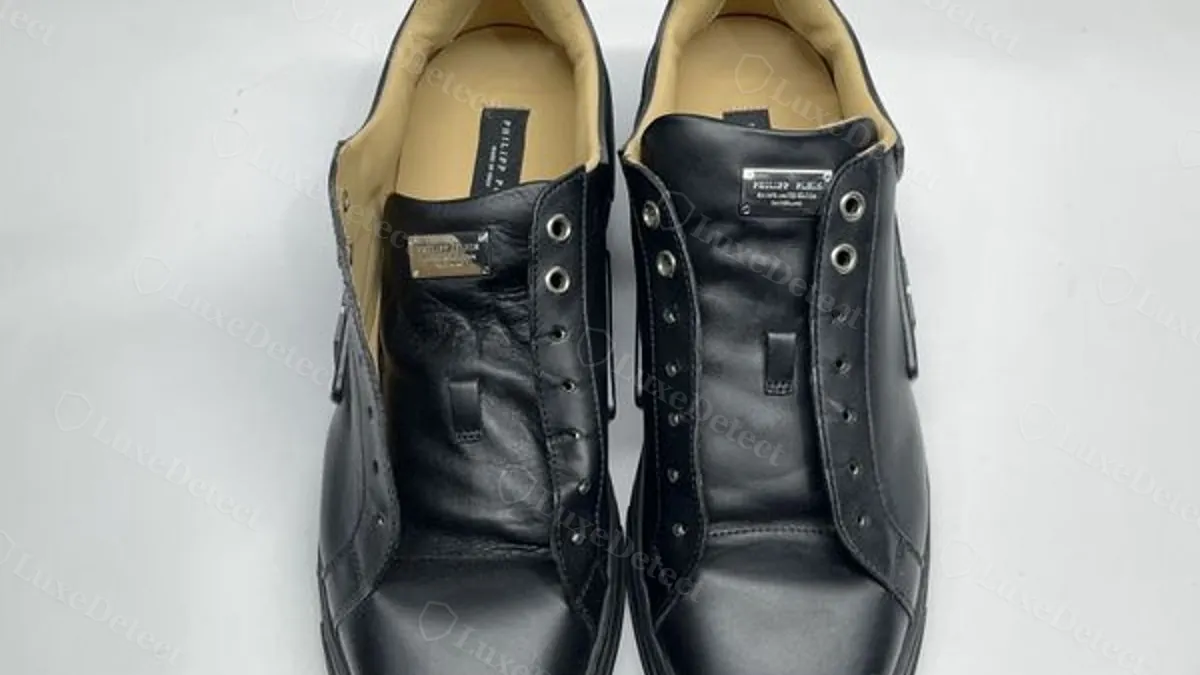
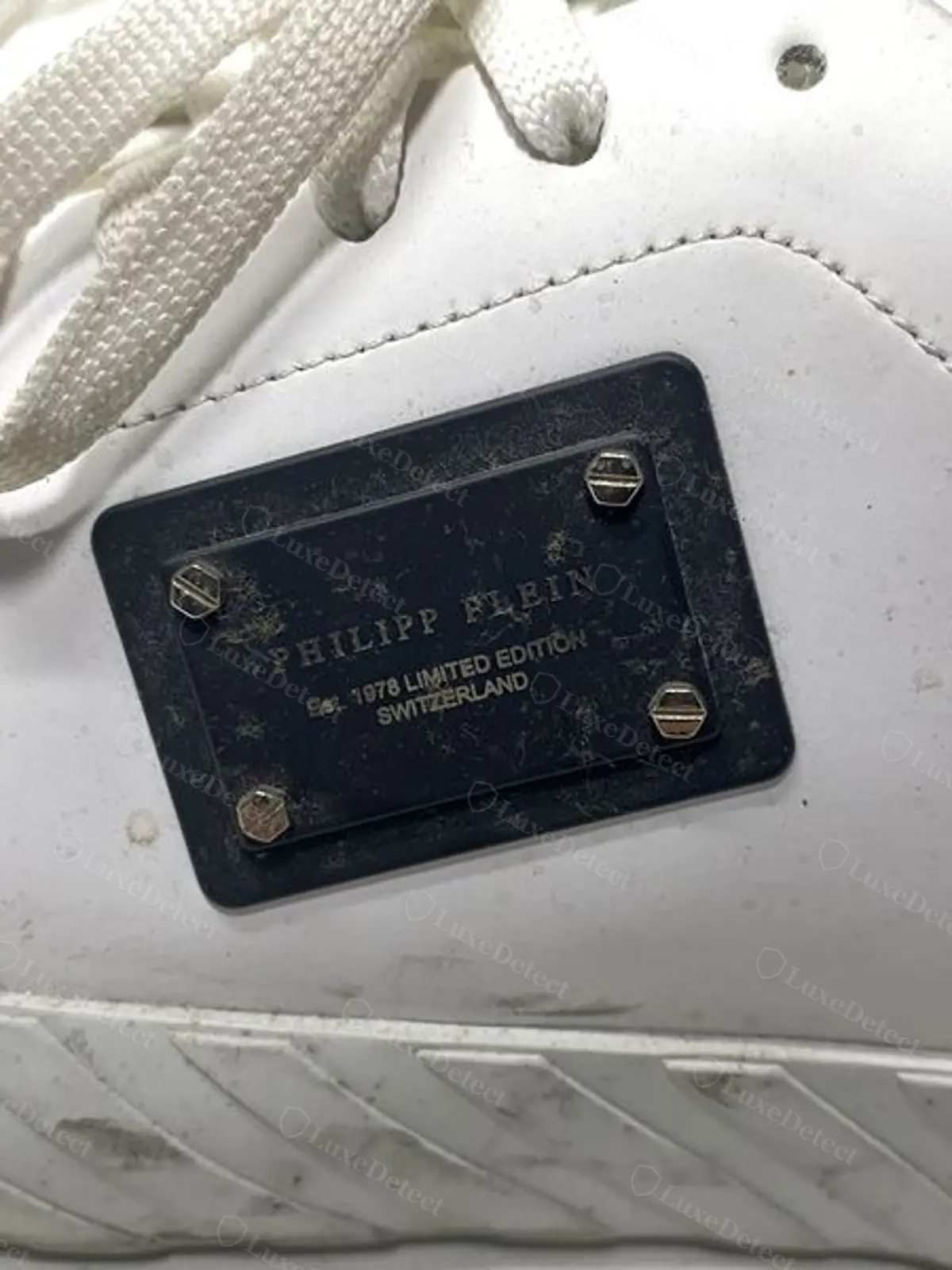
Across the counterfeits sampled, the hardware differs almost every time. One low-top fake substitutes a completely different design: a flat rectangular metal plaque riveted on with four visible hex-head screws, reading "PHILIPP PLEIN Est. 1978 LIMITED EDITION SWITZERLAND" — different shape, different construction method, and different text entirely from anything the genuine hardware carries. A separate fake, a Phantom Kick$-style knit sneaker, uses a hexagonal tag closer in shape to the authentic version but applied as a stitched-on metal charm rather than embossed leather. A third fake substitutes a plain riveted rectangle with no hexagon at all.
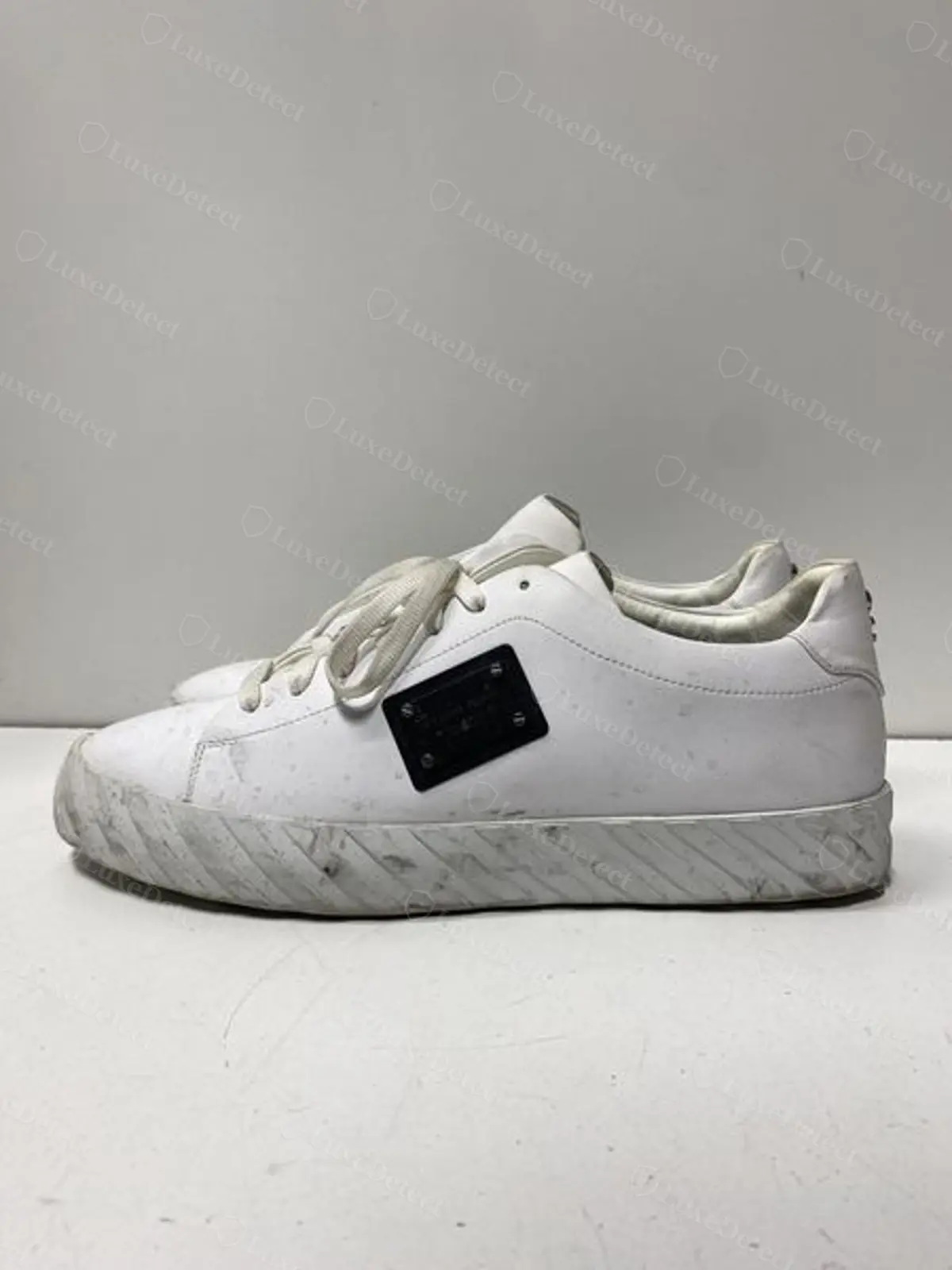
| Element | Authentic | Counterfeit |
|---|---|---|
| Shape | Hexagonal, embossed directly into the leather upper | Varies: rectangular riveted plaques, or a stitched-on hex charm instead of an embossed panel |
| Construction | Raised panel moulded into the leather, no visible screws or rivets | Applied hardware, often with four visible hex-head screws around the edge |
| Monogram | Clean interlocking "PP," crisp edges | Present but on the wrong hardware shape, or paired with extra unrelated text |
| Text on the plaque | None beyond the monogram itself | Some fakes add invented copy such as "Est. 1978 Limited Edition Switzerland" — text the genuine hardware never carries |
Red flag
A riveted, screwed-on rectangular plaque in place of a hexagonal panel embossed into the leather. Every fake sampled that deviated from the embossed hex shape also came with construction (visible screws, a bolted-on look) the genuine hardware doesn't have. If the side plaque is a separate piece of hardware fastened to the shoe rather than moulded leather, that is enough on its own to reject the pair.
Worth knowing
Philipp Plein was founded by the designer Philipp Plein in 1998 in Germany; the group's holding company is headquartered in Lugano, Switzerland today, but the brand did not exist in 1978 (that's Plein's birth year, not a founding date) under any name. A plaque reading "Est. 1978" is inventing a history the brand doesn't have — not a typo, a fabricated provenance claim, and decisive on its own.
The Sole — Branding and Repeating Monogram Tread
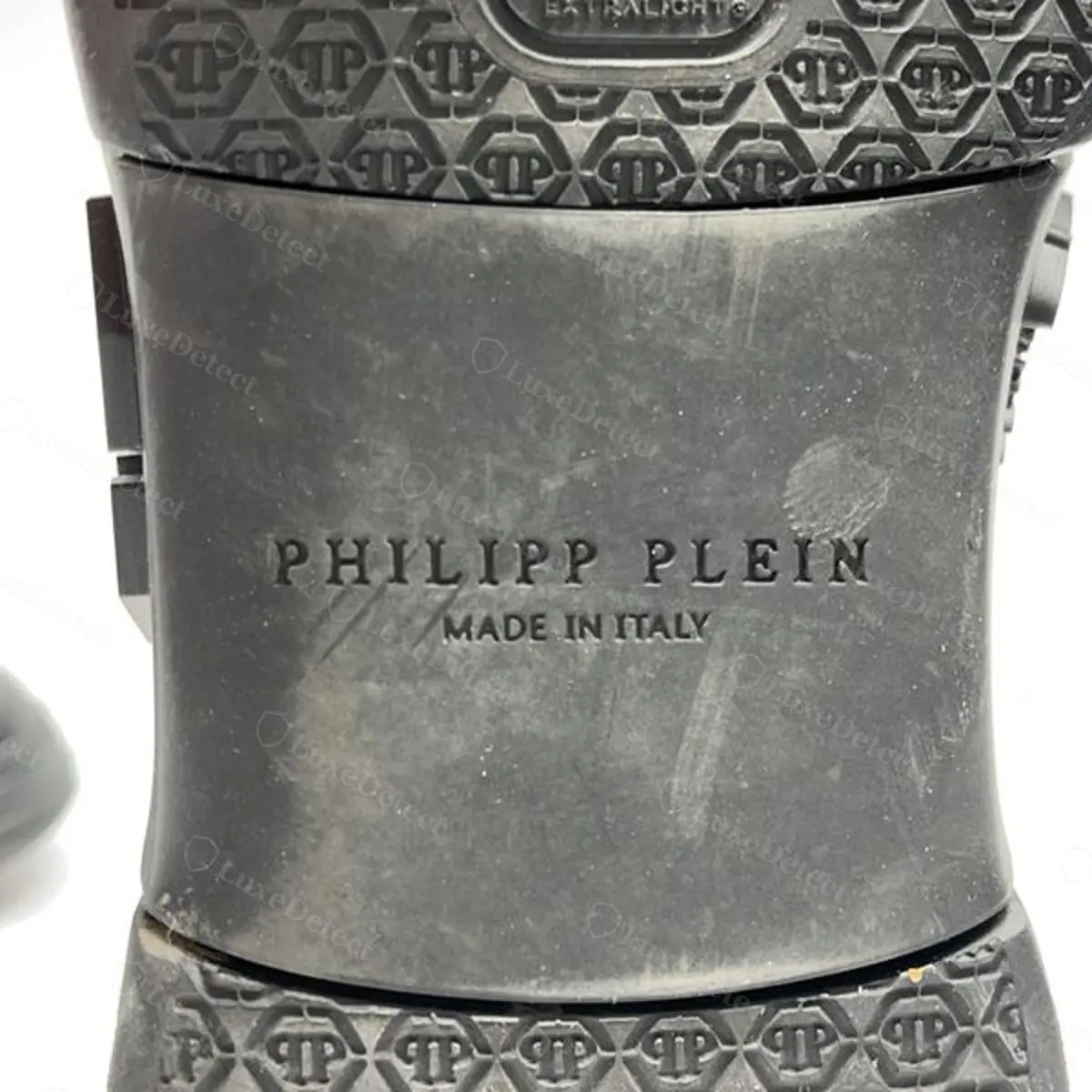
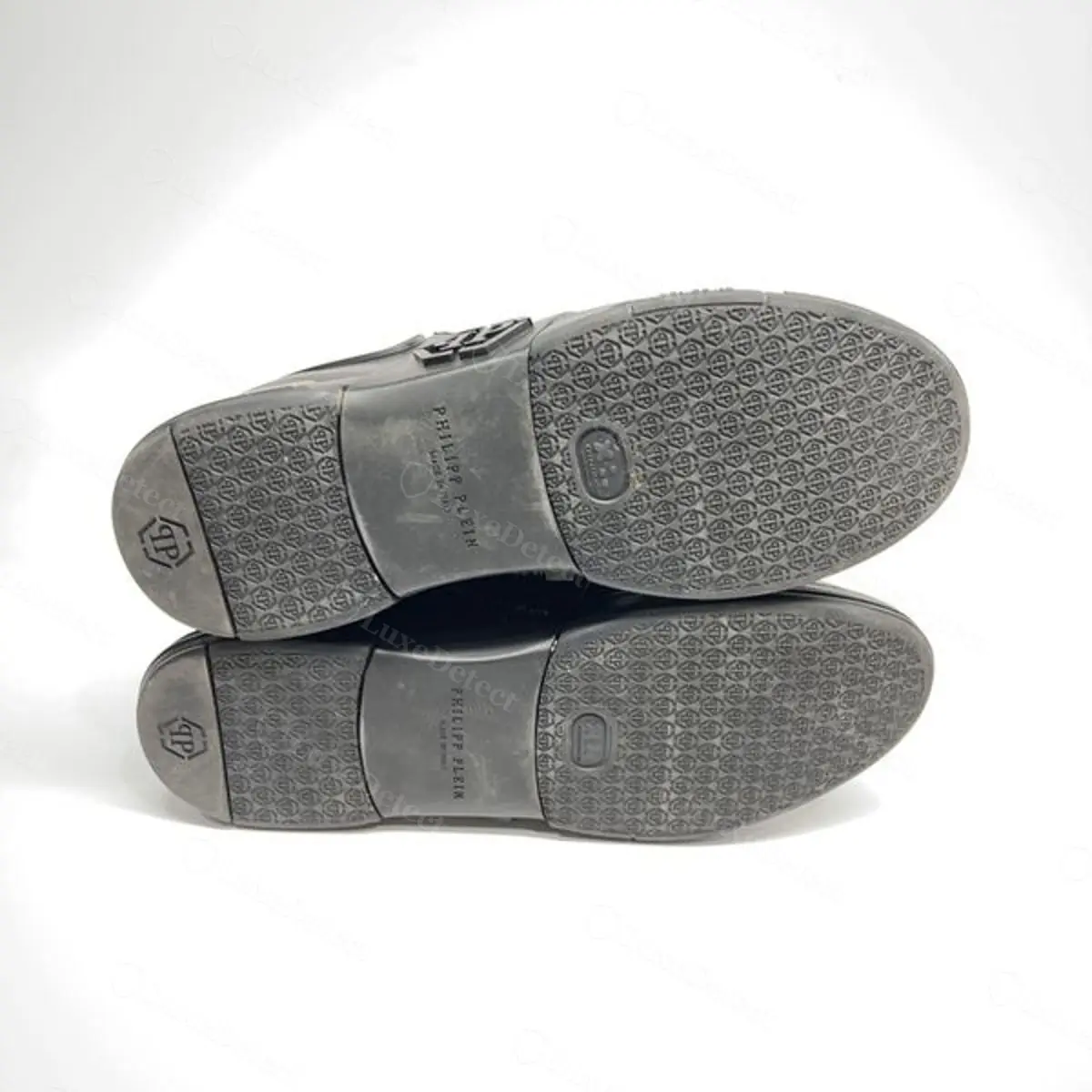
Genuine Philipp Plein soles do real work advertising the brand: the authentic pair reviewed here has "PHILIPP PLEIN MADE IN ITALY" embossed cleanly into the heel/arch section of the sole, flanked by a tread pattern built from a repeating small hexagonal "PP" monogram rather than a generic waffle or diamond grid. Both feet carry matching, evenly struck text with no smudging or doubling.
None of the fakes in this sample reproduced that. The clearest contrast is a low-top white sneaker fake with a completely blank rubber sole — a generic diagonal-groove tread with zero text or monogram anywhere on it. Another fake carries a plain waffle-style tread pattern that has nothing to do with the brand's hex-PP signature. Where a fake sole does carry any text, it tends to be shallow, inconsistently struck between the left and right shoe, or paired with a tread pattern unrelated to the brand.
| Element | Authentic | Counterfeit |
|---|---|---|
| Sole text | "PHILIPP PLEIN MADE IN [country]" cleanly embossed, consistent depth both feet | Absent entirely on some fakes; shallow or unevenly struck on others |
| Tread pattern | Repeating hexagonal "PP" monogram built into the tread | Generic diagonal grooves, waffle grids, or other patterns with no brand connection |
| Consistency between feet | Matching depth and placement on both soles | Not verifiable when the branding is missing altogether |
Red flag
A blank or generic sole with no brand text or monogram tread at all. A genuine Philipp Plein sneaker sole is branded real estate; a sole that reads as an unbranded rubber unit off a generic trainer is one of the clearest tells in this whole guide, because it's expensive for a counterfeiter to tool a custom sole and cheap for them to skip it.
Heel and Tongue Branding — Lettering and the Skull-and-Crossbones
Philipp Plein's skull-and-crossbones motif appears across accessories, hardware, and footwear as a recurring signature, usually paired with "PLEIN" or "PHILIPP PLEIN" lettering on the heel counter, the lace toggle, or a hardware tag on the tongue.
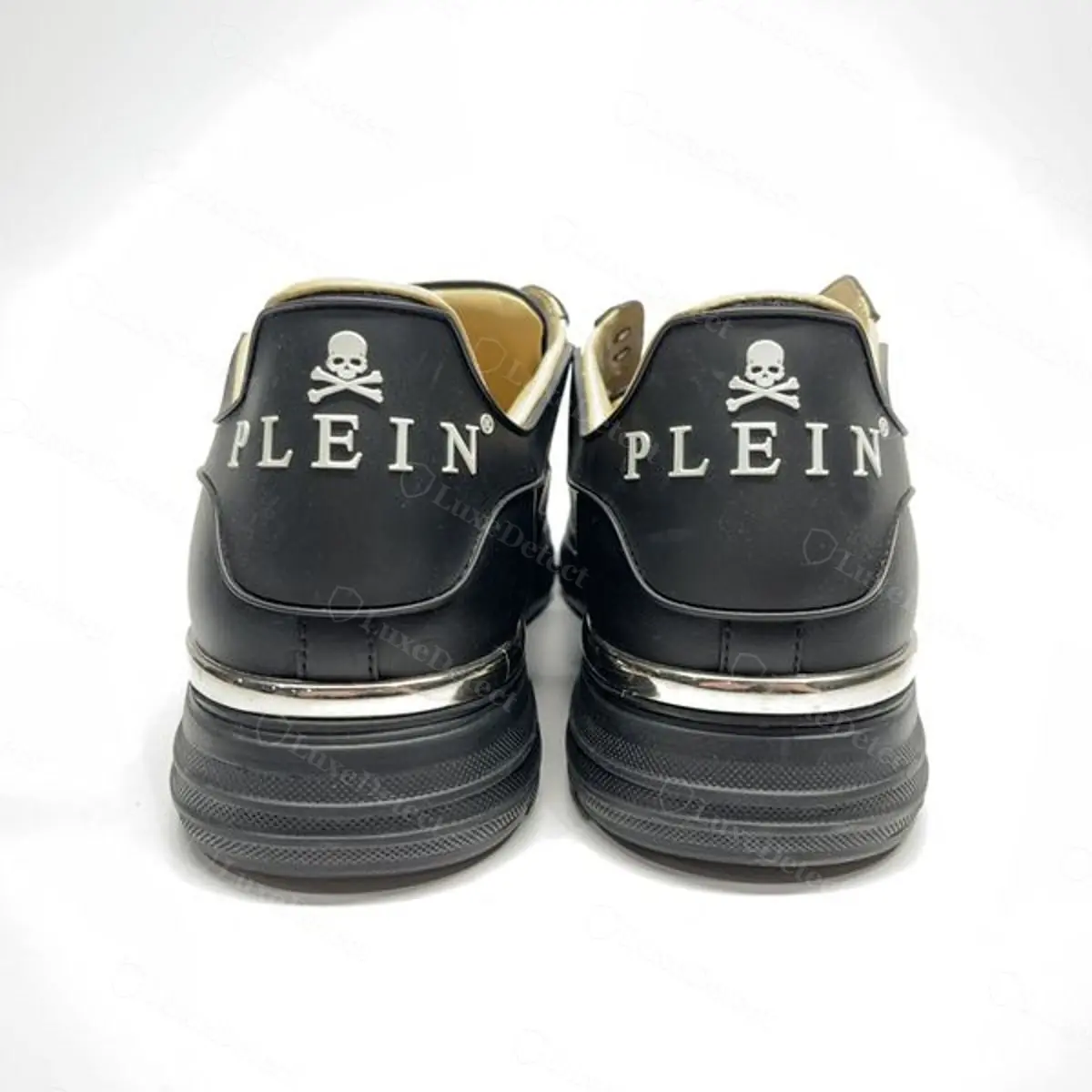
On the authentic pair, the heel carries a small skull-and-crossbones motif printed directly above clean embossed "PLEIN" lettering, both in matching off-white against the black leather, evenly spaced and centred on each heel. The interior fabric tag separately reads "PHILIPP PLEIN MADE IN ITALY" in white lettering on black woven fabric, standard branded-label construction.
The fakes sampled reproduce the general idea (skull motif, brand lettering) with varying execution quality. One fake heel carries "PHILIPP PLEIN" embossed into a patent-leather panel that's legible but noticeably less crisp than the genuine embossing, with letters that look pressed rather than moulded. Where fakes use a metal skull charm as hardware (several of the sampled pairs do, usually on the tongue near the laces), the casting is heavier and less detailed than the genuine skull-and-crossbones, with the bones rendered as thick undefined shapes rather than distinct crossed bones.
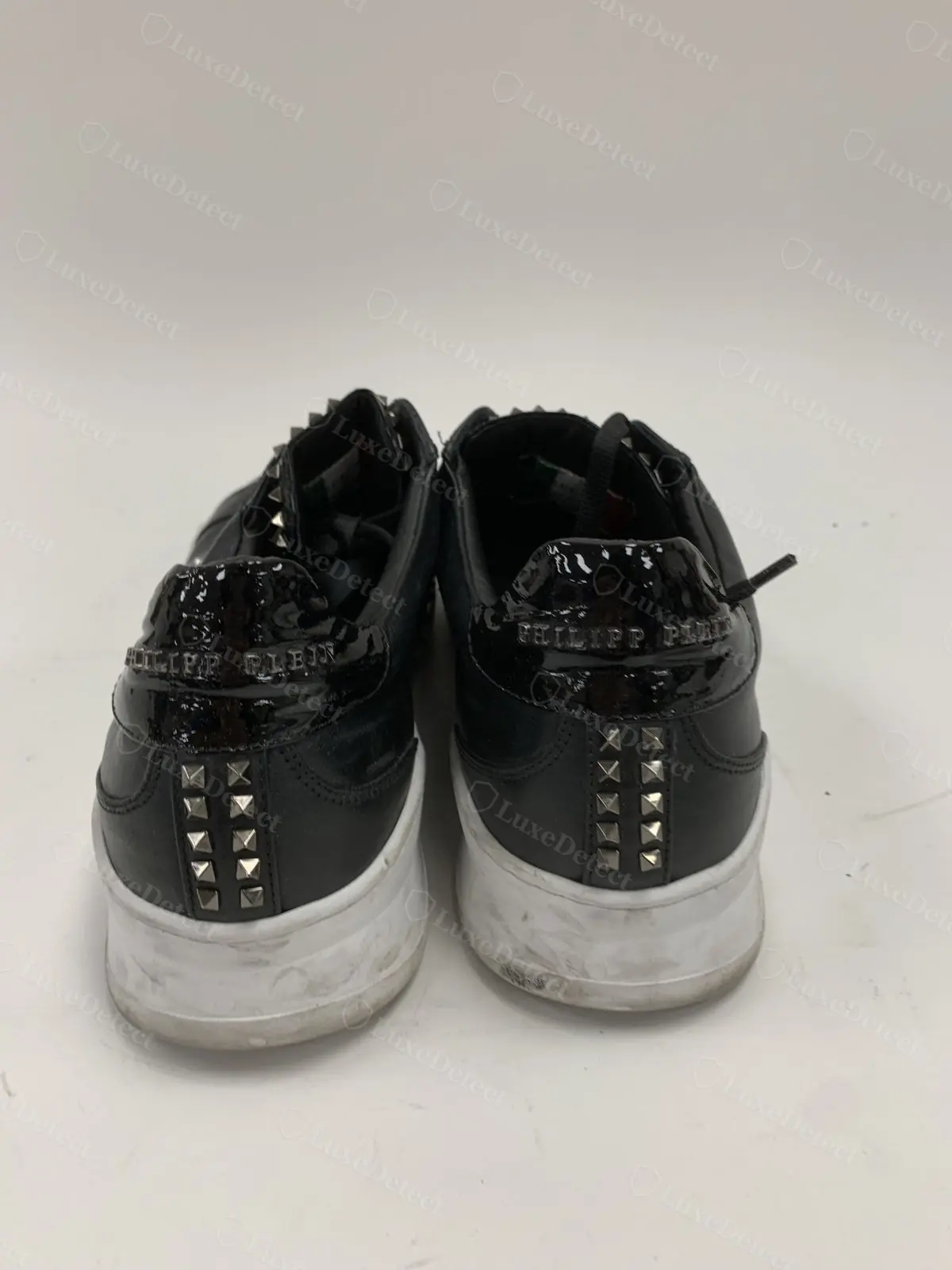
Worth knowing
A skull-and-crossbones motif and "PLEIN" text alone are not proof of anything — Philipp Plein leans hard into this branding and it appears, correctly, on some counterfeits too. What matters is execution: crispness of the lettering, and whether the skull charm (if present) shows defined detail or reads as a blob under any zoom.
The Interior Tag and Insole
The authentic pair's interior tag is a woven fabric label sewn into the tongue lining, reading "PHILIPP PLEIN MADE IN ITALY" in clean white serif-style lettering on black fabric, standard construction for a mainline leather trainer. The sole additionally carries a small embossed hexagonal "PP" stamp near the arch as a second, independent brand mark.
This is the checkpoint with the least consistency across the sample, and it's rated accordingly low here. Several fakes carry some kind of interior stamp or insole text — one fake's insole is stamped with a hexagonal monogram and "For..." text in an unusual, cramped layout; another simply has a plain leather footbed with a printed size number and nothing else. None of that is conclusive by itself: a missing insole stamp doesn't prove a fake, and a present one (even an odd-looking one) doesn't prove authenticity, because this is one of the easier elements for a workshop to imitate crudely and still pass a quick glance.
Worth knowing
Treat the interior tag as a tie-breaker, not a primary check. Weigh it alongside the plaque and sole findings above, not instead of them.
What the Box and Any Papers Do and Do Not Prove
Philipp Plein sneakers are typically sold in branded boxes with a dust bag, and resale listings often lean on "comes with box" as a selling point. A box proves nothing about the shoes inside it — boxes are trivially separated from one pair and reunited with another, and blank or generic replacement boxes are widely available. Use the box only to cross-reference a size or style number against the shoe itself, never as evidence of authenticity on its own.
Quick Authentication Checklist
- Check the side plaque: hexagonal shape embossed into the leather, not a riveted rectangular tag.
- Read the sole: brand text and hexagonal-PP tread pattern present and consistent between both feet.
- Inspect heel lettering and any skull hardware for crisp, moulded (not pressed) execution.
- Cross-reference the interior tag and insole stamp as a tie-breaker only.
- Confirm the model against Philipp Plein's actual product lines — mainline, Phantom Kick$, or Plein Sport — rather than a generic "sneakers" listing.
A wrong-shaped side plaque or a blank, unbranded sole is on its own sufficient to reject a pair. Two or more failures on the lower-reliability checks (heel execution, interior tag oddities) without a clear plaque or sole failure is a reason to get a second opinion before buying.
When to Get a Professional Opinion
The hardware and sole checks above catch the counterfeit tiers currently circulating in this sample, but Philipp Plein doesn't have the decades of public authentication documentation that a house like Nike or Gucci does, so listings can be harder to research independently. If you can't get a clear photo of the side plaque and the full sole, or if the checks above come back mixed, a professional photo-based review is a fast way to get a second opinion before you buy. LuxeDetect's sneaker authentication starts at $9 for a 24-hour turnaround, or $15 for a 2-hour review, with a Certificate of Authenticity on a pass.
FAQ
What's the fastest way to tell if Philipp Plein sneakers are fake?
Look at the side plaque first. A genuine pair has a hexagonal "PP" monogram embossed directly into the leather with no visible screws or rivets; if you see a riveted rectangular plaque, or a hexagonal tag bolted on rather than moulded into the upper, that's the single fastest reject.
Does Philipp Plein sole branding vary between shoe lines?
The mainline low-top and Phantom Kick$ silhouettes carry the "PHILIPP PLEIN MADE IN [country]" text and hexagonal-PP tread pattern reviewed in this guide. Plein Sport, the brand's diffusion sportswear line, uses different branding (typically a "PLEIN SPORT" wordmark on the heel strap) and wasn't covered in the sole checkpoint above — treat that sub-line separately.
Is "Made in Italy" proof that a pair is genuine?
No. It's one data point to cross-reference, not a verdict. Genuine current-production Philipp Plein footwear is Italian-made, so the claim should be consistent with what you'd expect — but a "Made in Italy" stamp is also one of the easier details for a counterfeiter to copy, so it doesn't outweigh a failed plaque or sole check.
Why does a plaque reading "Est. 1978 Switzerland" matter so much?
Because it's independently verifiable and wrong. Philipp Plein the brand launched in 1998, founded by designer Philipp Plein in Germany; 1978 is his birth year, not a founding date, and the two have been conflated on at least one counterfeit's hardware. A brand can't have been established in a year before it existed, so this is a fabricated detail rather than an ambiguous one.
Do genuine Philipp Plein sneakers always have a skull-and-crossbones detail?
No. It's a common recurring motif across the brand's footwear and accessories, but not every silhouette uses it, and some do use plain lettering instead. Its presence or absence isn't diagnostic by itself — what matters, when it is present, is the casting quality (defined bones and skull detail versus a blobby, undetailed charm).
Can I authenticate Philipp Plein sneakers from photos alone?
The plaque construction, sole branding, and heel lettering are all visible in well-lit photos, so yes, in most cases a photo-based review is sufficient. It's harder when only stock listing photos are available rather than photos of the actual pair for sale — always ask a seller for their own images of the side plaque, full sole, and interior tag before buying.
How much does professional sneaker authentication cost?
LuxeDetect's sneaker authentication starts at $9 for 24-hour turnaround and $15 for a 2-hour review, well below the categories with more complex construction like handbags or watches, reflecting how much of the verdict comes down to hardware and sole checks that are fast to review from clear photos.