Luxury Accessories Authenticator
Luxury accessories authenticator. Covers small leather goods, belts, and eyewear.
Published November 2026 · Contact
What Makes Must de Cartier Leather Distinctive
Older Must de Cartier leather goods, in burgundy leather and in patent leather, carry a small set of marks that are easy to list: a double-C monogram pressed into the leather, a "Cartier Paris" signature in gold on the inside, gold-tone hardware, and, when the piece comes complete, a card and a box that both say "les must de Cartier". Because the marks are few and all of them are cheap to imitate, a seller can show every one of them on a counterfeit.
This guide shows what each of those marks looks like on genuine pieces, a burgundy fold-over wallet and a brown patent leather tote, so you can compare your own item against them. It does not give a fake-tell table, because we do not have a confirmed counterfeit of these two pieces to set beside them. What it can do is teach you where to look and which details are worth a closer photograph.
Worth knowing
This guide is built from genuine examples only. Details such as the shape of the monogram, the clasp and the card wording may vary between models. Use the guide to learn what genuine construction looks like, not as a single checklist that every genuine piece must pass. When we have confirmed counterfeits of these models, the guide will be upgraded.
Use our free Cartier Serial Checker to check the engraved serial against the formats Cartier is documented to use.
Check My Serial →The Double-C Monogram: Pressed, Not Printed
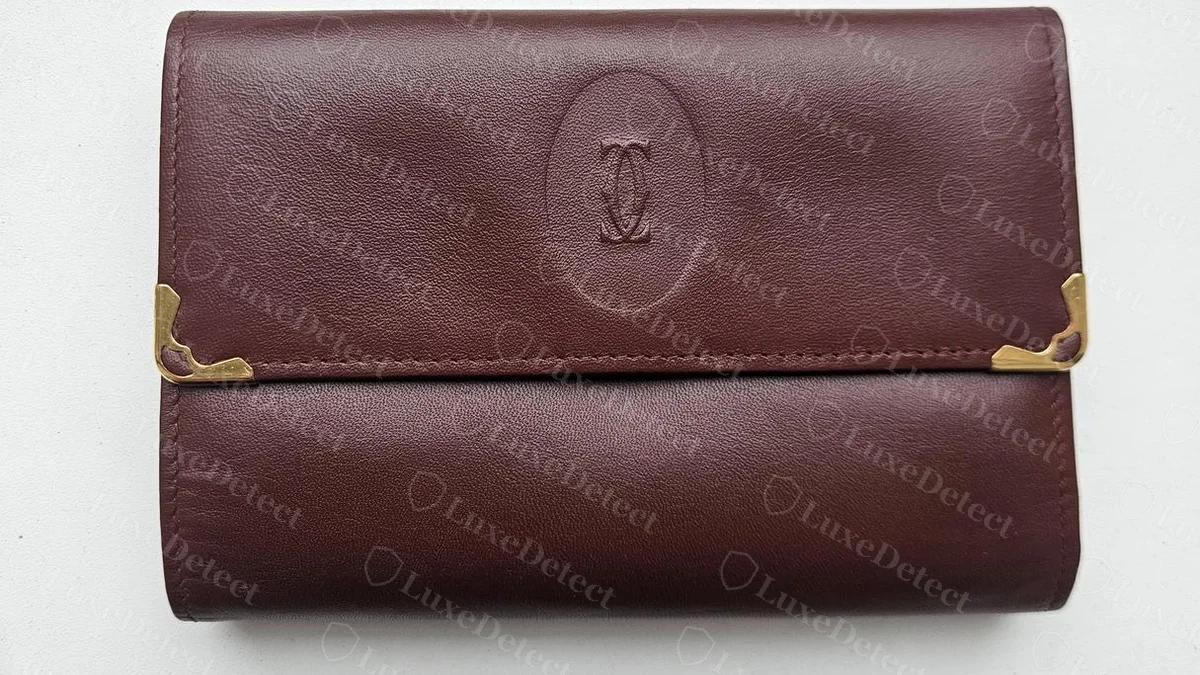
On the burgundy wallet the monogram sits on the front flap: an oval with two interlocked Cs, pressed into the leather so that it shows as a soft blind impression of the same colour as the hide, with no foil and no ink.
On the patent leather tote the monogram is repeated across the whole body as a tonal all-over pattern, a slightly darker brown pressed into the glossy surface. The tote's lining carries a similar tonal pattern in fabric. Look at how evenly the impressions are spaced and how crisply the two Cs interlock, and check that the pattern sits in the surface rather than looking like a printed layer on top.
Hardware: Corner Caps, Snap and Zipper Pull
The wallet's flap has gold-tone metal corner caps that wrap the leather at the corners and sit flat against it. Inside the flap the Cartier signature is stamped in gold close to the corner.
The snap that closes the flap carries lettering of its own. On this wallet the face of the snap is ringed by a dotted border and embossed around the rim with the word ORIGINAL, what reads as PRYM and a size number.
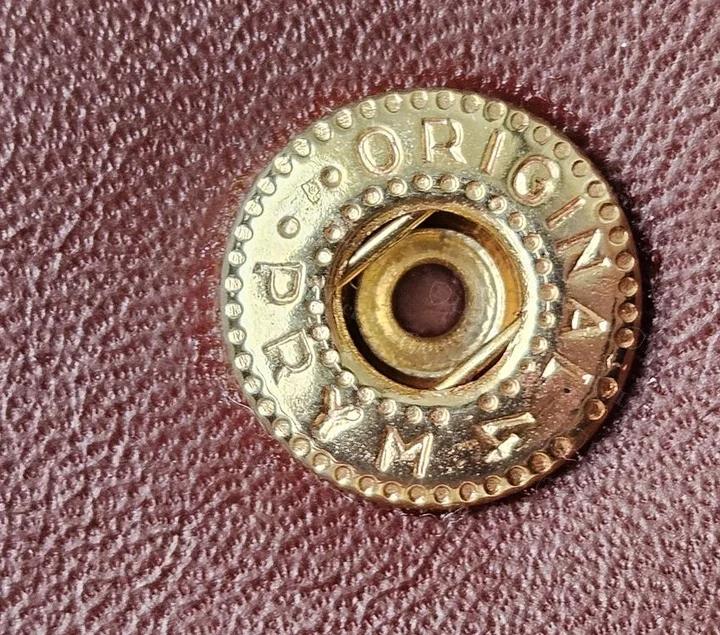
That is a detail worth checking on your own piece: a snap with clean, evenly cut lettering and a crisp dotted border is a good sign, while a blank snap, soft lettering or a snap in a different style is a reason to compare with a verified example of the same model. Do not treat the lettering as a mark that only Cartier would use, because a counterfeiter can copy any snap that is photographed.
On the tote the zipper pull is an oval gold-tone plate. The face reads Cartier PARIS in script and capitals, and the reverse carries the double-C monogram.
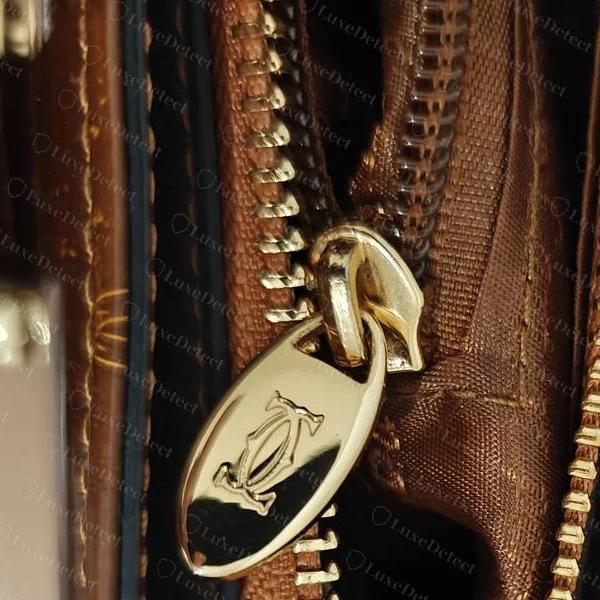
The zipper teeth are gold-tone to match, and the handles on this tote are fixed with small gold-tone metal ferrules. Check that the engraving on the pull is clean and even, that the plate sits straight on the slider, and that the metal finish matches the other hardware on the piece.
The Cartier Paris Signature Inside
On the wallet the signature is stamped in gold foil on the leather of the inside flap, reading Cartier with PARIS beneath it. On the tote it sits on a patent leather patch stitched inside the bag along the zipper, again in gold: Cartier in script with Paris below.
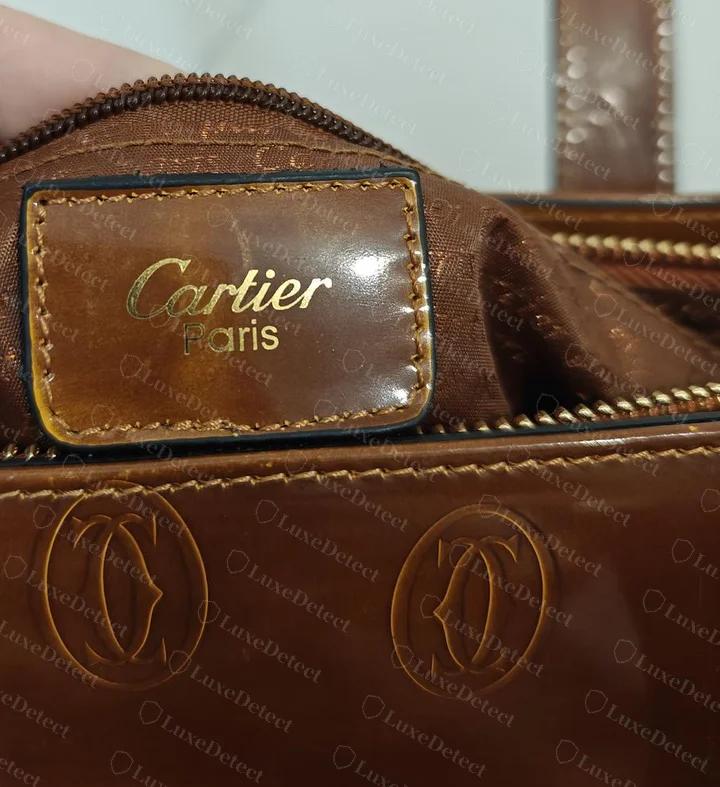
What to check is the stamping, not only the words. On the genuine examples the gold sits evenly in the letters, the script strokes are clean, and the patch is neatly edged and stitched. A signature that is blurred, filled unevenly or stamped crookedly is worth a second look, and so is a patch that is glued instead of stitched. The wording itself differs between pieces: the tote's patch reads Cartier Paris, and an older gold-tone plate reading "les must de Cartier Paris" is described in our Cartier serial number guide. Compare with a verified piece of the same model.
Interior Construction
Open the wallet and look at the lining and the way it is built. On the genuine wallet the compartments are lined in leather of the same burgundy colour, with a gold-tone framed clasp for the coin pocket and card slots with finished edges.
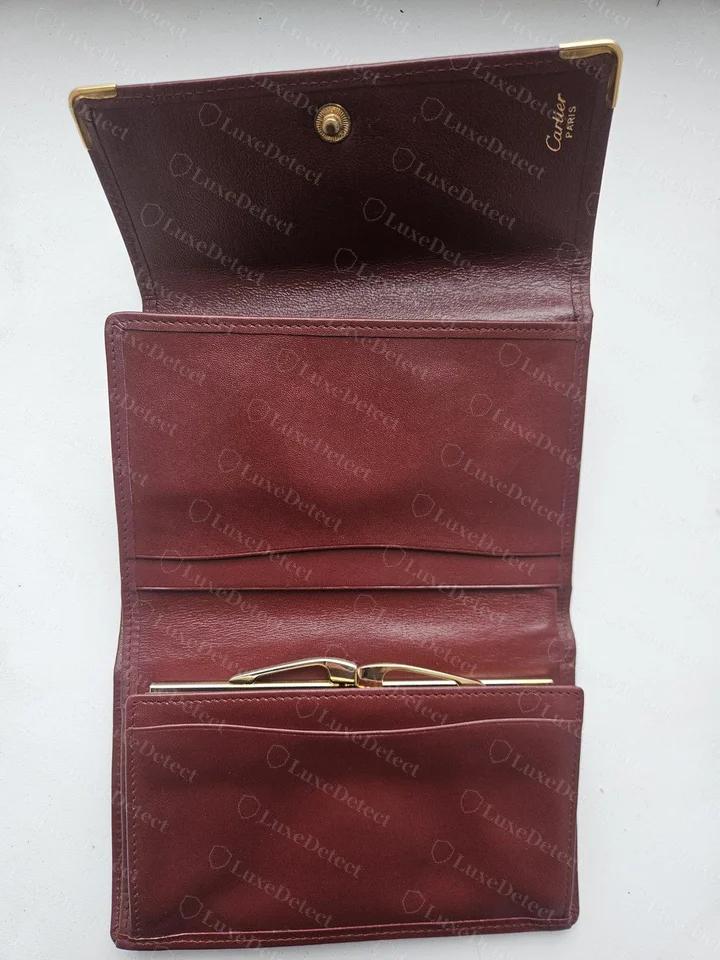
Edges, stitching and lining matter as much as the stamps. Look for even stitch length, cleanly finished edges and linings that match the outside in colour and quality. These are the parts that a cheaper copy economises on and that a seller rarely photographs unless you ask.
The Card and the Box
The genuine wallet came with a dark burgundy card with a gold border and gold printing. It reads "les must de Cartier, Paris" and states in French and in English that the object is made of real leather and belongs to the Must de Cartier collection and has been carefully controlled. A number is printed at the foot of the card.
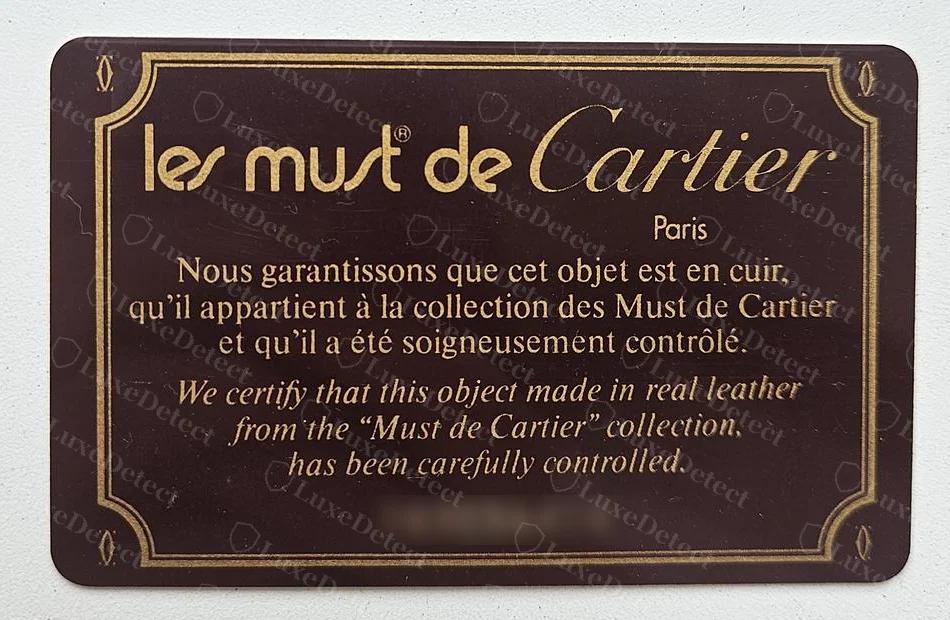
We have blurred the number on purpose. What is worth noting is its layout: on this card it is a run of nine characters, three digits, a letter and five digits. The card shown in our Cartier serial number guide carries a different layout, two letters and six digits. So the card number does not follow one fixed format across the pieces we have seen, and you should not reject or accept a card because its number looks different from another card's.
The box is plain white card with the double-C oval printed on the lid and "les must de Cartier Paris" beneath it. On its side a Ref: number is printed in a script typeface, and the number on the box is a reference to the item, not a serial that identifies one piece.
Worth knowing
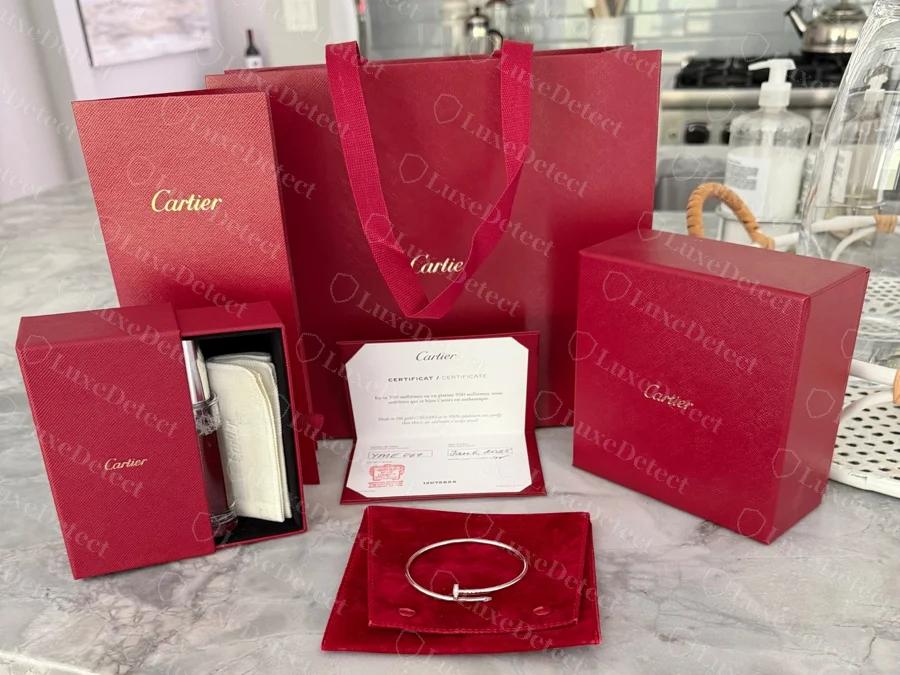
A card and a box are context, not evidence. We have seen a counterfeit Cartier wallet arrive with a red card and a presentation box, and a secondhand piece that is genuine often has neither. Never accept a card number, or a box reference, as proof on its own, and never pay a premium for a "full set" that you have not checked against the piece.
What a Matching Mark Does and Does Not Prove
Every mark on this page can be copied. A seller can photograph a genuine card and put it with a different wallet, and a counterfeiter can stamp the right words in the right place. A matching mark tells you the item has not failed that one check. It does not tell you the item is genuine, and no single mark should settle the question.
What does carry weight is how the marks fit together: monogram pressure and spacing, the finish and engraving of the hardware, the crispness of the gold stamping, the construction inside and the quality of the leather itself, set against a verified example of the same model. Weight, smell and the feel of the leather are checks done with the piece in hand.
Quick Checklist
- Check that the double-C monogram is pressed into the leather and evenly spaced, not printed.
- Look at the hardware: corner caps, snap and zipper pull should have crisp engraving and one consistent gold-tone finish.
- Read the Cartier Paris signature closely: even gold, clean letters, straight and well placed.
- Open the piece: check stitching, edges and the lining against the outside.
- Treat the card and the box as context, and never as proof.
- Compare with a verified example of the same model before you rely on any of the above.
When to Get a Professional Opinion
These pieces are easy to describe, so a seller can make almost any listing look convincing. If the item is expensive, if the marks look right but something feels off, or if you cannot find a verified example of your exact model to compare, a professional review is the safer route. LuxeDetect authenticates Cartier wallets from $15 and bags from $25 with a 24-hour turnaround and issues a Certificate of Authenticity for items that pass.
FAQ
How can I tell if a Must de Cartier wallet is real?
Look at how the marks fit together rather than at any single one. On the genuine wallet we reviewed the double-C monogram was pressed into the leather, the corner caps and snap were gold-tone with crisp lettering on the snap, the Cartier Paris signature was stamped in even gold inside the flap, and the inside was neatly stitched and lined. Compare your wallet against a verified example of the same model, because each mark can be copied.
What is written on a Must de Cartier card?
On the genuine card we reviewed, the heading is "les must de Cartier, Paris", followed by a short statement in French and in English that the object is made of real leather, belongs to the Must de Cartier collection and has been carefully controlled, with a number at the foot. Wording and number layouts can differ between cards, and a card on its own does not prove an item is genuine.
Does a Must de Cartier bag have a serial number?
Not in the genuine tote we reviewed. It carried a Cartier Paris patch inside, the double-C monogram on the leather and a Cartier plate on the zipper pull. Where a number appears, it is usually on the card. Our Cartier serial number guide explains where serial numbers do appear on other Cartier products.
Is a missing card or box a bad sign?
No. A secondhand piece often has no card or box. Their presence does not prove the piece is genuine either, because they can be reused or copied, so check the item itself.
Can I authenticate a Must de Cartier piece from photos?
Yes. Clear photos of the monogram, the hardware, the signature, the interior and the card let a specialist compare each detail against verified examples. For an expensive piece, a professional review is the safer route, and it is worth asking the seller for sharper photos of the snap, the zipper pull and the signature first.
How much does it cost to authenticate a Cartier wallet or bag?
LuxeDetect authenticates wallets from $15 and handbags from $25 with a 24-hour turnaround, and returns a Certificate of Authenticity for items that pass.