Luxury Fashion Authentication Specialist
Handbag authentication specialist. Has reviewed submissions across Hermès, Chanel, Louis Vuitton, and Dior since 2019.
Last updated September 2026 · Published July 2026 · Contact
Why Lemaire Bags Are Worth Checking Carefully
Like other quiet-luxury labels, Lemaire doesn't rely on visible branding to sell its bags — the Croissant and the Camera bag are recognised by silhouette, not logo. That makes them a growing counterfeit target as resale demand has climbed, and it means authentication has to focus on construction and materials rather than a wordmark comparison.
This inverts the usual authentication problem. On a monogrammed bag, the counterfeiter's hardest task is reproducing a printed pattern precisely, and the buyer's easiest check is comparing that pattern against a reference. Lemaire gives you neither. There is no logo to misprint and no pattern to misalign, so a fake that gets the shape roughly right can look convincing in photographs.
What remains are the things that cost money to do well: leather selection, hardware weight, and the precision of a curved seam. Those are also the things counterfeiters economise on first, because they are invisible in a listing image. The practical consequence is that Lemaire authentication rewards handling the bag and punishes buying from photographs — the opposite of a monogram-driven category, and the same challenge our The Row bag guide covers for that house's equally logo-free line.
Worth knowing
Lemaire's confirmed counterfeit volume is low compared with heavily monogrammed houses, and this guide draws on a very limited set of confirmed fake Croissant bags alongside several authenticated examples. Treat the construction and finishing checks below as the strongest signal available, and weigh a specific listing on the accumulation of these details rather than any one check alone.
What to check, ranked by reliability
| Checkpoint | Reliability | What it tells you |
|---|---|---|
| 1. Leather Grain and Feel | ★★★★★ | A repeating stamped grain or a glossy, plasticky surface is the most reliable single tell available for this brand. |
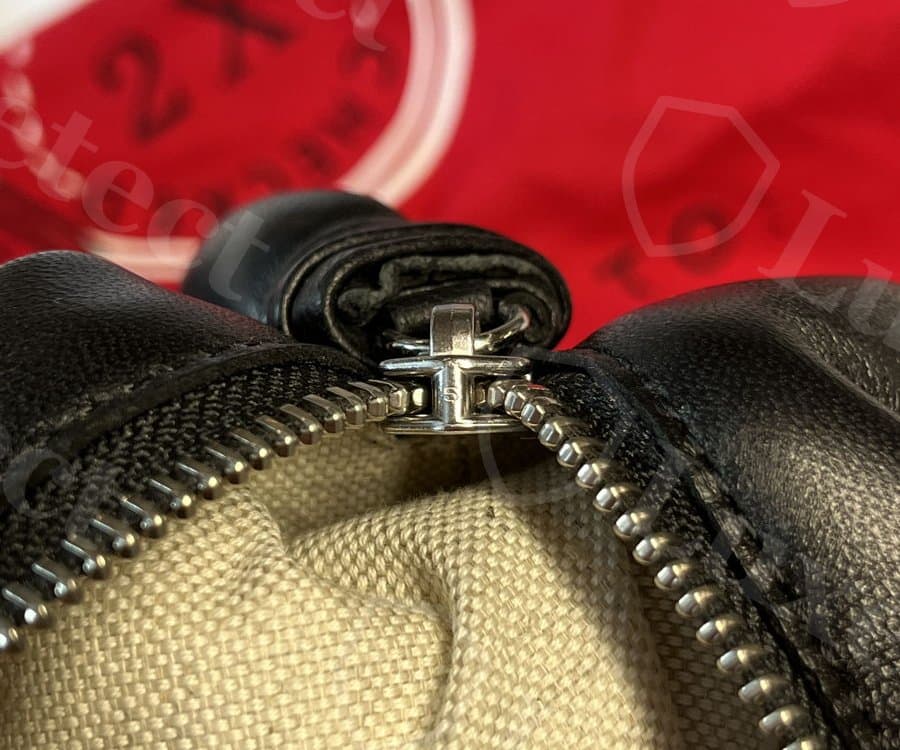
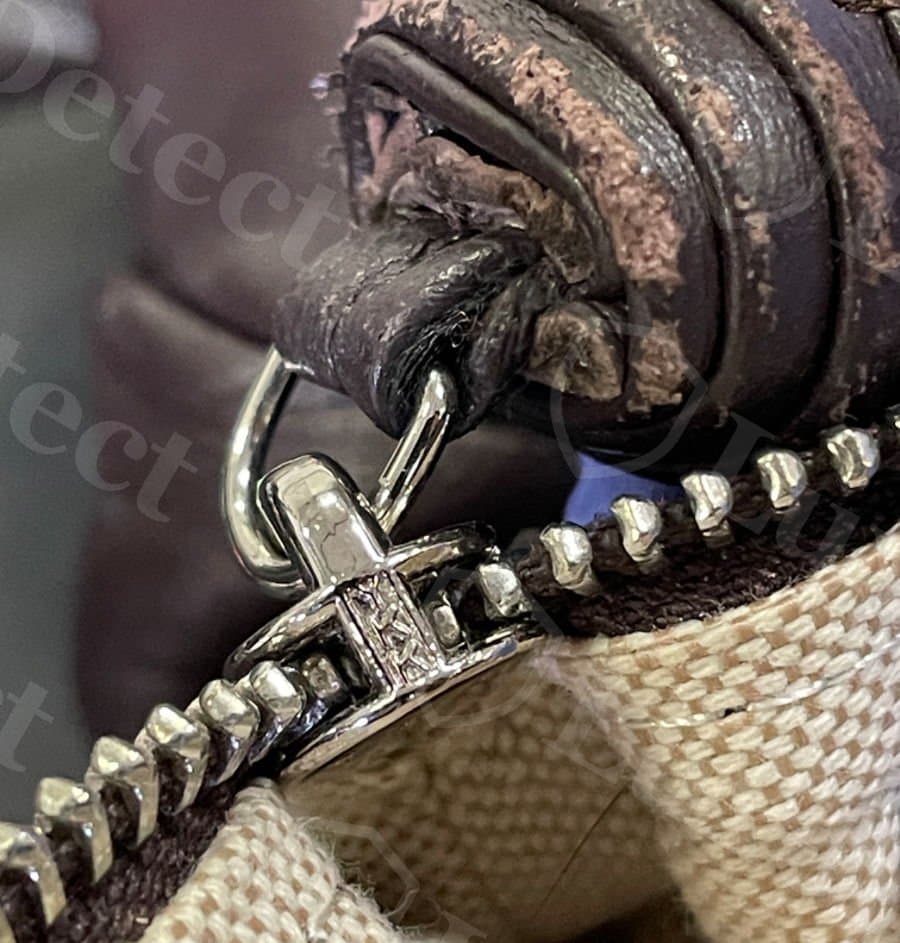
| 2. Hardware and Strap Attachment — The Twist-Lock and Strap Rings | ★★★★★ | Fraying or cracked leather exposed at the strap-to-ring fold, seen on a confirmed fake, is a strong construction tell, though the fake sample is very limited. |
| 3. Stitching and Seam Construction | ★★★★★ | A wandering stitch line through the Croissant's tightest curve is hard to fake well, but requires a clear close-up photo to assess. |
| 4. Interior Lining and Labels | ★★★★★ | Typography and spacing errors are useful, but a correct-looking label is common on better fakes and country of manufacture alone proves nothing here. |
Leather Grain and Feel
Lemaire uses a soft, lightly grained leather with a matte finish across most of its bag line.
Grain: Natural and non-repeating. Examine a palm-sized area closely — genuine hide shows irregular pore distribution with no pattern that recurs. A stamped, uniform texture that repeats at regular intervals is a strong fake signal and the most reliable single check available.
Hand-feel: Supple rather than stiff. The leather drapes and takes a soft fold rather than holding a rigid shape. On a Croissant, the body should slump slightly under its own weight when set down empty.
Finish: Genuinely matte, with a soft sheen at most. Lemaire does not use high-gloss finishes on its core leather lines, and a glossy or plasticky surface indicates a coated substitute.
Smell: A genuine leather scent — faintly tannic. A plastic, chemical, or solvent smell points to bonded leather or polyurethane.
Fake tells: Repeating grain pattern under close inspection. Stiffness that holds an unnatural shape. A surface sheen brighter than Lemaire's matte standard. Chemical odour. Leather that feels uniformly thick with no natural variation across panels.
Edge finishing
Authentic: Cut edges are finished smoothly and evenly, with edge paint applied in thin consistent coats that follow the curve without pooling. On curved seams the edge treatment maintains uniform width throughout the arc.
Fake tells: Edge paint that thickens on the outside of a curve and thins on the inside. Cracking or flaking on a bag described as new. Rough or fibrous edges where paint has been applied too thinly.
Hardware and Strap Attachment — The Twist-Lock and Strap Rings
The Croissant's signature closure is a simple twist-lock or knot-tie depending on the style; the Camera bag uses a compact buckle and D-ring strap system.
Authentic hardware:
- A matte, low-shine metal finish consistent with the brand's understated aesthetic — never bright or mirror-polished
- Solid and weighted, with density you notice when the component is handled independently of the bag
- Smooth mechanical action on any buckle or twist mechanism, with definite engagement and no looseness at rest
- Uniform finish across every hardware component on the bag, including rings and any zip pulls
Fake tells:
- Overly shiny or bright-toned hardware, the most common tell because counterfeiters default to a brighter finish
- Light, hollow-feeling clasps or rings
- A twist or buckle mechanism that binds, sticks, or wobbles in its seat
- Finish varying between components, indicating separately sourced parts
Attachment points
Authentic: Hardware sits flush against the leather with even pressure and no gapping. Rivets and screws are finished to match the surrounding hardware and sit level with the surface. Where the strap folds into the zipper-pull ring, the leather is cleanly finished at the fold with no exposed edge.
Fake tells: Visible gaps between hardware and leather. Rivets standing proud or recessed. Attachment points showing stress marks or leather distortion on a new bag. Fraying or cracking at the leather fold where the strap meets the ring, exposing the substrate underneath the finished surface.
| Detail | Authentic | Counterfeit |
|---|---|---|
| Strap-to-ring fold | Clean, tightly finished leather roll with no visible substrate | Frayed or cracked leather at the fold, substrate visible underneath |
| Zip-pull hardware | Smooth, precisely cast finish | Rougher, less refined casting on close inspection |
Red flag
Frayed or cracked leather exposing the substrate at the strap-to-ring fold, on a bag represented as new or lightly used, is a strong construction tell — this is exactly the kind of finishing detail counterfeiters skip because it's invisible in a listing photo.
Worth knowing
This comparison is drawn from a very limited set of confirmed fakes against several authenticated examples, so treat it as a strong supporting signal rather than a standalone verdict — corroborate with the leather grain and stitching checks below.
Stitching and Seam Construction
Authentic: Stitch length and tension are even across every seam, with no skipped stitches and no visible thread inconsistency. Thread colour matches the leather closely. On the Croissant's curved silhouette, seam allowances are clean and symmetrical, with the stitch line holding a constant distance from the edge throughout the arc. Interior seams are finished to the same standard as exterior ones.
Fake tells: Stitch length varying along a seam, most visible where the seam curves. A stitch line that wanders relative to the edge on the tightest part of the curve — the single hardest thing to reproduce on a Croissant and a useful construction tell. Skipped or doubled stitches. Loose thread ends. Interior seams noticeably rougher than exterior ones.
The curve test
Lay the Croissant flat and compare the two halves of its curved seam. Genuine construction produces a symmetrical arc with matched stitch spacing on both sides. Counterfeits attempting the shape frequently produce an arc that is subtly fuller on one side, or whose stitch density increases where the sewer slowed through the tightest radius.
Interior Lining and Labels
Authentic: The interior label carries clean, evenly spaced sans-serif typography with correct brand spelling. On Croissant and Camera leather bags the label reads "LEMAIRE" debossed into a small leather patch, with "MADE IN SPAIN" beneath it — a genuine Lemaire label and a confirmed fake in this guide's photo set both carried that same country marking, so country of manufacture alone does not distinguish real from fake here. Lining fabric is smooth and evenly applied, with no glue bleed at the seams and no bubbling where the lining meets the leather.
Fake tells: Typography that is close but not exact, with letter spacing the usual error rather than letterform. Misspellings, which still occur. Visible adhesive at the lining seams. Lining that bubbles or lifts.
Worth knowing
Don't treat "Made in Spain" on a Lemaire leather goods label as a red flag by itself — it appears on genuine Croissant and Camera bags. Country of origin only helps when it's wrong for the specific style, which requires checking current production references, not assuming a single expected country.
Label attachment
Authentic: Labels are stitched with the same thread quality and stitch density used elsewhere on the bag.
Fake tells: A label attached with noticeably coarser stitching than the surrounding construction, or glued rather than stitched.
Quick Authentication Checklist
- Leather: natural non-repeating grain, supple drape, genuinely matte finish, leather scent
- Edges: even paint width through curves, no cracking on a new bag
- Hardware: matte low-shine finish, solid weight, smooth definite action, uniform across all components
- Stitching: even length and tension throughout, constant distance from the edge through curves
- Curve symmetry: matched arcs and stitch spacing on both halves of the Croissant seam
- Interior: correct label typography (country of manufacture alone proves nothing), no glue bleed, stitched not glued
- Overall shape: soft but not collapsed — a slight slump when set down empty is normal, while a fully collapsed or an overly rigid silhouette warrants a closer look
FAQ
Why don't Lemaire bags have visible logos?
It is a deliberate design choice consistent with the brand's minimal aesthetic — the same positioning used by The Row, Khaite, and Toteme. The commercial logic is that the customer recognises the silhouette without needing the brand announced. For authentication it means silhouette accuracy and construction quality carry the entire burden that a logo would normally share.
Is the Lemaire Croissant bag commonly faked?
Yes, and increasingly so as resale demand has grown. Because there is no logo to misprint, fakes are judged almost entirely on leather quality, hardware weight, and the precision of the curved seam — areas harder for counterfeiters to replicate convincingly than a printed monogram, but also harder for buyers to assess from listing photographs.
Can I authenticate a Lemaire bag from photographs?
Less reliably than in most categories. Grain repetition, hardware finish tone, stitch regularity, and curve symmetry are assessable from good close-up images. Leather hand-feel, hardware weight, and mechanism action require handling. For any Lemaire purchase above a few hundred dollars, request detailed close-ups of the curved seam on both sides and video of the closure operating.
Does the leather vary between Lemaire bag lines?
Yes. The core lines share the soft matte grained leather described here, but Lemaire has used smooth, textured, and coated variants across seasons and collaborations. Verify the expected material for the specific style and season before applying grain-based checks — an unexpected finish may be a legitimate seasonal variant rather than a fake.
Where should I buy Lemaire secondhand?
Platforms with an authentication step reduce risk compared with unmoderated peer-to-peer listings. For higher-value pieces, an independent authentication check adds confidence beyond a platform's own review — particularly worthwhile here, since quiet-luxury brands receive less authenticator attention than heritage houses and platform reviewers are correspondingly less practised.
How much does professional Lemaire authentication cost?
Photo-based authentication typically runs $25 for handbag authentication with a 24-hour turnaround. Given that this category is harder to assess photographically than most, provide as many close-range images as possible — particularly of the curved seam, the hardware at rest, and the interior label.