Streetwear Authentication Specialist
Streetwear authentication specialist. Focuses on print quality, tagging, and seasonal production codes.
Last updated October 2026 · Published June 2026 · Contact
Why the Shark Hoodie Is Faked More Than Any Other BAPE Piece
The BAPE Shark Full Zip Hoodie has been in continuous production since the mid-2000s, with retail prices ranging from $450–$600+ depending on colorway. Certain collaborative colorways and limited seasonal drops trade at $800–$2,000 on resale. BAPE's distinct ABC Camo pattern and the Shark face detail make it visually unmistakable — and visually easy for counterfeiters to approximate.
The volume of fake Shark Hoodies on the market is extraordinary. Here's how to authenticate one, and which checks to trust less than the internet suggests.
Labels and stamps are not the evidence here. Fake Shark Hoodies copy the care label layout, the style code, the phone number, the "A Bathing Ape / World Gone Mad" neck label and the "bape" lettering on the zip pull. A hoodie with all of them correct is not thereby genuine. The checks that carry weight are the ones a printer or sewing line has to do well: print registration, fleece weight, shark-teeth alignment and zip hardware feel, judged against a verified hoodie of the same season and colorway.
What to check, ranked by reliability
| Checkpoint | Reliability | What it tells you |
|---|---|---|
| 2. The Shark Face — Alignment Is Critical | ★★★★★ | Upper and lower teeth that clearly do not meet when zipped, or a jaw gradient that changes between hood and body, is hard to excuse as a QC variation. |
| 1. ABC Camo Pattern — Color and Scale | ★★★★★ | Palette, scale and seam registration corroborate a verdict only against a verified hoodie of the same season and colorway. |
| 5. Fabric Weight and Construction | ★★★★★ | Thin fleece or loose ribbing corroborates a fake when handled next to a verified hoodie; we give no gram figure. |
| 6. Ape Head Logo — Embroidery Quality | ★★★★★ | Thin fill, blurry features or off-colour thread corroborate a fake; a clean Ape Head proves little. |
| 3. Zipper — Hardware Feel, Not the Stamp | ★★★★★ | A catching zip or hollow pull corroborates a fake, but the "bape" pull lettering is copied and the YKK rule is untested. |
| 4. Interior Tags — Copied by Fakes | ★★★★★ | Care label, style code, phone number, neck label and the Ape Head tag are all copied by fakes, so a correct tag proves nothing. |
ABC Camo Pattern — Color and Scale
BAPE's ABC Camo is proprietary — the specific camouflage pattern that incorporates the Ape Head and "A BATHING APE" text at a micro scale within the camo design.
On authentic hoodies:
- The camo is printed at the documented scale for that specific season and colorway. BAPE's camo elements are small and intricate — the Ape Head within the pattern is visible but requires close inspection
- Color palette is accurate and consistent throughout. The green camo should be a specific olive-forest-khaki range, not bright green or yellow-green
- The ABC text and Ape Head elements within the camo are clean and legible at the original scale — not blurry or compressed
- The print registers correctly at all seams — the camo pattern should continue across panel joins without a dramatic offset
Fake tells:
- Wrong color palette — fakes can use colors that are too saturated, too bright, or the wrong shade
- Blurry micro-elements — the Ape Head and text within the camo are soft/illegible on poor-quality prints
- Scale that's wrong — camo too large or too small relative to the authentic scale for that product
- Pattern that doesn't register across seams (dramatic misalignment at the chest or sleeve joins)
Worth knowing
Palette and scale only mean something against a verified hoodie of the same season and colorway. BAPE has printed the camo in many versions, so a generic memory of "the right green" is not a reference.
The Shark Face — Alignment Is Critical
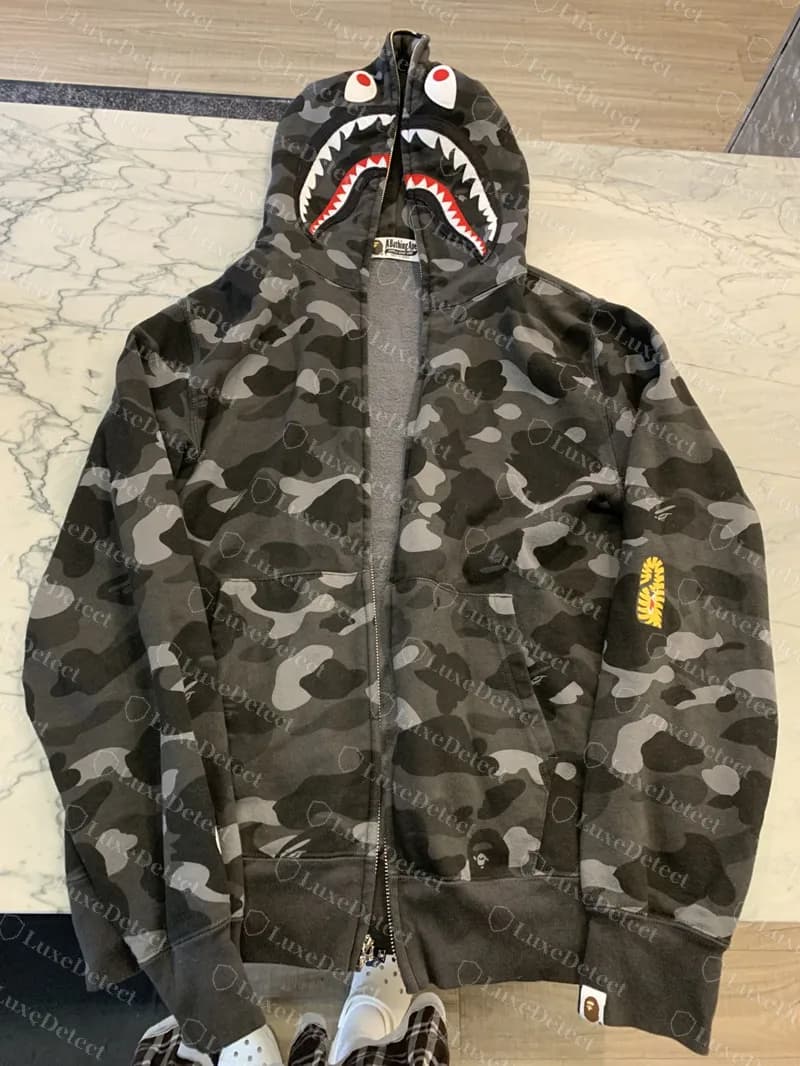
The Shark Hoodie's defining element is the shark face graphic that appears when the full zip is raised. The upper jaw is on the hood; the lower jaw is on the zipper body. When zipped to the top, the face completes.
Perfect alignment is the standard:
- When zipped fully, the teeth on the upper and lower jaw align precisely — no tooth appears to sit above or below its pair
- The eye graphic, positioned on the hood above the zip line, sits at the correct height and proportion
- The gradient or color fill within the shark face is consistent and correctly saturated
Fake tells:
- Misaligned teeth — the upper and lower jaw don't match when zipped, creating an offset that ruins the face
- Color gradient that doesn't match between upper and lower sections (because they're printed separately and the fake manufacturer didn't calibrate both to match)
- Eye proportion or placement that's off from the documented authentic position for that colorway
Red flag
Upper and lower teeth that clearly do not meet when the zip is closed, or a jaw gradient that visibly changes between hood and body, is hard to explain as a quality-control variation. Zip it to the top and look before anything else.
Zipper — Hardware Feel, Not the Stamp
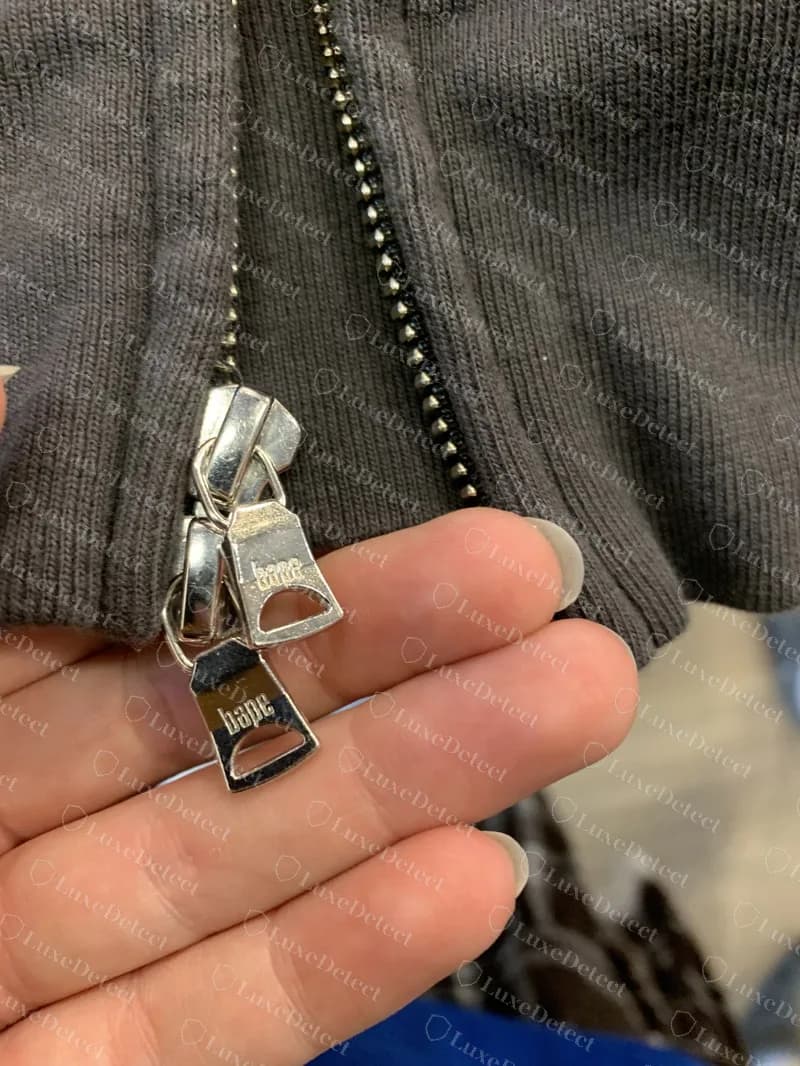
The zip is a good place to judge construction, but the lettering on it does not separate genuine from fake.
What genuine hoodies show:
- A metal slider with a pull lettered "bape"
- A zip that runs smoothly with even resistance from bottom to top
- Teeth that interlock cleanly with no skipping or catching
- A pull with real weight to it, not a hollow-feeling piece
What fakes copy:
- The "bape" lettering on the pull. Fake hoodies carry the same lettering, so seeing it proves little.
- The YKK claim: you will often read that a genuine hoodie has "YKK" stamped on the zip and that a missing stamp means fake. We have not tested that. We could not see the back of the pulls on the fake hoodies we looked at, so "no YKK means fake" is untested and we do not use it as a rule.
Fake tells that hold up in hand:
- A zip that catches or needs force to close
- A lightweight pull that feels hollow
- Teeth that aren't uniform in size
Worth knowing
Treat the zip as a feel test. A correctly lettered pull is a detail fakes commonly copy, so it should never raise your confidence by itself.
Interior Tags — Copied by Fakes
Every interior label on this hoodie gets copied, so read them for consistency with the season, not as proof.
What genuine hoodies show:
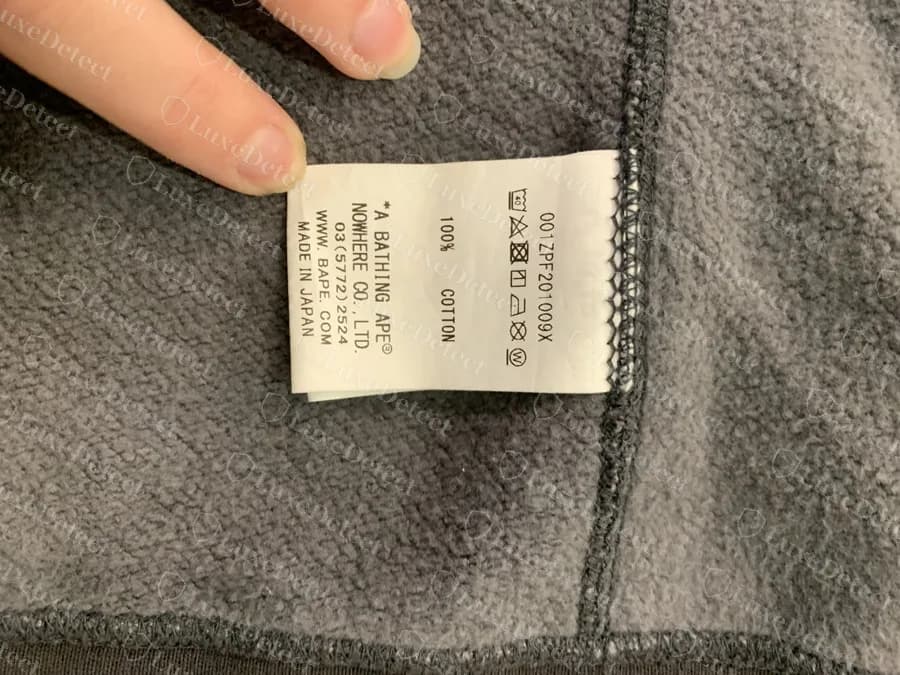
- A care label with a style code (for example "001ZPF…X"), the "*A BATHING APE®" line, "NOWHERE CO., LTD.", the 03 phone number, "WWW.BAPE.COM" and a country line
- A woven "A Bathing Ape / World Gone Mad / 1993 to 2093" neck label
- A small Ape Head tag with the ® mark
- Letter sizes on the labels we saw (S, M, L, XL, or XS) rather than a 1 to 4 scale
What fakes copy:
- The care label layout, the style code format and the phone number, in the same arrangement
- The "World Gone Mad" neck label, which appears on genuine and fake hoodies alike
- The ® mark on the Ape Head tag
Country of manufacture: both "MADE IN JAPAN" and "MADE IN CHINA" appear on genuine Shark and zip hoodies, and on fakes. Either one is normal. Match it to the documented production for that release if you can, but it is not a tell on its own.
Worth knowing
You will see online that the neck label is "double-layered, black over white" and that sizes run on a Japanese 1 to 4 scale. Neither showed up on the genuine hoodies we checked, so we do not use them. A tag that looks wrong is a reason to look harder at the print and the fleece, not a verdict, and a tag that looks right settles nothing.
Is My BAPE Tag Real? How to Read a Bathing Ape Tag
"Is this BAPE tag real?" is the question buyers ask most, and the honest answer is that a real A Bathing Ape tag looks the same as a good fake one. What a tag check can do is catch a hoodie whose labels do not belong together. Read them as a set:
- The neck label. A woven "A Bathing Ape / World Gone Mad / 1993 to 2093" label, with a letter size on the hoodies we saw.
- The Ape Head tag. A small tag with the Ape Head and the ® mark.
- The care label. A style code, the "*A BATHING APE®" line, "NOWHERE CO., LTD.", the 03 phone number, "WWW.BAPE.COM" and a country line, either Japan or China.
- Consistency. The text should be cleanly printed and spelled correctly, and the labels and the style code should match those on a verified hoodie of the same season and colorway.
A tag set that disagrees with itself, or with the hoodie it is sewn into, is a reason to look hard at the print and the fleece. A tag set that agrees is what fakes are built to show, so it settles nothing on its own: on this hoodie the shark face, the camo print and the fleece carry the verdict.
Fabric Weight and Construction
Authentic BAPE Shark Hoodies are made from a heavyweight cotton fleece that's noticeably dense in hand.
- The exterior face is a tight, fine jersey texture — not the loose grain of cheaper fleece
- The interior loop terry is dense and even — not thin or loosely looped
- The hoodie maintains its shape when held up — it doesn't stretch or distort under its own weight
- Seams are even and the ribbing at the cuffs and hem is thick and springy
Fakes are often reported to use lighter fleece, and the difference is easiest to feel with a verified hoodie in the other hand.
Worth knowing
We have not weighed genuine hoodies, so we give no gram figure. You will see "700 to 800 g for a size L" quoted online; treat it as unmeasured. Weight differs by season and by size, which is why the comparison is against a verified hoodie of the same season.
Ape Head Logo — Embroidery Quality
The Ape Head logo appears on the chest, sleeve, or interior depending on the specific model. On embroidered versions:
- The Ape Head uses tight, even stitch density — the face fills completely with no fabric showing through
- Individual facial features (eyes, nose, teeth) are cleanly defined with consistent thread color transitions
- The embroidery backing (the stabilizer on the interior of the garment where the embroidery sits) is trimmed cleanly
Fakes often produce embroidered Ape Heads where the fill is uneven (thin spots where the base fabric shows), features are blurry, or thread colors are off.
Quick Authentication Checklist
- Shark face — upper/lower jaw teeth align precisely when zipped; eye placement correct
- ABC Camo — palette, scale and registration match a verified hoodie of the same season and colorway
- Fabric — dense, heavyweight fleece against a verified hoodie (no gram figure to rely on)
- Ape Head embroidery — tight fill, clean feature definition
- Zip — smooth, solid pull; "bape" lettering is expected but copied
- Labels — care label, style code, phone number, neck label and ® mark are all copied, so they only need to be consistent
FAQ
How do I know what the correct camo colors are for a specific colorway?
BAPE releases are documented extensively. The BAPE official website archives past releases, and Grailed/StockX listings for verified authentic pairs provide reference photos. Always compare to a verified authentic reference for the specific colorway — not a generic green shark hoodie if you're evaluating a blue one.
Is "Made in China" a fake tell on a BAPE hoodie?
No. Both "MADE IN JAPAN" and "MADE IN CHINA" appear on genuine Shark and zip hoodies, and fakes carry either one. BAPE produces some lines in China and others in Japan, so the country alone tells you nothing. Check it against the documented production run for that release if you want a consistency check.
Can I trust the care label and style code?
Use them to check consistency, not to confirm. Fake hoodies copy the care label layout, the style code format and the phone number. A label that looks right does not make a hoodie genuine; judge the print, the fleece and the zip.
How can I tell if a BAPE tag is real?
Not from the tag alone. A real Bathing Ape tag set includes the "World Gone Mad / 1993 to 2093" neck label, the Ape Head tag with the ® mark and a care label with the style code, "NOWHERE CO., LTD.", the phone number and WWW.BAPE.COM, but fake hoodies copy all of them. Check that the labels are cleanly printed and match a verified hoodie of the same season, then judge the shark face, the camo print and the fleece.
Is the "no YKK means fake" rule reliable?
We haven't been able to test it, so we don't use it. Genuine hoodies show a metal slider with a "bape"-lettered pull, and fakes copy that lettering. Judge how the zip runs and feels.
Can the shark face misalignment be a manufacturing defect on an authentic piece?
Occasionally. BAPE quality control is high but not perfect, and very slight alignment variations are documented on some authentic pairs. A slight offset of 1–2mm on one or two teeth could be a QC variation. A significant misalignment where the face clearly doesn't form correctly is a fake indicator, not a QC variation.
What's the fastest check at a resale event?
Zip it to the top and look at the shark face, then run the zip and feel the fleece. If the teeth meet, the zip is smooth and the fleece is dense next to a verified hoodie, proceed to the detailed checks. If the face does not form, move on.