Streetwear Authentication Specialist
Streetwear authentication specialist. Focuses on print quality, tagging, and seasonal production codes.
Last updated September 2026 · Published June 2026 · Contact
Why Faking the Box Logo Is So Profitable
Supreme releases Box Logo hoodies in extremely limited quantities — typically 300–600 units per colorway at $188 retail. On resale, deadstock bogo hoodies regularly sell for $800–$3,000+, with vintage or collaboration pieces reaching five figures. That spread makes faking them one of the most profitable exercises in counterfeit streetwear.
The fakes range from obvious (wrong font, thin fleece, clearly misaligned box) to extremely convincing replicas that fool buyers on Instagram and even some resale platforms. Here's the complete breakdown.
What to check, ranked by reliability
| Checkpoint | Reliability | What it tells you |
|---|---|---|
| 1. The Box Logo Print — The Most Diagnostic Check | ★★★★★ | Flat ink with no raised puff texture is the most common tell on mid-tier fakes and is decisive on its own. |
| 2. Box Proportions and Futura Typography | ★★★★★ | Wrong letterforms in Futura Heavy Oblique, especially the u or S, is the most common failure point even on expensive fakes. |
| 3. Fabric Weight and Feel | ★★★★★ | A hollow-feeling, lightweight fleece corroborates a fake strongly but requires the garment in hand. |
| 4. Interior Tags — The Second Most Reliable Check | ★★★★★ | A tag mismatch is meaningful only once the specific era of the piece is known. |
| 5. Drawstrings and Hood Construction | ★★★★★ | A round rather than flat drawstring is a fast screen but cheap for a fake to get right. |
| 6. The Back and Sleeves | ★★★★★ | Sleeve proportions are context for cross-referencing a size chart, not a standalone signal. |
The Box Logo Print — The Most Diagnostic Check
The Supreme Box Logo is screen-printed using puff ink, which gives the print a very slightly raised, three-dimensional texture. On an authentic bogo, running your fingertip across the logo you'll feel the print sitting fractionally above the surface of the fabric. Press it flat and it springs back.
Fake tells on the print:
- Flat ink with no raised texture — the most common tell on mid-tier fakes
- Ink that cracks at the edges of letters — genuine puff printing stays flexible
- A slight sheen or glossy look — authentic box logo matte is more consistent
- Bleeding ink at letter edges — genuine prints have razor-sharp definition
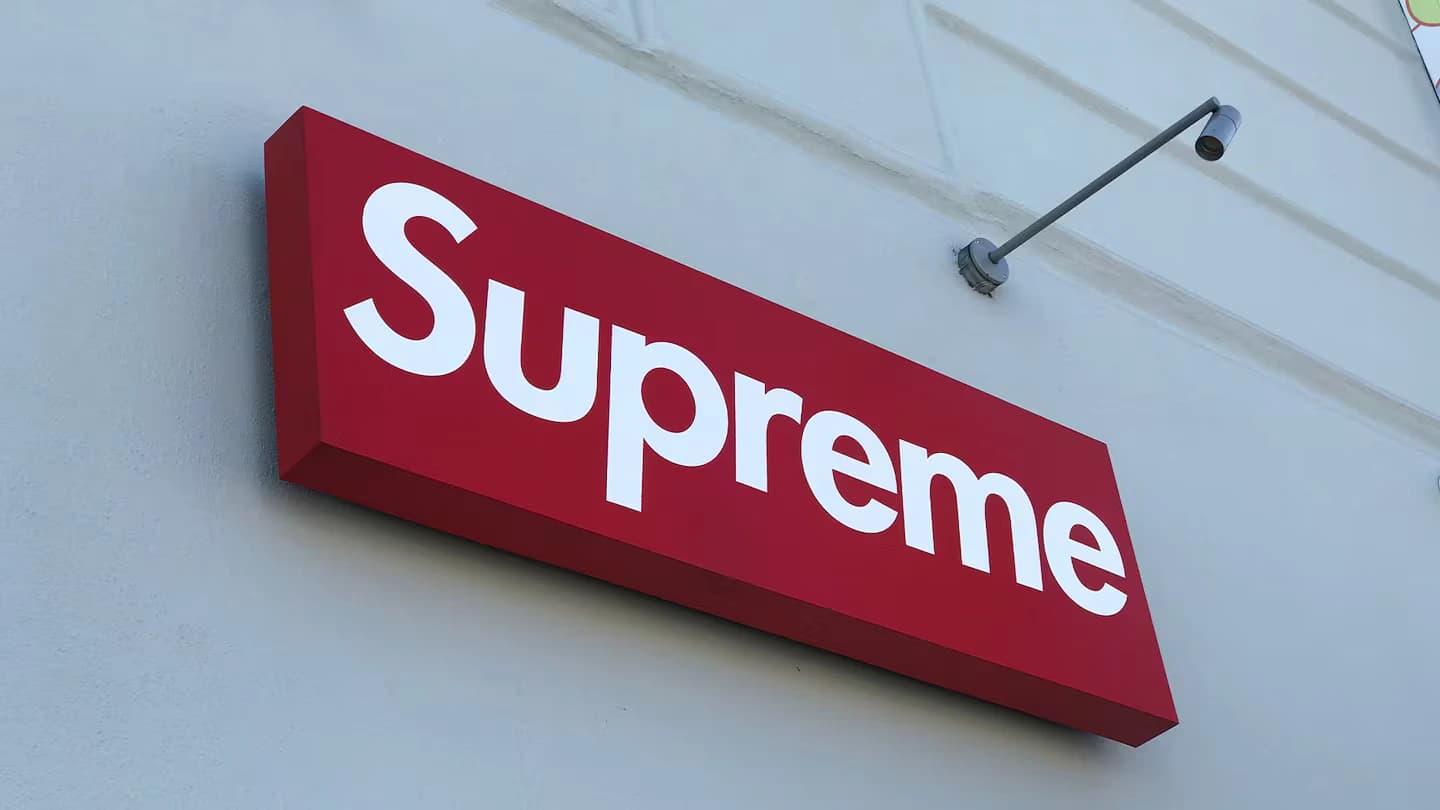
Some high-end fakes use puff ink but get the opacity wrong. The red box should be a deep, fully opaque cardinal red — not orange-red, not brick, not candy red. The white "Supreme" text inside it should be pure white with no semi-opacity.
Red flag
Flat ink with no raised texture that springs back under a fingertip is the single most common tell on mid-tier fakes and is decisive on its own — genuine puff printing is expensive to reproduce accurately.
Box Proportions and Futura Typography
The box logo uses Futura Heavy Oblique — a specific cut of the Futura font family. Getting this wrong is the most common failure point even on expensive fakes.
The box itself: The authentic box is wider than it is tall, with consistent 90-degree corners and uniform border thickness on all four sides. The border should be the same width at the top, bottom, left, and right of the box.
The type inside the box: Individual letters to examine closely:
- The S has a very specific curve ratio — the top and bottom bowls are near-equal in size, with a slightly more open curve at top
- The u (lowercase) has straight sides that drop vertically before curving — not an overly round bowl
- The p descender should drop cleanly and symmetrically
- Letter spacing is tight but consistent — no letter appears isolated or cramped
- The entire word sits centered horizontally and vertically within the box, with equal white space on all sides
Use a reference image from a verified authentic piece (Supreme's own archive photos, verified StockX listings with factory photos) and compare letter by letter.
Red flag
Wrong letterforms in Futura Heavy Oblique — especially a too-round lowercase "u" or an off-ratio "S" — is the most common failure point even on expensive fakes, and settles the question on its own.
Fabric Weight and Feel
Authentic Supreme Box Logo hoodies are made from heavyweight cotton fleece. The weight varies by era:
- Classic era (1994–2010s): Vintage Supreme used Champion fleece bodies — dense, warm, with a tight loop terry on the inside. Extremely heavy for its size.
- Modern era: Supreme now uses a custom fleece construction that's still very heavyweight (14–16 oz range). The exterior should feel thick with a slight brushed surface; the interior loop terry should be dense and not feel stretched or loose.
What fakes feel like: Most fakes use lighter fleece in the 8–10 oz range. Pick up an authentic bogo and a suspected fake together — the weight difference is immediately apparent. The fake feels hollow; the authentic feels like a serious garment.
Also feel the fabric texture: authentic Supreme fleece has a slightly rough, matte hand feel when new. It doesn't feel soft and smooth like fast-fashion cotton.
Worth knowing
Fabric weight corroborates a finding strongly but requires the garment in hand — it does not travel well in photos, unlike the print texture check above.
Interior Tags — The Second Most Reliable Check
Interior tag details change every season, which is one reason why authentication requires knowing the specific era of the piece. General rules that hold across eras:
Neck tag: Supreme uses woven labels, not printed. The tag is sewn into the neck seam and should lie flat. The text is clean and the Supreme logo (if present) is correctly proportioned.
Size tag: Attached to the neck label or side seam. It should list the size and "MADE IN USA" (for most classic pieces) or the country of manufacture. The font on the tag matches Supreme's standard typeface — not a generic font.
Wash care tag: Located at the left seam. Authentic wash tags list detailed care instructions and the country of manufacture. The text is printed cleanly with no bleed. On many fakes, wash tags have generic icons with poor registration or missing information.
Side label: Many seasons include a woven label listing fabric composition and country of origin. If it says 100% cotton and the fabric doesn't feel like cotton, investigate further.
Worth knowing
Tag details change every season, so a mismatch is only meaningful once you know the era of the specific piece — treat this as strong corroboration, not a standalone check.
Drawstrings and Hood Construction
This is a quick check most buyers overlook:
- Authentic bogo hoodies use flat drawstrings — rectangular in cross-section, with a woven texture. They are the same fabric composition as the hoodie.
- Fakes frequently use round drawstrings (cylindrical cord). If the drawstring is round, it's almost certainly not authentic.
- The aglets (metal tips on the drawstring ends) should be uniform in size and tightly crimped with no sharp edges.
- The drawstring channels inside the hood should be cleanly sewn with no puckering.
Also check the kangaroo pocket opening: on authentic hoodies, the pocket opening has consistent width and the internal bag of the pocket is deep. Thin pocket construction that barely fits both hands is a fake indicator.
Worth knowing
A round drawstring instead of a flat one is a fast, easy check but a fake can source the correct flat drawstring cheaply, so treat it as a quick screen rather than a decisive test.
The Back and Sleeves
If the hoodie has a back graphic (some seasons), apply the same print quality standards as the box logo. Back prints on fakes often fade at the edges or show color bleeding.
The sleeve length on authentic bogos runs slightly long relative to modern sizing conventions — Supreme's fits are traditionally generous. If the sleeves feel short for the marked size, compare to size charts from authenticated pieces.
Worth knowing
Sleeve proportions are context only — useful for cross-referencing against a size chart, but not a standalone authentication signal.
Quick Authentication Checklist
- Puff ink print — slightly raised, springs back when pressed
- Box proportions — wider than tall, uniform border thickness
- Futura Heavy Oblique — correct letter shapes, centered in box
- Cardinal red — deep opaque red, not orange or candy-colored
- Fabric weight — heavy, 14–16 oz range; interior is dense loop terry
- Interior tags — woven neck label, correct country of manufacture
- Flat drawstrings — rectangular cross-section, not round cord
- Drawstring aglets — uniform, tightly crimped
FAQ
Can a genuine Supreme bogo shrink significantly in the wash?
Yes — authentic Supreme fleece shrinks approximately 10–15% in a hot wash, which is why many buyers size up. If a seller claims an "XL" fits like a modern medium, it may have been washed. This doesn't indicate a fake, but it does affect sizing expectations.
How can I verify the specific season of a bogo?
Supreme has released box logos in specific colorways by season since the early 2000s. The "Supreme Talk" community on Reddit maintains detailed release archives with photos and authentication resources for each colorway. Match the specific colorway, weight, and tag details to the documented authentic reference for that release.
Are bogo hoodies made in the USA?
Most classic and mid-era pieces are "MADE IN USA." More recent international releases (Japan-exclusive boxes, for example) may be manufactured elsewhere. The wash tag should reflect this — a USA piece claimed to be Japan-exclusive, or a Japan piece with a USA tag, is a mismatch worth investigating.
What is the best way to authenticate a bogo before buying online?
Request photos of: the box logo print at 45 degrees to show texture, the interior neck tag, the wash/size tag, the drawstrings, and a full flat-lay front and back. Compare every letter of "Supreme" to a verified reference image for the same colorway and season. If the seller can't provide these photos, don't buy.