Streetwear Authentication Specialist
Last updated September 2026 · Published June 2026 · Contact
Why Stone Island Gets Faked So Often
Stone Island sits at the intersection of high fashion and streetwear — jackets retail between €400 and €3,000+ (roughly £350–£1,200 for standard fabrics, with Dyneema, Ghost, and Nassimo special editions exceeding £2,000). That price spread, combined with the brand's enormous following across the UK, Europe, and increasingly worldwide, makes Stone Island one of the most counterfeited outerwear brands in existence. The compass badge is one of the most recognisable logos in menswear, and it can be removed and resold separately — entire jackets are built around a single genuine or fake badge stitched onto a budget shell.
The good news: Stone Island's quality markers are stacked. Badge, garment tags, embroidery, garment dye, zips, and hardware all carry tells, and a fake that passes one check almost always fails the next. This guide covers everything a professional runs through, in order.
What to check, ranked by reliability
| Checkpoint | Reliability | What it tells you |
|---|---|---|
| 1. The Compass Badge — Your First and Fastest Check | ★★★★★ | A seasonal code that contradicts the claimed season and year, or low-density embroidery, is decisive on its own. |
| 5. Fabric and Garment Dye Authentication | ★★★★★ | Flat, even colour with no seam fading on a piece sold as garment-dyed is very hard for a fake to reproduce. |
| 3. The Interior Label and Season Code System | ★★★★★ | A printed rather than woven label, or a QR code that fails to resolve to the specific garment, is a strong indicator. |
| 7. Stitching Quality | ★★★★★ | Loose stitch density and sparse bartacks corroborate a fake but a good copy can get close. |
| 6. Zippers and Hardware | ★★★★★ | A branded puller on unbranded zipper tape supports a fake finding more reliably than the zipper brand alone. |
| 4. Garment Body Embroidery | ★★★★★ | An open-grid backing or heat-transfer outline supports a fake finding but is easy to miss without turning the garment inside out. |
| 2. Shadow Project and Ghost Badges | ★★★★★ | Only rules out a mismatched or fabricated special edition; irrelevant to a standard compass-badge garment. |
| 8. Packaging and Extras | ★★★★★ | Garment bag, swing tag and booklet are context only — never evidence on their own. |
The Compass Badge — Your First and Fastest Check
The detachable compass badge on the left sleeve is Stone Island's signature element and the single most important authentication point. Examine it in three parts: the embroidery, the seasonal code, and the metal chassis.
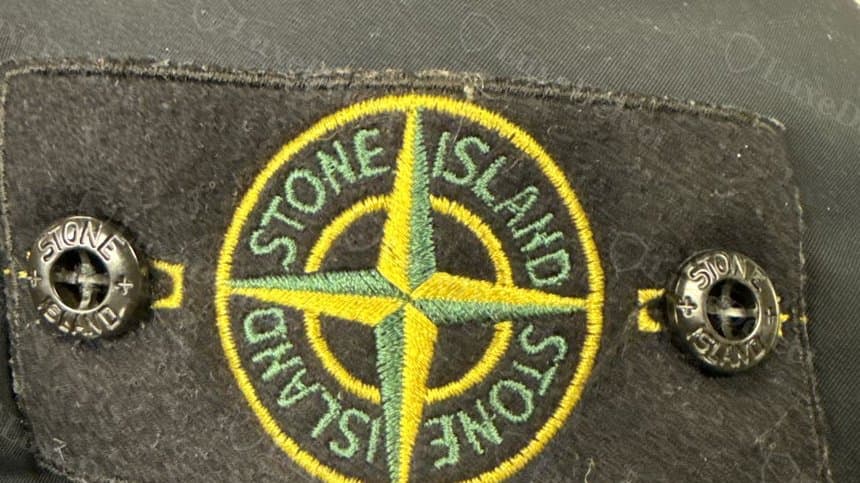
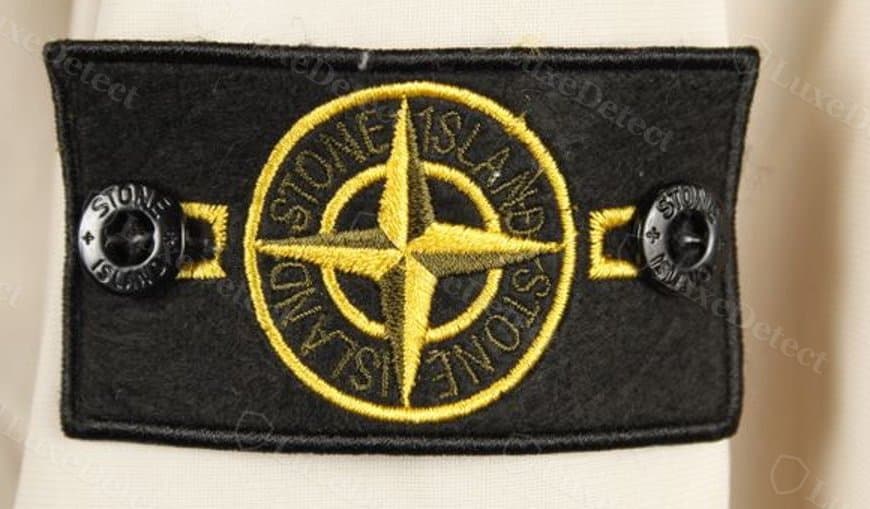
Embroidery quality: The compass rose is embroidered directly onto the badge fabric. On a genuine badge, the stitching is extremely dense — you cannot see daylight between threads, and the surface has a smooth, raised texture you can feel by running your thumb across it. Fakes use a lower stitch count, producing a flat or fuzzy finish where individual threads are visible from a metre away.
The "STONE ISLAND" text arcing over the compass is stitched in the same dense, even thread. Letters should be uniform height with a consistent arc and tight, even letter spacing — most visibly checked in the gap between "STONE" and "ISLAND." Fakes often compress letters at the ends of the arc or space them unevenly.
The compass needle and ring: On genuine badges, the needle inside the compass is a sharp, clean diamond shape pointing toward "N." Fakes frequently render it rounder, tilted off-axis, or disproportionately thick. The outer ring should be a perfectly consistent circle — fakes often show a slightly oval ring or uneven line weight around the circumference.
Worth knowing
On the standard compass badge, the "STONE ISLAND" lettering and outer ring are meant to read as a distinct green, not a second shade of yellow. A badge where the ring and text are the same flat yellow as the compass itself is worth treating with suspicion, but check first that the garment isn't a Ghost or monochrome special edition, which use single-colour badges by design and aren't covered by this tell.
The seasonal code: Every genuine badge carries a seasonal production code embroidered on the back of the badge fabric (the inner face, not the side you see when worn):
| Era | Format | Example |
|---|---|---|
| Pre-2005 | No seasonal code | (vintage, no code) |
| 2005–2014 | Four digits: season + year | 6415 = AW 2014/15 |
| 2015–present | Six characters: season + two-digit year | 721522 = SS 2022 |
The first digit indicates the season: 6 = Autumn/Winter, 7 = Spring/Summer. For a jacket listed as AW2023, the badge code should begin with 6 and reference year 23. If the code doesn't match the claimed season and year, it's either a fake or the badge has been swapped from a different piece. To check it, detach the badge (velcro on most pieces; press stud on early models) and look at the inner face — genuine embroidery is tight and legible, fakes are often blurry or absent entirely.
The metal chassis: The compass badge housing is a pressed metal frame with a fabric insert. On genuine badges, the metal edge is clean and even with no sharp tool marks or casting seams, and the corners are rounded consistently. Fakes often show uneven corner radii or a slight crimp where the metal was folded.
Badge attachment: Genuine badges attach by velcro (2005–present) — a neatly finished hook-and-loop patch with no fraying — or press stud (pre-2005), which should have the Stone Island logo embossed on the visible dome. The sleeve patch underneath should sit flat and flush; fakes often have a patch that sits proud of the sleeve fabric.
Red flag
A seasonal code that doesn't match the claimed season and year (for example a code starting with "7" on a jacket sold as Autumn/Winter) means either the badge is fake or it's been swapped from a different, mismatched garment — the badge alone can end the inspection.
Shadow Project and Ghost Badges
Stone Island Shadow Project, the brand's technical sub-line, uses its own badge — a circular emblem with "STONE ISLAND" text and a different central motif. Authentication follows the same embroidery-density principles as the compass badge, but the stitching pattern is concentric rather than compass-rose, with an even higher thread count. Fake Shadow Project badges almost always substitute a printed motif for embroidery.
Ghost pieces have no external badge at all — brand identification lives only on an interior label sewn into a pocket. Fakes claiming to be Ghost pieces often add an external badge (an immediate tell) or use a simplified interior label with the wrong font and layout. The Ghost fabric itself is a special reflective material that appears almost transparent in natural light — hold the garment up to a strong light source; genuine Ghost fabric becomes nearly translucent, with a light, crisp, slightly papery hand unlike typical nylon.
Cross-reference any seasonal badge colourway against the garment's season code on the care label — a mismatch between the two is a red flag regardless of how good either individually looks.
Worth knowing
Shadow Project and Ghost checks only apply to those sub-lines — they rule out a mismatched or fabricated special edition but say nothing about a standard compass-badge garment.
The Interior Label and Season Code System
Inside every genuine Stone Island garment is a woven label with the brand name and a product code system.
- Weave, not print: The label is woven — text is embedded in the fabric structure, and you can feel raised warp threads under your fingertip. Fakes are usually printed onto the label, so the text sits on the surface rather than being part of the weave, and feels completely flat.
- Product code: Pre-2007 codes run 6–8 characters; from 2007 onward the format is a 12-character code (XXXXXX-YYYY-ZZ) encoding garment type, fabric, color, and season. On some labels this appears as a shorter four-digit season code (two digits for year, two for season).
- Font consistency: The "Stone Island" text on the label uses the same geometric sans-serif typeface as the badge. Any deviation in weight or spacing between badge, label, and swing tag is a flag.
- Composition and care: Fabric composition is listed in Italian and English, with Italian preceding English on genuine garments (Stone Island is Italian, and the Italian text should read as native, not translated). Care symbols follow the GINETEX international standard at consistent size and spacing — fakes frequently use symbols that don't exist in the standard, or list them in the wrong order.
The QR Code (2019–Present)
From AW2019, Stone Island added a QR code to interior labels linking to the brand's own product verification page. Scan it with your phone camera:
- Genuine: Resolves to stoneisland.com with the specific garment's product page — code, fabric, season, and a registration prompt.
- Fake: No QR code on a piece claiming to be 2019 or later, a code that doesn't scan, or one that redirects elsewhere.
The QR code alone isn't a guarantee — genuine codes can be photographed and reprinted onto fakes — but its absence on a post-2019 garment is a strong red flag.
Confirms authentic
A woven (not printed) interior label with raised, feelable text and a QR code that resolves to the specific garment's page on stoneisland.com is a strong positive signal, though not conclusive alone since genuine codes can be reprinted.
Garment Body Embroidery
Beyond the badge, Stone Island uses secondary "STONE ISLAND" text embroidery on the garment body itself — typically the left chest interior, back collar, or a patch pocket. On genuine garments this matches the badge's embroidery quality: dense, raised, even tension, with consistent letter weight throughout.
Check the reverse side of the fabric (inside the garment) at this embroidery. Genuine work shows a clean, dense lock-stitch backing. Fakes often show an open grid pattern from cheap embroidery backing, or a heat-transfer outline visible through thin fabrics.
Fabric and Garment Dye Authentication
Stone Island is famous for garment dyeing — dyeing a finished garment rather than dyeing yarn before construction. This produces a characteristic uneven, slightly faded-at-seams color that's almost impossible to fake convincingly.
On a genuinely garment-dyed piece:
- Seam fading: Fabric at seams, pocket edges, and reinforced areas absorbs dye differently than surrounding fabric, producing a subtle, consistent lightening along every seam. This is intentional and expected — not a defect.
- Surface texture: The dye process alters the fabric's hand slightly, giving cotton pieces a specific roughened texture — what dye-industry people call "bloom."
- Color consistency: Despite intentional seam fading, the main body color should be uniform — no random lighter or darker patches mid-panel.
Fakes attempting to replicate garment dye either apply flat, even color with no seam variation (too clean), or artificially distress areas unevenly in patches that don't follow the seam logic.
Red flag
Flat, perfectly even colour with zero seam fading on a piece sold as garment-dyed is very hard to fake convincingly and is one of the strongest tells in this guide.
Special Fabric Lines
- Nylon Metal: A woven nylon with metallic thread integrated into the weave. Held up to light, genuine fabric produces a consistent metallic shimmer across the whole surface. Fakes use a coated or laminated fabric that reflects more uniformly and less texturally.
- Dyneema: Used on Stone Island's highest-end technical pieces, genuine Dyneema fiber is 15x stronger than steel by weight and has a distinctive waxy, paper-like hand and sheen that's very difficult to replicate with standard synthetics.
- Ice Jacket: Garment-dyed nylon with thermosensitive pigment. The authentic fabric hardens and becomes rigid below 0°C, and rubbing your hand vigorously across a cold genuine piece briefly alters the color under your palm. Fakes use a visually similar quilted fabric that does neither — hard to test in-store, easy in cold conditions.
Zippers and Hardware
Stone Island uses YKK zippers on standard pieces, Lampo on some premium pieces, and custom Stone Island-branded zippers (with the compass logo on the pull) on higher-end garments from SS2017 onward.
- Branding: The zipper brand name is embossed on the pull and often the zipper tape. Fakes frequently use unbranded or generic zippers, or print a false brand name onto the pull.
- Movement: A genuine zipper runs smoothly with consistent resistance — it should not catch or skip. Many fakes use lower-grade zippers that skip teeth under normal use.
- Puller quality: The metal pull should be heavy gauge with crisp edges; fake pulls are typically thin and flex visibly when gripped.
- Mismatches: If a piece has a custom Stone Island puller but unbranded or non-YKK zipper tape, that's a red flag.
Stone Island's velcro closures — on jacket cuffs and badge tabs — use dense-pile velcro with strong adhesion. Fake closures use thin-pile velcro that stiffens and loses adhesion after a few wash cycles. Internal press studs (hood attachments, storm flaps) on genuine pieces are heavy-gauge metal with a positive click; fakes use lightweight plastic-backed studs that feel hollow.
Worth knowing
Hardware quality is a useful supporting check but not decisive alone — some well-made fakes source genuine-looking YKK zippers, so treat a mismatch (branded puller, unbranded tape) as the more reliable signal than the zipper brand itself.
Stitching Quality
Count stitches where you can: genuine main seams run roughly 8–10 stitches per centimeter, while fakes typically run 6–7, producing looser seams that eventually unravel. The badge-area sleeve patch is attached with a seam running exactly 3–4mm from the edge, perfectly parallel with no wavering. Bartack reinforcement stitches at stress points (pocket corners, strap attachments) should be dense and even — fake bartacks are often sparse or absent.
Packaging and Extras
Garments above a certain price tier ship with a fabric garment bag branded with the compass, a swing tag attached by a plastic loop and printed with the product code on both sides, and a care booklet in English and Italian (with native-quality Italian). The swing tag font should match the label and badge typeface exactly — any font variation across the three is a red flag.
Worth knowing
Packaging is context, not evidence — a correct swing tag and garment bag don't make a garment genuine, since accessories are easily sourced or reused separately from the piece itself.
FAQ
How do I read the seasonal code on a Stone Island badge?
Detach the badge by pulling the velcro and look at the inner face. The code is embroidered in small numerals: the first digit is the season (6 = AW, 7 = SS), and the following digits reference the year. A code starting with "721" on a claimed AW2021 piece is wrong — it should start with "621."
Can I authenticate a Stone Island badge separately from the garment?
Partially. You can check embroidery density, seasonal code, and metal chassis finishing on the badge alone. But badge-only authentication isn't conclusive — genuine badges are sometimes removed from real garments and sold separately, and fakes sometimes source one genuine badge to attach to a fake shell. Always authenticate the full garment, including tags and stitching.
Are all Stone Island badges detachable?
No. Pre-velcro vintage pieces (roughly pre-1990) had the badge permanently stitched to the sleeve — this is not a fake indicator. For vintage pieces, authenticate the badge via the stitching pattern around the border, thread color, and badge fabric weave instead.
What does a genuine Stone Island label feel like?
Woven, not printed. You can feel raised warp threads under your fingertip; a printed label feels completely flat. Run your thumbnail across the "Stone Island" text — woven labels have slight texture, printed ones don't.
Can I verify a Stone Island garment online?
Yes, partially. The QR code on post-2019 garments links to Stone Island's own authentication page, and you can also check the interior label's product code against the Stone Island website. Neither check is definitive alone — fakes increasingly copy correct codes — but a code that returns no product, or a QR code that fails to scan, is a hard fail.
Are all Stone Island garments made in Italy?
No. Stone Island manufactures in Italy, Portugal, and other countries depending on garment category. "Made in Italy" is common on premium pieces but not universal — the country of origin on the label should match the production record for that season.
How do I authenticate a Stone Island Ghost piece?
Hold it up to strong natural light — genuine Ghost fabric becomes nearly translucent. Check the interior label for the "Ghost" designation and correct seasonal code, and confirm there's no external badge (Ghost pieces never have one).
Why is the color slightly different at the seams?
That's expected. Garment dyeing intentionally produces seam variation — reinforced fabric at seams absorbs dye less evenly than the surrounding panel. This is diagnostic of genuine garment dye construction, not a defect or fake indicator.