Luxury Jewelry Authentication Specialist
Authentication analyst covering the resale market, marketplace verification programs, and counterfeit trends.
Last updated August 2026 · Published July 2026 · Contact
Why Graff Demands the Most Rigorous Checks
Graff jewelry sits at the top of the fine jewelry market, with pieces frequently running into six and seven figures. At this price point, authentication isn't optional due diligence — it's a requirement, and it should involve both the setting's construction and independent verification of the stones themselves.
Graff differs from every other brand in this library in one decisive respect: most of the value is in the stones, not the name. A Graff ring worth $800,000 is worth that because of the diamond it carries. This inverts the usual authentication problem. With a handbag, the brand is the value and the question is whether the object is genuine. With Graff, the question is whether the stone is what the paperwork says — and a genuine Graff mount fitted with a substituted stone is both authentic and worthless relative to its asking price.
Everything below follows from that. Setting and hallmark checks confirm the mount. Only independent gemological verification confirms what you are actually paying for.
Diamond and Gemstone Certification
Graff sources exceptional diamonds and coloured gemstones, and virtually every significant stone is independently graded — by GIA, or by Graff's own in-house gemological team for the rarest stones.
What to verify:
- Request the certificate and check it against the issuing lab's database directly. For GIA-graded stones this is a free online lookup by report number, and it takes under a minute
- Confirm that carat weight, cut, colour, and clarity on the certificate match the physical stone's measured characteristics — not merely that a certificate exists
- Check the certificate's stated measurements in millimetres against the stone in hand. This is the check that catches substitution, because a swapped stone rarely matches the original's exact dimensions
- Look for a laser inscription on the girdle. GIA-graded stones typically carry the report number inscribed microscopically; a jeweller can read it under magnification in seconds
- For extremely rare coloured diamonds or gemstones, Graff-specific provenance documentation should accompany the piece. Its absence on a claimed rare-stone piece is a serious concern, not a minor gap
Red flags: A certificate from an unrecognised lab. A report number that returns no record, or returns a record whose details differ from the document presented. Measurements that do not match the physical stone. A missing girdle inscription on a stone whose certificate states one was applied.
Setting Craftsmanship
Graff's settings are engineered to showcase the stone with minimal visual interference, executed at a level of precision commensurate with the stones involved.
Authentic:
- Prong work is flawless — perfectly symmetrical, flush against the stone, with no visible gaps between prong and girdle and no tool marks on the prong surface
- Metalwork shows no casting seams, rough transitions, or inconsistent polish anywhere, including the reverse and the inner shank
- On pavé or halo settings, every small stone is uniformly set with consistent spacing, matched colour and clarity across the field, and no visible adhesive or excess metal
- The gallery beneath the centre stone is fully finished and open, admitting light through the stone
- Under magnification, every metal surface shows the same finishing standard — Graff does not leave unfinished areas on the assumption they will not be seen
Fake tells: Any gap between prong and stone. Tool marks, file marks, or casting texture on visible metal. Pavé stones varying in size, colour, or spacing. Visible adhesive. A closed or roughly finished gallery. Polish quality that drops off on the reverse.
Symmetry
Authentic: Halo and pavé arrangements are symmetrical when the piece is rotated. Stone spacing is uniform to the tenth of a millimetre.
Fake tells: Asymmetry visible when comparing the left and right halves of a halo, or spacing that visibly tightens or opens around the arrangement.
Hallmarks and Maker's Marks
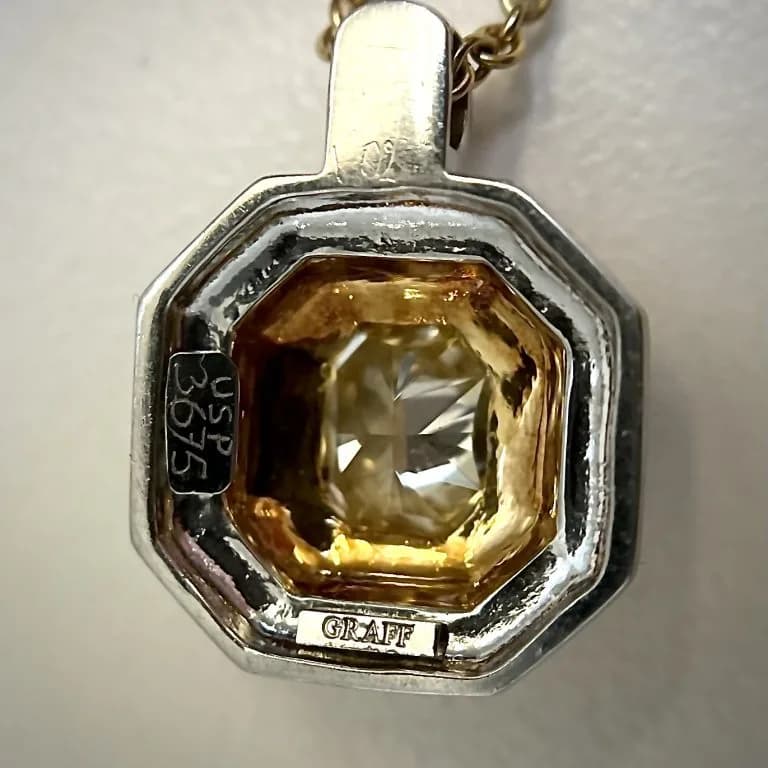
Genuine Graff pieces carry standard fine jewellery hallmarks — 750 for 18k gold, 950 for platinum — alongside a Graff signature mark, typically laser-engraved in an inconspicuous location consistent with the piece's design.
Authentic: Sharp, consistent laser engraving with clean character walls under magnification. Graff's manufacturing standard does not tolerate the irregularities common in mass-market hallmarking. Positioning is consistent with documented genuine examples of that specific piece or collection, and all marks share a single character style.
Fake tells: Shallow, soft, or acid-etched marks. Irregular depth across characters. Positioning inconsistent with documented examples. A purity mark whose numerals differ in style from the signature mark, indicating separate operations. A missing signature mark on a piece whose reference documents one.
A note on scale: hallmark checks carry less weight at Graff's price point than at any other brand in this library. A counterfeiter capable of producing a convincing setting can produce a convincing hallmark. Treat marks as necessary but far from sufficient.
Provenance and Purchase History
At Graff's price point, provenance matters as much as physical authentication.
Strong provenance: Documented purchase history from Graff or an authorised retailer. Prior Graff servicing records, which the house maintains. Original boutique paperwork with matching reference and serial details. A chain of ownership that can be verified independently.
Weak provenance: Photographs only. A seller unable or unwilling to describe how the piece was acquired. Paperwork that names a different piece, or whose details do not match the item. Certificates separated from their original documentation.
At these values, a piece with documented history and servicing records carries materially more assurance than one supported only by images — and prices accordingly in the resale market.
Independent Appraisal
For any Graff purchase, independent gemological appraisal before completion is standard practice rather than excessive caution.
An appraiser working from the physical piece will verify that the stone matches its certificate in every measured respect, assess the setting's construction against Graff's known standards, and confirm metal purity by test rather than by stamp. The cost is trivial relative to the transaction, and it is the only step that reliably catches the substitution problem described above.
Quick Authentication Checklist
- Stone certification: verified against the issuing lab's database, with measurements matching the physical stone
- Girdle inscription: present and matching the report number where the certificate states one
- Setting: flawless symmetrical prong work, no gaps or tool marks, finished gallery, uniform pavé
- Finish: identical standard on reverse and inner surfaces as on visible faces
- Hallmark: sharp laser engraving, correct purity, Graff signature present and correctly positioned
- Provenance: purchase history, servicing records, or boutique documentation
- Independent appraisal: completed before purchase
FAQ
Is it safe to buy Graff jewellery without a certificate?
Not recommended, especially for pieces with a significant centre stone. At Graff's price point the certificate is not a formality — it is core to verifying you are paying for the stone quality being claimed. Buying without one, or without verifying one that is provided, carries real financial risk measured in six figures.
How is Graff authentication different from mid-market jewellery brands?
The stakes and the rigour both scale up, and the emphasis shifts. At mid-market, the brand carries the value and authentication asks whether the object is genuine. At Graff, the stone carries the value, so independent gemological verification of the stone — not just the setting — is standard practice, and professional authentication is worth the cost relative to purchase price in nearly every case.
Should I get an independent appraisal even if the seller provides documentation?
Yes, for any purchase at this price point. Seller-provided documentation can be entirely genuine but describe a different stone — a common resale-market issue — or in rare cases be altered. An independent appraisal confirms that the physical piece matches its paperwork, which is the specific failure mode that costs buyers the most.
Can a genuine Graff piece contain a substituted stone?
Yes, and it is the principal risk in this category. A genuine mount refitted with a cheaper stone passes every hallmark and construction check because the mount is authentic. Compare the certificate's stated measurements against the physical stone, check for a girdle inscription, and have the piece appraised independently before completing.
What does a girdle inscription tell me?
GIA-graded diamonds typically carry their report number laser-inscribed on the girdle, readable under magnification. Matching that inscription to the certificate confirms this specific stone is the one graded — which no other check does as directly. A jeweller can read it in under a minute.
How much does professional Graff authentication cost?
Photo-based authentication runs $30 for jewelry authentication and serves as a reasonable first screening step. At Graff's values, treat it as a filter ahead of in-person gemological appraisal rather than as a substitute — photographs cannot verify that a stone matches its certificate's measurements.